• Fri frakt över 249 kr
  • •
  • Snabba leveranser
  • •
  • Billiga böcker
Kundservice

Du är på sajten för privatpersoner.

Företag, bibliotek eller offentlig verksamhet?

Du handlar på classic.bokus.com, där alla dina funktioner finns intakta.
Till classic.bokus.com
Bokus logotyp. Gå till startsidan.
  • Erbjudanden
  • Student
  • Topplistor
  • Barn & ungdom
  • Bokus Play
  • E-böcker
  • Ljudböcker
  • Pocketböcker
  • Spel & pussel

Upp till 25% på utvalda nyheter →

Sidfot

Mina sidor

    Hjälp

    • Kundservice
    • Vanliga frågor och svar
    • Frakt och leverans
    • Retur vid ångerrätt
    • Reklamera vara
    • Betalning
    • Köpvillkor
    • Allmänna villkor
    • Information om webbplatsens tillgänglighet

    Om Bokus

    • Om oss
    • Pressrum
    • För studenter
    • För företag
    • För bibliotek och offentlig verksamhet
    • För leverantörer
    • Hållbarhet

    Populärt

    • Aktuella erbjudanden
    • Presentkort
    • Studentlitteratur
    • Nya böcker
    • Topplistor
    • Signerade böcker
    • Engelska böcker

    Inspiration

    • Boktips
    • BookTok
    • Populära bokserier
    • Barnbokskaraktärer
    • Populära författare
    Logotyp för Bokus
    Följ oss på Facebook (extern länk)Följ oss på Instagram (extern länk)Följ oss på YouTube (extern länk)Följ oss på TikTok (extern länk)
    bokus @ CookiesAnpassa cookiesIntegritetspolicyKöpvillkor
    Till Citymail hemsida (extern länk)Till Budbee hemsida (extern länk)Till Postnord hemsida (extern länk)Till Schenker hemsida (extern länk)Till Early Bird hemsida (extern länk)Till Walleys hemsida (extern länk)
    1. Språk och ordböcker
    2. Språkvetenskap och lingvistik

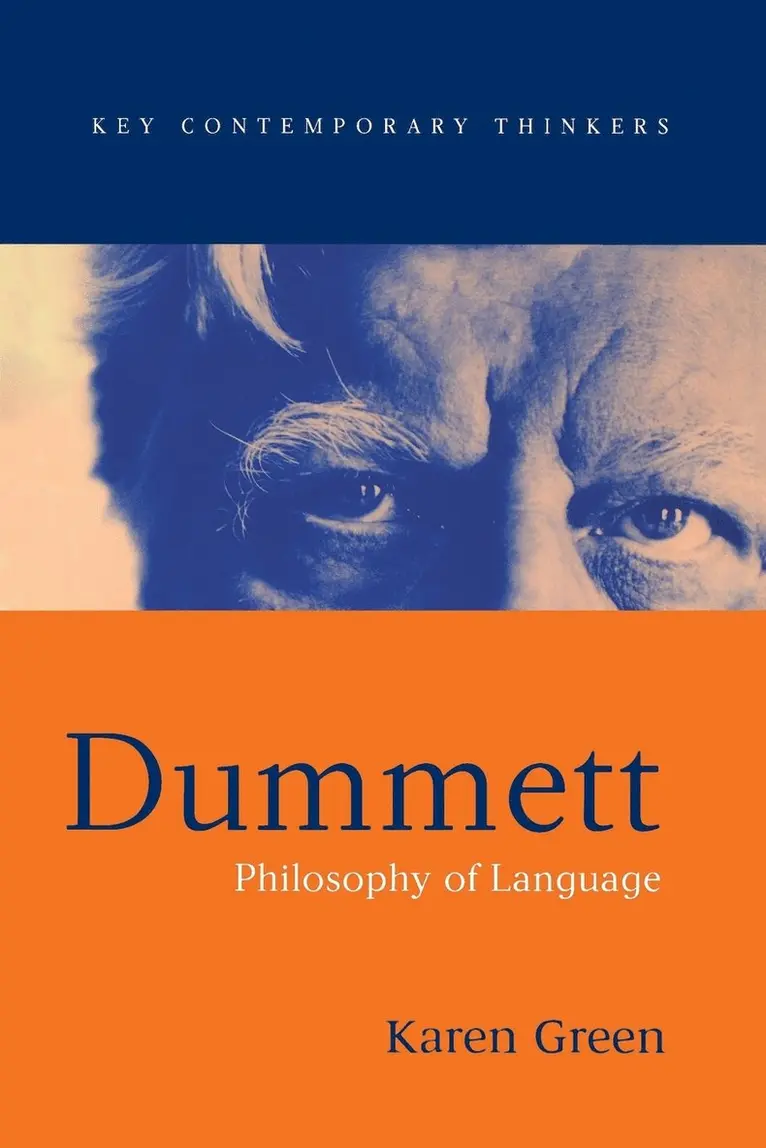
    Dummett

    Philosophy of Language

    AvKaren Green

    Häftad, Engelska, 2001

    Del i serien Key Contemporary Thinkers

    308 kr

    Beställningsvara. Skickas inom 5-8 vardagar. Fri frakt över 249 kr.

    Fler format och utgåvor

    E-bok

    284 kr

    Inbunden

    Tillf. slut

    Beskrivning

    Michael Dummett stands out among his generation as the only British philosopher of language to rival in stature the Americans, Davidson and Quine. In conjunction with them he has been responsible for much of the framework within which questions concerning meaning and understanding are raised and answered in the late twentieth-century Anglo-American tradition. Dummett's output has been prolific and highly influential, but not always as accessible as it deserves to be. This book sets out to rectify this situation. Karen Green offers the first comprehensive introduction to Dummett's philosophy of language, providing an overview and summary of his most important arguments. She argues that Dummett should not be understood as a determined advocate of anti-realism, but that his greatest contribution to the philosophy of language is to have set out the strengths and weaknesses of the three most influential positions within contemporary theory of meaning - realism, as epitomised by Frege, the holism to be found in Wittgenstein, Quine and Davidson and the constructivism which can be extracted from Brouwer. It demonstrates that analytic philosophy as Dummett practices it, is by no means an outmoded approach to thinking about language, but that it is relevant both to cognitive science and to phenomenology.

    Produktinformation

    • Utgivningsdatum:2001-08-02
    • Mått:152 x 229 x 19 mm
    • Vikt:363 g
    • Format:Häftad
    • Språk:Engelska
    • Serie:Key Contemporary Thinkers
    • Antal sidor:248
    • Förlag:John Wiley and Sons Ltd
    • ISBN:9780745622958

    Utforska kategorier

    • Språkvetenskap och lingvistik inom Språk och ordböcker

    Mer om författaren

    Karen Green is Senior Lecturer in Philosophy, Monash University, Australia.

    Recensioner i media

    'Karen Green has done more than write a study of Dummett's philosophy of language. She has in effect written a critical history of the treatment of the theory of meaning by leading figures from Frege and Wittgenstein on to the present; and she demonstrates how, in relation to all of them, Dummett has elaborated his own position, acknowledging what they have severally contributed while at the same time avoiding their excesses. She shows how his judiciously selective denial of bivalence generates an "anti-realism" which is perfectly consistent with the realism of common sense.' Sir Peter Strawson, University College, Oxford 'For the student, getting to grips with Michael Dummett's philosophy can be a formidable task. For Dummett's theses are deep and challenging, and his arguments for them are subtle and complex. Karen Green is to be thanked and commended for this lucid and accessible account of the main features of Dummett's system of thought. She explains how Dummett has developed theses from Frege and Wittgenstein, about objectivity, normativity, systematicity, publicity, and the dependence of thought on language. She traces also significant points of contact and contention with Husserl, Brouwer, Quine and Davidson. She explains the anti-realist misgiving that truth cannot be bivalent for a language in which meaning derives from use, and does much to prevent the frequent confusion of anti-realism with subjective idealism or phenomenalism. All in all, this is a remarkable exposition and development of the views of one of the most important philosophers of our age.' Professor Neil Tennant, The Ohio State University "Overall, this book demonstrates Green's remarkable command of the whole of Dummett's writings...Green's discussion of thhese issues offer a well argued and remarkable cohesive perspective on the great breadth of Dummett's work." David Kilfoyle, Philosophy in Review

    Innehållsförteckning

    • Introduction. Fregean Foundations.Sense and Reference in Frege and Dummett.Truth Assertion and the Central Argument Against Bivalence.Frege's Platonism.Frege's Kantian Connections.The Context Principle.Wittgenstein and Quine.The Manifestability Constraint and Rejection of Mentalism.Dummett and Quine.Two Challenges: Holism and Strict Finitism.The Manifestability Constraint and the Priority of Language.How do Anti-Mentalism and Anti-Psychologism Stand to Each Other?.The Influence of Intuitionism .Brouwer's Intuitionism.The Intuitionist Case Against Bivalence.Metaphysical debates and the Theory of Meaning.The Traditional case for Nominalism and Subjective Idealism.Moderate Idealism and the Denial of Bivalence.The Case Against Strict Finitism.Pure versus Mediated Constructivism: Truth Theories and Semantics.A Common-Sense Realist Appropriation of the Argument Against Bivalence.The Reality of the Past.Anti-Realism with Respect to the Past.Anti-Realism with Respect to the Future.What Do We Know When We Know A Language?.Languages and Idiolects.Davidson on Malapropism and the Social Character of Meaning.Psychologism, Phenomenology and Philosophy of Mind.On the Relationship of Phenomenology to Analytic Philosophy.How Close are Frege and Husserl on Sense and Reference?.Wittgenstein and Intentionality.Conclusion.Notes.Bibliography