• Fri frakt över 249 kr
  • •
  • Snabba leveranser
  • •
  • Billiga böcker
Kundservice

Du är på sajten för privatpersoner.

Företag, bibliotek eller offentlig verksamhet?

Du handlar på classic.bokus.com, där alla dina funktioner finns intakta.
Till classic.bokus.com
Bokus logotyp. Gå till startsidan.
  • Erbjudanden
  • Nyheter
  • Student
  • Topplistor
  • Barn & ungdom
  • Bokus Play
  • E-böcker
  • Pocketböcker
  • Spel & pussel

10% rabatt på allt med kod: NYSTART10 →

Sidfot

Mina sidor

    Hjälp

    • Kundservice
    • Vanliga frågor och svar
    • Frakt och leverans
    • Retur vid ångerrätt
    • Reklamera vara
    • Betalning
    • Köpvillkor
    • Allmänna villkor
    • Information om webbplatsens tillgänglighet

    Om Bokus

    • Om oss
    • Pressrum
    • För studenter
    • För företag
    • För bibliotek och offentlig verksamhet
    • För leverantörer
    • Hållbarhet

    Populärt

    • Aktuella erbjudanden
    • Presentkort
    • Studentlitteratur
    • Nya böcker
    • Topplistor
    • Signerade böcker
    • Engelska böcker

    Inspiration

    • Boktips
    • BookTok
    • Populära bokserier
    • Barnbokskaraktärer
    • Populära författare
    Logotyp för Bokus
    Följ oss på Facebook (extern länk)Följ oss på Instagram (extern länk)Följ oss på YouTube (extern länk)Följ oss på TikTok (extern länk)
    bokus @ CookiesAnpassa cookiesIntegritetspolicyKöpvillkor
    Till Citymail hemsida (extern länk)Till Budbee hemsida (extern länk)Till Postnord hemsida (extern länk)Till Schenker hemsida (extern länk)Till Early Bird hemsida (extern länk)Till Walleys hemsida (extern länk)
    1. Samhälle och politik
    2. Sociologi och antropologi
    3. Sociologi

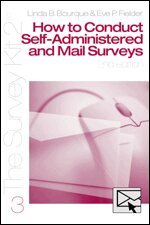
    How to Conduct Self-Administered and Mail Surveys

    AvLinda B. Bourque,Eve P. Fielder

    Häftad, Engelska, 2003

    1 271 kr

    Beställningsvara. Skickas inom 3-6 vardagar. Fri frakt över 249 kr.

    Beskrivning

    "The authors discuss self-administered questionnaires, the content and format of the questionnaire, "user-friendly" questionnaires and response categories, and survey implementation. They offer excellent checklists for deciding whether or not to use a mail questionnaire, for constructing questions and response categories, for minimizing bias, for writing questionnaire specifications, for formatting and finalizing questionnaires, and for motivating respondents and writing cover letters."
    --Peter Hernon, Graduate School of Library and Information Science, Simmons College


    How do you decide whether a self-administered questionnaire is appropriate for your research question? This book provides readers with an answer to this question while giving them all the basic tools needed for conducting a self-administered or mail survey. Updated to include data from the 2000 Census, the authors show how to develop questions and format a user-friendly questionnaire; pretest, pilot test, and revise questionnaires; and write advance and cover letters that help motivate and increase response rates. They describe how to track and time follow-ups to non-respondents; estimate personnel requirements; and determine the costs of a self-administered or mailed survey. They also demonstrate how to process, edit, and code questionnaires; keep records; fully document how the questionnaire was developed and administered; and how the data collected is related to the questionnaire. New to this edition is expanded coverage on Web-based questionnaires, and literacy and language issues.

    Produktinformation

    • Utgivningsdatum:2003-01-14
    • Mått:152 x 228 x 14 mm
    • Vikt:370 g
    • Format:Häftad
    • Språk:Engelska
    • Antal sidor:264
    • Upplaga:2
    • Förlag:SAGE Publications
    • ISBN:9780761925620

    Utforska kategorier

    • Sociologi inom Samhälle och politik

    Mer om författaren

    Linda Bourque, PhD, is a Professor in the Department of Community Health Sciences and an associate director of both the Center for Public Health and Disasters and the Southern California Injury Prevention Research Center in the UCLA School of Public Health. Trained as a sociologist, she teaches courses on research design with an emphasis on the design, data processing, and data analysis of questionnaires and community-based surveys. Her research during the last twenty years has focused on community response to disasters. A public website contains all of the raw data, codebooks, questionnaires, publications and related material from surveys conducted on California earthquakes since 1971 by Leo Reeder, Ralph Turner, Dennis Mileti and Linda Bourque. Current research includes the National Survey of Disaster Experiences and Preparedness (NSDEP), and the California Survey of Earthquake Preparedness.Funded by the Department of Homeland Security and the National Science Foundation, NSDEP examines the factors that predict disaster preparedness and risk avoidant behavior, with an emphasis on terrorism. A stratified sample of 3,300 households was selected using random digit dialing: 1,000 households were selected for interview in areas considered at high risk of terrorism (Washington, D.C., New York City, Los Angeles County), and 2,300 households were selected for interview throughout the rest of the continental United States. Respondents were asked whether they had invested in six preparedness behaviors and seven risk avoidant behaviors either because of terrorism, natural disasters, other reasons, or any combination of the three. NSDEP reports and other documentation are available here. Eve Picardy Fielder died on Oct. 27 at home in Venice, CA, after a long illness. She was 67. An academic researcher, she received her doctorate in public health from UCLA, where she was the director of the Survey Research Center. Many of the hundreds of survey research projects she managed focused on public policies related to social issues and service delivery in the areas of health and welfare. She also conducted research of her own on issues of relevance to the Hispanic/Latino communities

    Recensioner i media

    "The authors discuss self-administered questionnaires, the content and format of the questionnaire, "user-friendly" questionnaires and response categories, and survey implementation. They offer excellent checklists for deciding whether or not to use a mail questionnaire, for constructing questions and response categories, for minimizing bias, for writing questionnaire specifications, for formatting and finalizing questionnaires, and for motivating respondents and writing cover letters."