• Fri frakt över 249 kr
  • •
  • Snabba leveranser
  • •
  • Billiga böcker
Kundservice

Du är på sajten för privatpersoner.

Företag, bibliotek eller offentlig verksamhet?

Du handlar på classic.bokus.com, där alla dina funktioner finns intakta.
Till classic.bokus.com
Bokus logotyp. Gå till startsidan.
  • Erbjudanden
  • Nyheter
  • Student
  • Topplistor
  • Barn & ungdom
  • Bokus Play
  • E-böcker
  • Pocketböcker
  • Spel & pussel

10% rabatt på allt med kod NYSTART10 →

Sidfot

Mina sidor

    Hjälp

    • Kundservice
    • Vanliga frågor och svar
    • Frakt och leverans
    • Retur vid ångerrätt
    • Reklamera vara
    • Betalning
    • Köpvillkor
    • Allmänna villkor
    • Information om webbplatsens tillgänglighet

    Om Bokus

    • Om oss
    • Pressrum
    • För studenter
    • För företag
    • För bibliotek och offentlig verksamhet
    • För leverantörer
    • Hållbarhet

    Populärt

    • Aktuella erbjudanden
    • Presentkort
    • Studentlitteratur
    • Nya böcker
    • Topplistor
    • Signerade böcker
    • Engelska böcker

    Inspiration

    • Boktips
    • BookTok
    • Populära bokserier
    • Barnbokskaraktärer
    • Populära författare
    Logotyp för Bokus
    Följ oss på Facebook (extern länk)Följ oss på Instagram (extern länk)Följ oss på YouTube (extern länk)Följ oss på TikTok (extern länk)
    bokus @ CookiesAnpassa cookiesIntegritetspolicyKöpvillkor
    Till Citymail hemsida (extern länk)Till Budbee hemsida (extern länk)Till Postnord hemsida (extern länk)Till Schenker hemsida (extern länk)Till Early Bird hemsida (extern länk)Till Walleys hemsida (extern länk)
    1. Ekonomi och Ledarskap
    2. Företagsekonomi
    3. Affärsstrategi

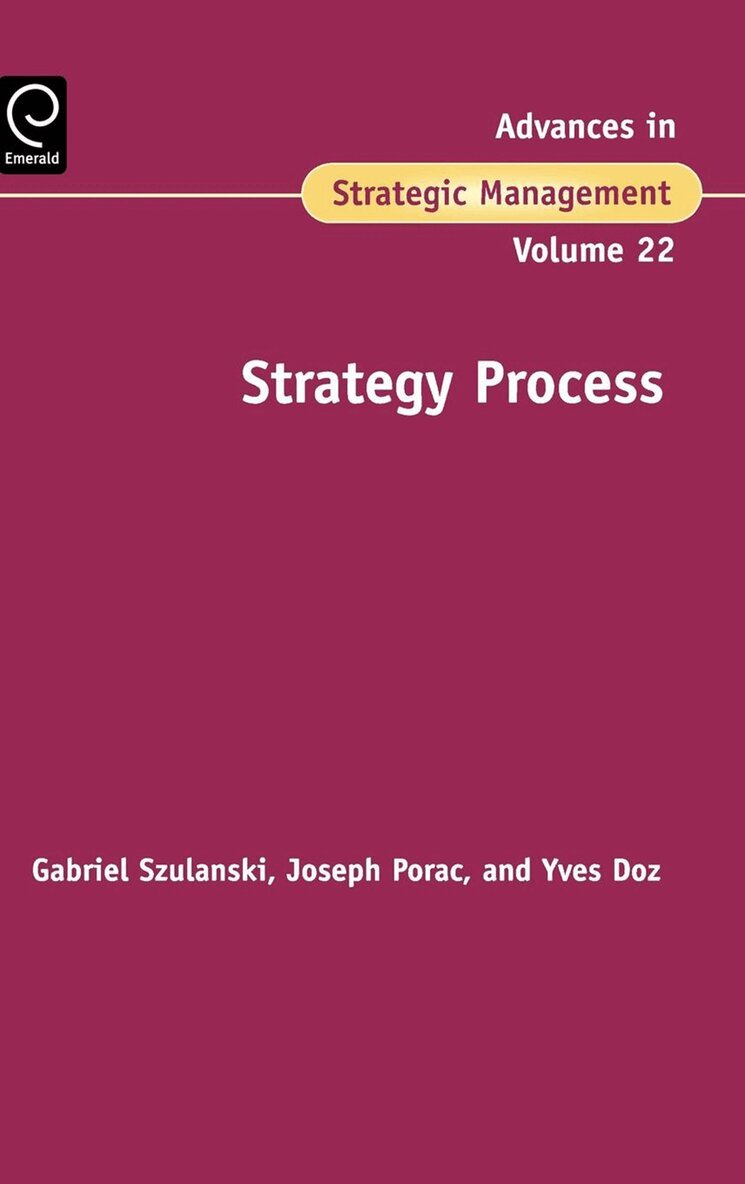
    Strategy Process

    AvGabriel Szulanski,Joseph F. Porac

    Inbunden, Engelska, 2005

    Del 22 i serien Advances in Strategic Management

    1 332 kr

    Beställningsvara. Skickas inom 5-8 vardagar. Fri frakt över 249 kr.

    Beskrivning

    Enduring scholarly interest in the process of strategy making stems from an abiding assumption that some ways of strategizing are more efficacious than others, and thus lead to higher firm performance in the long run; higher than luck alone would bring. Expressions of interest in and endorsements of the strategy process are abundant in the academic literature. For senior managers and leaders, the question of how to make effective strategies stands usually at the top of their agenda. Not surprisingly then, the quest to uncover stable principles of good strategy making has attracted much support and interest over the years. Researchers who responded to the strategy process challenge have known many moments of exhilaration and disillusion. Scholarly insights took long to accumulate, perhaps too long to serve as the sole basis for helping the eager practitioner in search of simpler but applicable advice. As a result, a significant and often highly visible part of the field is characterized by a controversial normative orientation. But beneath this dramatic and unstable facade lies a gradual, patient, and seemingly more stable, hard-at-work, academic enterprise. Scholarly strategy process research apparently goes on, perhaps more than ever, suggesting that there is something fundamental and deeply interesting and profound about how strategies are made, where they originate in organizations, and how the process of strategy making impacts the performance of organizations. This volume is the culmination of our three year effort to explore and uncover this relatively hidden or at least less visible side of the strategy process field. Taken together, the sixteen chapters represent current scholarly strategy process research.

    Produktinformation

    • Utgivningsdatum:2005-12-16
    • Mått:156 x 234 x 30 mm
    • Vikt:945 g
    • Format:Inbunden
    • Språk:Engelska
    • Serie:Advances in Strategic Management
    • Antal sidor:552
    • Förlag:Emerald Publishing Limited
    • ISBN:9780762312009

    Utforska kategorier

    • Affärsstrategi inom Ekonomi och Ledarskap

    Innehållsförteckning

    • Editors' Introduction. (G. Szulanski, J. Porac, Y. Doz). Cognitive and Emotional Foundations of Strategy Making. An Emotion-based View of Strategic Renewal. (Q. Nguyen Huy). An Attention-Based Theory of Strategy Formulation: Linking Micro and Macro Perspectives in Strategy Processes. (W. Ocasio, J. Joseph). Top Managerial Cognitions, Past Performance, and Strategic Change: A Theoretical Framework. (J. Haleblian, N. Rajagopalan). Sequence of Thinking and Acting in Strategy-Making. (J. Ignacio Canales, (J. Vila). Interorganizational Monitoring: Process, Choices, and Outcomes. (G. Labianca, J.F. Fairbank). Institutional and Resource Foundations of Strategy Making. Adaptive and Creative Strategy Logics in Strategy Processes. (P. Regner). The Development of the Resource-Based Firm Between Value Appropriation and Value Creation. (A. Mocciaro Li Destri, G. Battista Dagnino). Managing the MNC and Exploitation/Exploration Dilemma: From Static Balance to Dynamic Oscillation. (C. Thomas, R. Kaminska-Labbe, B. McKelvey). Contemporary Empirical Studies of Strategy Making. Communication Dissonnance and Pragmatic Failures in Strategic Processes: The Case of Cross-Border Acquisitions. (O. Irrmann). Strategy-Making as a Complex, Double-Loop Process of Knowledge Creation: Four Cases of Established Banks Reinventing the Industry by Means of the Internet. (M.P. Salmador, E. Bueno). Top Managers and the Product Improvement Process. (C. Annique Un, A. Cuervo-Cazurra). Strategy Content and Process in the Context of E-Business Performance. (T.R. Coltman, T.M. Devinney, D.F. Midgley). Emergent Strategies and their Consequences: A Process Study of Competiton and Complex Decision-Making. (Q.R. Jett, J.M. George). Meta-Commentaries on Methodologies for Strategy Process Research. Comparative Causal Analysis in Processual Strategy Research: A Study of Causal Methanisms in Organizational Decline and Turnarounds. (K. Pajunen). Future Directions from the Past: Management and Accounting Discourse in Historial Perspective. (L. Zan). Practices of Organizing: Inside and Outside the Processes of Change. (E. Molloy, R. Whittington).