• Fri frakt över 249 kr
  • •
  • Snabba leveranser
  • •
  • Billiga böcker
Kundservice

Du är på sajten för privatpersoner.

Företag, bibliotek eller offentlig verksamhet?

Du handlar på classic.bokus.com, där alla dina funktioner finns intakta.
Till classic.bokus.com
Bokus logotyp. Gå till startsidan.
  • Erbjudanden
  • Nyheter
  • Student
  • Topplistor
  • Barn & ungdom
  • Bokus Play
  • E-böcker
  • Pocketböcker
  • Spel & pussel

10% rabatt på allt med kod NYSTART10 →

Sidfot

Mina sidor

    Hjälp

    • Kundservice
    • Vanliga frågor och svar
    • Frakt och leverans
    • Retur vid ångerrätt
    • Reklamera vara
    • Betalning
    • Köpvillkor
    • Allmänna villkor
    • Information om webbplatsens tillgänglighet

    Om Bokus

    • Om oss
    • Pressrum
    • För studenter
    • För företag
    • För bibliotek och offentlig verksamhet
    • För leverantörer
    • Hållbarhet

    Populärt

    • Aktuella erbjudanden
    • Presentkort
    • Studentlitteratur
    • Nya böcker
    • Topplistor
    • Signerade böcker
    • Engelska böcker

    Inspiration

    • Boktips
    • BookTok
    • Populära bokserier
    • Barnbokskaraktärer
    • Populära författare
    Logotyp för Bokus
    Följ oss på Facebook (extern länk)Följ oss på Instagram (extern länk)Följ oss på YouTube (extern länk)Följ oss på TikTok (extern länk)
    bokus @ CookiesAnpassa cookiesIntegritetspolicyKöpvillkor
    Till Citymail hemsida (extern länk)Till Budbee hemsida (extern länk)Till Postnord hemsida (extern länk)Till Schenker hemsida (extern länk)Till Early Bird hemsida (extern länk)Till Walleys hemsida (extern länk)
    1. Ekonomi och Ledarskap
    2. Nationalekonomi
    3. Internationell ekonomi

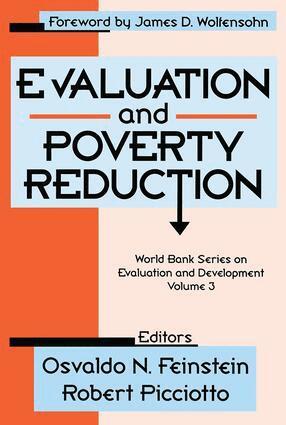
    Evaluation and Poverty Reduction

    AvOsvaldo N. Feinstein,Osvaldo N. Feinstein

    Häftad, Engelska, 2001

    Del i serien Advances in Evaluation & Development

    723 kr

    Beställningsvara. Skickas inom 10-15 vardagar. Fri frakt över 249 kr.

    Fler format och utgåvor

    Inbunden

    1 762 kr

    E-bok

    858 kr

    E-bok

    855 kr

    Beskrivning

    In his foreword, the president of the World Bank, James D. Wolfensohn, states plainly and precisely the rationale for this volume. "Evaluation is a central aspect of any poverty reduction endeavor. Evaluation implies that we have adopted a methodology that allows us to look in an effective way at the results of what we are doing so that we can, in turn, adapt our future actions toward the effective achievement of our goals. Evaluation adds value if we can learn something useful from it. It is not just a scorecard. It is something that helps us change our behavior or influence the behavior of others."This high powered collection of papers illustrates this statement. The network of world class scholars and development practitioners covers the gamut from methodological issues to policy concerns with respect to participatory evaluation, poverty reducing growth, macro and micro levels of intervention, health, nutrition and population programs, social inclusion and the changing role of the civil society. The participants include major figures, including a Nobel Laureate as well as cutting edge policy makers. Poverty reduction is examined in innovative ways-utilizing state of the art techniques of the social and economic sciences.The editors and contributors emphasize "what works" in poverty reduction programs. They point to making interventions context specific with a holistic vision of the problem. Contributors emphasize social funds and safety nets, social services, crisis prevention, informal social security and insurance systems, anti-corruption programs, mobilization of the poor, and ultimately, the creation, where none existed in the past, of a workable civil society. In short, this volume lies at the intersection of development economics and political economy. It seeks to promote development effectiveness through social learning and problem solving.The volume is unabashedly focussed on pro-poor growth. It has its roots in a conference sponsored by the Operations Evaluation Department, an independent unit within the World Bank. The goals of evaluation are to learn from experience, to provide an objective basis for assessing the results of the Bank's work, and to provide accountability in the achievement of its objectives.Osvaldo N. Feinstein is a manager, and Robert Picciotto, director general of the Operations Evaluation Department. The World Bank is located in Washington, D.C. with offices throughout the developing world.

    Produktinformation

    • Utgivningsdatum:2001-05-31
    • Mått:152 x 229 x 22 mm
    • Vikt:544 g
    • Format:Häftad
    • Språk:Engelska
    • Serie:Advances in Evaluation & Development
    • Antal sidor:400
    • Förlag:Taylor & Francis Inc
    • ISBN:9780765808769

    Utforska kategorier

    • Internationell ekonomi inom Ekonomi och Ledarskap
    • Sociala och etiska frågor inom Samhälle och politik

    Mer om författaren

    Osvaldo N. Feinstein is a manager, and Robert Picciotto, director general of the Operations Evaluation Department. The World Bank is located in Washington, D.C. with offices throughout the developing world.

    Innehållsförteckning

    • I: Introduction: Identifying the Challenges; Synthesis and Overview; II: Evaluation: A Macro Perspective; 1: Valuation and Evaluation; Floor Discussion: Valuation and Evaluation; 2: Evaluation in a World of Complexity and Information Failures; Floor Discussion: Evaluation in a World of Complexity and Information Failures; 3: Panel Discussion: Evaluation Perspectives on Poverty Reduction; Floor Discussion: Evaluation Perspectives on Poverty Reduction; III: Methodological Issues in Evaluation; 4: Impact Evaluation: Concepts and Methods; Comments: Impact Evaluation: Concepts and Methods; Floor Discussion: Impact Evaluation: Concepts and Methods; 5: Panel Discussion: Quantitative and Qualitative Methods in Evaluation; Floor Discussion: Quantitative and Qualitative Methods in Evaluation; 6: Theory-Based Evaluation: Theories of Change for Poverty Reduction Programs; IV: Participatory Evaluation: Costs and Benefits; 7: The Front-End Costs and Downstream Benefits of Participatory Evaluation; Comments: The Strategic Choices of Stakeholders: The Front-End Costs and Downstream Benefits of Participatory Evaluation; Floor Discussion: Front-End Costs and Downstream Benefits of Participatory Evaluations; 8: Building Local Capacity for Participatory Monitoring and Evaluation; Comments: Building Local Capacity for Participatory Monitoring and Evaluation; Floor Discussion: Building Local Capacities for Participatory Monitoring and Evaluation; V: Poverty-Reducing Growth; 9: Africa and Asia: Evaluation of the Poverty Alleviation Impact of Alternative Development Strategies and Adjustment Responses; Comments: Africa and Asia: Evaluation of the Poverty Alleviation Impact of Alternative Development Strategies and Adjustment Responses; Floor discussion: Africa and Asia: Evaluation of the Poverty Alleviation Impact of Alternative Development Strategies and Adjustment Responses; 10: Lessons Learned from Evaluation of DFID’s Aid Program; Comments: Lessons Learned from Evaluation of DFID’s Aid Program; Floor Discussion: Lessons Learned from Evaluation DFID’s Aid Program; VI: Sectoral and Microlevel Interventions; 11: Evaluating Microfinance’s Impact: Going Down Market; Comments: Microfinance Impact Evaluation: Going Down Market; 12: Evaluating Targeted Versus Nontargeted Approaches to Poverty Reduction; Floor Discussion: Evaluating Targeted Versus Nontargeted Approaches to Poverty Reduction; VII: Social Funds and Safety Nets; 13: What Are Social Funds Really Telling Us?; Comments: What Are Social Funds Really Telling Us?; Floor Discussion: What Are Social Funds Really Telling Us?; 14: Economic Crises and Social Protection for the Poor: The Latin American Experience; Comments: Economic Crises and Social Protection for the Poor: The Latin American Experience; Floor Discussion: Economic Crises and Social Protection for the Poor: The Latin American Experience; VIII: Developm ent Effectiveness in Health, Nutrition, and Population Services; 15: Delivering Social Services: Lessons on Health, Nutrition, and Population; Comments: Delivering Social Services Lessons on Health, Nutrition, and Population; Floor Discussion: Delivering Social Services: Lessons on Health, Nutrition, and Population; IX: Crisis Prevention; 16: Tackling Horizontal Inequalities; Comments: Tackling Horizontal Inequalities; Floor Discussion: Tackling Horizontal Inequalities; 17: Governance and Anticorruption: New Insights and Challenges; Comments: Governance and Anticorruption: New Insights and Challenges; Floor Discussion: Governance and Anticorruption; 18: Panel Discussion: Combatting Public Corruption; X: Social Inclusion and Civil Society; 19: Nongovernmental Organizations and Evaluation: The BRAC Experience; Comments: NGOs and Evaluation: The BRAC Experience; Floor Discussion: NGOs and Evaluation: The BRAC Experience; 20: Social Exclusion and Rural Underdevelopment; Comments: Social Exclusion and Rural Underdevelopment; Floor Discussion: Social Exclusion and Rural Underdevelopment; XI: Conclusions; 21: Panel Discussion: Final Roundtable; 22: Concluding Remarks