• Fri frakt över 249 kr
  • •
  • Snabba leveranser
  • •
  • Billiga böcker
Kundservice

Du är på sajten för privatpersoner.

Företag, bibliotek eller offentlig verksamhet?

Du handlar på classic.bokus.com, där alla dina funktioner finns intakta.
Till classic.bokus.com
Bokus logotyp. Gå till startsidan.
  • Erbjudanden
  • Nyheter
  • Student
  • Topplistor
  • Barn & ungdom
  • Bokus Play
  • E-böcker
  • Pocketböcker
  • Spel & pussel

Må bättre, för mindre! Upp till 50% rabatt på hälsoböcker

Sidfot

Mina sidor

    Hjälp

    • Kundservice
    • Vanliga frågor och svar
    • Frakt och leverans
    • Retur vid ångerrätt
    • Reklamera vara
    • Betalning
    • Köpvillkor
    • Allmänna villkor
    • Information om webbplatsens tillgänglighet

    Om Bokus

    • Om oss
    • Pressrum
    • För studenter
    • För företag
    • För bibliotek och offentlig verksamhet
    • För leverantörer
    • Hållbarhet

    Populärt

    • Aktuella erbjudanden
    • Presentkort
    • Studentlitteratur
    • Nya böcker
    • Topplistor
    • Signerade böcker
    • Engelska böcker

    Inspiration

    • Boktips
    • BookTok
    • Populära bokserier
    • Barnbokskaraktärer
    • Populära författare
    Logotyp för Bokus
    Följ oss på Facebook (extern länk)Följ oss på Instagram (extern länk)Följ oss på YouTube (extern länk)Följ oss på TikTok (extern länk)
    bokus @ CookiesAnpassa cookiesIntegritetspolicyKöpvillkor
    Till Citymail hemsida (extern länk)Till Budbee hemsida (extern länk)Till Postnord hemsida (extern länk)Till Schenker hemsida (extern länk)Till Early Bird hemsida (extern länk)Till Walleys hemsida (extern länk)
    1. Ekonomi och Ledarskap
    2. Nationalekonomi

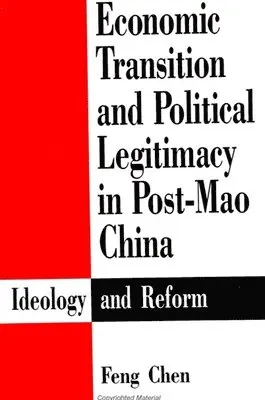
    Economic Transition and Political Legitimacy in Post-Mao China

    Ideology and Reform

    AvFeng Chen

    Häftad, Engelska, 1995

    462 kr

    Beställningsvara. Skickas inom 5-8 vardagar. Fri frakt över 249 kr.

    Fler format och utgåvor

    Inbunden

    Tillf. slut

    Beskrivning

    Traces the role of ideas in Chinese economic reform from 1978 to the present, exploring the conversion of China's policymakers to capitalist economic thinking.Tracing the role of ideas in Chinese economic reform from 1978 to the present, this book explores the conversion of China's policymakers to capitalist economic thinking. Chen argues that the reform process has created a gap between the legitimacy of the leadership, which remains rooted in Marxist-Leninist ideology, and the practice of reform, which has abandoned such ideological constraints. Through a systematic survey of party documents and resolutions, official publications, leaders' speeches, academic journals, and newspapers, Chen shows how Chinese policymakers reconceptualized the ownership system and adjusted related policies. Focusing on a number of economic policy issue areas such as state economy, rural reform, privatization, and income distribution, he analyzes in depth the implications of this gap for the current Chinese leadership and the future of China's political development.

    Produktinformation

    • Utgivningsdatum:1995-09-21
    • Mått:229 x 151 x 19 mm
    • Vikt:408 g
    • Format:Häftad
    • Språk:Engelska
    • Antal sidor:246
    • Förlag:State University of New York Press
    • ISBN:9780791426586

    Utforska kategorier

    • Nationalekonomi inom Ekonomi och Ledarskap

    Mer om författaren

    Feng Chen is Assistant Professor in the Department of Political Science at Upsala College.

    Recensioner i media

    "This book discusses an important topic—how economic reforms have undermined the Chinese Communist Party's legitimacy—that many scholars have mentioned in passing but which no one, to my knowledge, has examined as systematically as this author. The contradiction between necessary reform and maintaining the party's legitimacy is one of the most important aspects—possibly the single most important aspect—of contemporary Chinese politics." — Barrett L. McCormick, Marquette University"The first serious study on the role of ideology in China's economic reform, it adds something important to the emerging literature on the Chinese reform period." — Zhiyuan Cui, MIT"This book is well written and persuasively argued. It makes an important contribution to the field and is likely to be adopted in a number of undergraduate courses on Chinese politics." — Joseph Fewsmith, Boston University

    Innehållsförteckning

    • Preface List of Tables Abbreviations Chapter 1. Introduction The Role of Ideas/IdeologyIdeology versus Economic Development: The Goal ConflictAlternative ExplanationsAnalytical FrameworkThe Fundamental Principles versus Instrumental PrinciplesThe Fundamental-Instrumental Discrepancy and the Legitimacy CrisisThe Organization of This BookChapter 2. The Ownership System before the Reform: Its Rationale The Dominance of Public Ownership: Its RationaleThe Ownership System in Pre-Reform ChinaChapter 3. Theoretical Adjustments: The "Practice Criterion" and the "Criterion of Productive Forces" Remodeling Mao Zedong Thought: Hua Guofeng's FailureThe Debate on the Criterion for TruthThe Practice Criterion and the Guiding Role of MarxismThe Practice Criterion versus the Political CriterionThe Primacy of Practice: Significance and LimitationsRevolution versus ProductionThe Criterion of Productive ForcesThe Revival of Historical MaterialismThe Criterion of Productive Forces and the Preliminary Stage of SocialismThe Criterion of Productive Forces and Capitalistic PracticesThe Criterion of Productive Forces: Its Significance and ImplicationsChapter 4. Agricultural Decollectivization The Agricultural Ownership System: Performance and ProblemsThe Emergence of the Contract System and Ideological ControversyRedefining the Contract System: Expedient Measures versus Alternatiave OrganizationThe Legitimization of the Individual Household ContractThe Long-Term Contract: Its ImplicationsThe IHC and the Land System: The Search for New AlternativesPredicament and Limitations: An Uncertain FutureChapter 5. Reforming State Ownership Problems of China's State Ownership before the ReformState Ownership as an Issue of ManagementState Ownership as an Issue of State-Enterprise Financial RelationshipsState Ownership as an Issue of Separation of Ownership and ControlState Ownership: The Property Rights ProblemThe Shareholding SystemChapter 6. Justifying the Private Economy The Urban Individual Economy: An Initial Step toward PrivatizationThe Private Economy as a Supplement to Socialist EconomyThe Private Economy as an Agent of ModernizationThe Private Economy as an Alternative Economic InstituttionReconciling the Socialist System and a Private Economy: A Problem UnsettledChapter 7. The Distribution Issue in the Economic Reform Egalitarianism: Theory and PracticeRehabilitation of "To Each According to His Work"The New Dimensions of Distributional Inequality in Rural AreasThe "Rich First" versus Common ProsperityThe Emergence of Urban Distributional InequalityJustifying a Market-Driven Distribution of IncomeThe Conflict between Ideology and Practice: What are Its Solutions?Chapter 8. Conclusion Marxism and Underdeveloped SocialismThe Irreconcilability of the Fundamental-Instrumental Discrepancy under Communist SystemsThe Fundamental-Instrumental Discrepancy and Ideological TransformationNotes Bibliography Index