• Fri frakt över 249 kr
  • •
  • Snabba leveranser
  • •
  • Billiga böcker
Kundservice

Du är på sajten för privatpersoner.

Företag, bibliotek eller offentlig verksamhet?

Du handlar på classic.bokus.com, där alla dina funktioner finns intakta.
Till classic.bokus.com
Bokus logotyp. Gå till startsidan.
  • Erbjudanden
  • Nyheter
  • Student
  • Topplistor
  • Barn & ungdom
  • Bokus Play
  • E-böcker
  • Pocketböcker
  • Spel & pussel

10% rabatt på allt med kod: NYSTART10 →

Sidfot

Mina sidor

    Hjälp

    • Kundservice
    • Vanliga frågor och svar
    • Frakt och leverans
    • Retur vid ångerrätt
    • Reklamera vara
    • Betalning
    • Köpvillkor
    • Allmänna villkor
    • Information om webbplatsens tillgänglighet

    Om Bokus

    • Om oss
    • Pressrum
    • För studenter
    • För företag
    • För bibliotek och offentlig verksamhet
    • För leverantörer
    • Hållbarhet

    Populärt

    • Aktuella erbjudanden
    • Presentkort
    • Studentlitteratur
    • Nya böcker
    • Topplistor
    • Signerade böcker
    • Engelska böcker

    Inspiration

    • Boktips
    • BookTok
    • Populära bokserier
    • Barnbokskaraktärer
    • Populära författare
    Logotyp för Bokus
    Följ oss på Facebook (extern länk)Följ oss på Instagram (extern länk)Följ oss på YouTube (extern länk)Följ oss på TikTok (extern länk)
    bokus @ CookiesAnpassa cookiesIntegritetspolicyKöpvillkor
    Till Citymail hemsida (extern länk)Till Budbee hemsida (extern länk)Till Postnord hemsida (extern länk)Till Schenker hemsida (extern länk)Till Early Bird hemsida (extern länk)Till Walleys hemsida (extern länk)
    1. Filosofi och religion
    2. Religion och tro
    3. Hinduism

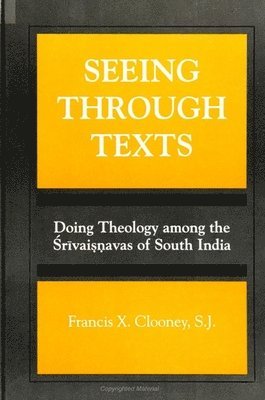
    Seeing through Texts

    Doing Theology among the Śrīvaiṣṇavas of South India

    AvFrancis X. Clooney

    Häftad, Engelska, 1996

    Del i serien SUNY series, Toward a Comparative Philosophy of Religions

    410 kr

    Tillfälligt slut

    Beskrivning

    Examines texts and commentaries in the Tamil-language SArivastradition of South India; about the general issues of text, vision, and narrative that such texts raise, and about the implications of these for a particular style of comparative theology.Seeing through Texts invites us into the world of south Indian Hinduism through a study of 100 songs of the Tiruvāymoli, the great masterpiece of the ninth-century Hindu saint Saṭkōpan. These unique songs, dedicated to the Hindu god Viṣṇu/Kṛṣṇa, lead us through poetic and imaginative, philosophical and moral reflections on the nature of the self and the world, ancient myths and temple worship, and the mystical moods of longing, desire, and love in which one seeks, loses, and finds again the God who loves us first. The book is also a study of the interpretation of the Tiruvāymoli in the traditional Hindu Śrivaiṣṇava commentaries of the twelfth-fourteenth centuries, as well as a comparative theological study which explores the implication of the songs and their commentaries for readers from outside the Śrivaiṣṇava tradition.

    Produktinformation

    • Utgivningsdatum:1996-07-03
    • Mått:153 x 229 x 19 mm
    • Vikt:499 g
    • Format:Häftad
    • Språk:Engelska
    • Serie:SUNY series, Toward a Comparative Philosophy of Religions
    • Antal sidor:351
    • Förlag:State University of New York Press
    • ISBN:9780791429969

    Utforska kategorier

    • Hinduism inom Filosofi och religion

    Mer om författaren

    Francis X. Clooney, S. J. is Professor of Comparative Theology at Boston College. He is the author of Theology after Vedanta, also published by SUNY Press, and of Thinking Ritual.

    Recensioner i media

    "Clooney has turned an analysis of Satakopan's Tiruvaymoli, a theology treatise in the form of a long sensual poem about a girl's love for God, into seductive contemporary theology. In this work, Clooney has established himself as our most passionate, discriminating, deferential, and subtle comparative theologian." — Robert C. Neville, Boston University"I find Clooney's notion of 'reading through texts' to be a very powerful idea that should be of interest to a large audience of textual scholars, and not only South Asianist scholars. I also find Clooney's formulation and exploration of the issues incumbent on the project of doing comparative theology and reading texts from a comparative perspective to be very engaging. His representation of the great Tamil religious poem Tiruvaymoli is quite successful in giving the reader a good sense of the qualities of this text and an appreciation of its considerable merits." — Norman Cutler, University of Chicago

    Innehållsförteckning

    • Foreword Preface Chapter One: Taking a First LookI. Some Opening QuestionsII. Getting Inside TiruvaymoliIII. Pondering the Author: Sifting the Multiple Contexts1. Locating Satakopan Historically2. Finding Satakopan in his Songs3. Satakopan Under the Tamarind Tree: Learning fromHagiographyIV. Joining the Conversation: Tiruvaymoli and its Acaryas1. Introducing the Acaryas and What They Thought2. The Commentarial ConversationV. Being a Reader of Tiruvaymoli, Now1. Comparative, Theological Commitments2. This Particular Venture: Seeing Christianity andSrivaisnavism Together3. This TheologianVI. Where All of This LeadsChapter Two: Getting Inside TiruvaymoliI. Listening to the Songs1. A Dubious Beginning2. On (Not) Knowing TamilII. Thematic Resources1. Some Major Themesa. The Transcendent Perfection of Godb. The Gracious Acts of Divine Nearnessc. Holy Places where God Chooses to Dwelld. The Beauty of Gode. Moral and Religious Appealsf. Love Songs in an Ancient Genreg. The Self-Understanding of the Poeth. Expanding and Exceeding the Described ReligiousWorldIII. Some Formal Components of Tiruvaymoli1. How the Themes are Locateda. The Litany Effectb. Form as Frame2. Antati3. The Formal Contribution of the Eleventh VersesIV. Understanding Tiruvaymoli1. The Direction of the Text2. Understanding Tiruvaymoli: Reading Across the Texta. Finding a Context: "Tall One"b. Finding a Context: "With No Place to Enter, I HaveEntered Right Beneath Your Feet"c. Finding a Context: Total SurrenderV. Theologizing Tiruvaymoli1. Boundaries2. Tiruvaymoli as Map3. Desire in the Texta. The Desire to Serveb. The Desire to SeeVI. Reading, Alone or with OthersChapter Three: Tiruvaymoli as Meditation, Narrative and Drama: Reading with the AcaryasI. Satakopan:Anguished Soul, Best of Theologians1. The Plight of Satakopan2. The Perfect TheologianII. The Theological Problem of Vision1. Ramanuja on the (Indirect) Experience of God2. The Acaryas' Reading of the Problem of Vision in Tiruvaymolia. Looking for Godb. On Not Quite Seeing God: Some Examplesc. Visualizationd. As Near as One Can Get to VisionIII. Tiruvaymoli as Meditation1. Tiruvaymoli as the Act of MeditationIV. Tiruvaymoli as Dramatic Narrative1. The Preliminaries2. Interpreting the Divine Silence: A Brief Theodicy3. Resolution and UnionChapter Four: Five Ways to Think about Tiruvaymoli Following the Acaryas' Practical ResponseI. The First Way: Tiruvaymoli in Correlation with the Three Holy Mantras1. Smaller Correlations2. Larger Correlations3. Correlations with the WholeII. The Second Way: Tiruvaymoli as a Guidebook to the Right Means to Union with GodIII. The Third Way: Satakopan as Exemplar and Teacher of Surrender1. I.12. I.23. V.7-104. VI.10.105. X.4IV. The Fourth Way: Imagining the Ramayana and Tiruvaymoli as a Moral Scenario1. Paralleling Tiruvaymoli and the Ramayana2. Characters in Parallel: The Alvar and his Soulmates3. Parallel Lives: Satakopan and Laksmana4. Multiple Dramas, One EndingV. The Fifth Way: Living Tiruvaymoli in the Community.VI. On the Threshold of ParticipationChapter Five: Seeing through Texts: Some Marginal Insights, Presented in ReflectionsI. The Prospect from Here1. What We Have Seen2. Did the Acaryas Notice Everything?II. Doing Things with Texts: Composing a Biblio/Biographical Self1. The Desires of the Song of Songs2. Encountering the Word in the Gospel According to St. John3. Travelling the Journey of the Mind to God4. Working Through the Spiritual Exercises of St. Ignatius Loyola5. Hans Urs von Balthasar's Prayer6. Contexts on the Other Side: Mimamsa and Vedanta7. In ConclusionIII. Learning to See1. Making Comparisons, Possibly2. Toward a Systematic Theology—But Not There Yet3. Telling New Stories: A New Story4. The End of this Venture: Seeing It Through, Seeing Through ItNotes Selected Bibliography Index of Full Verses Cited from Tiruvaymoli Index of Names and Subjects