• Fri frakt över 249 kr
  • •
  • Snabba leveranser
  • •
  • Billiga böcker
Kundservice

Du är på sajten för privatpersoner.

Företag, bibliotek eller offentlig verksamhet?

Du handlar på classic.bokus.com, där alla dina funktioner finns intakta.
Till classic.bokus.com
Bokus logotyp. Gå till startsidan.
  • Erbjudanden
  • Nyheter
  • Student
  • Topplistor
  • Barn & ungdom
  • Bokus Play
  • E-böcker
  • Pocketböcker
  • Spel & pussel

Må bättre, för mindre! Upp till 50% rabatt på hälsoböcker

Sidfot

Mina sidor

    Hjälp

    • Kundservice
    • Vanliga frågor och svar
    • Frakt och leverans
    • Retur vid ångerrätt
    • Reklamera vara
    • Betalning
    • Köpvillkor
    • Allmänna villkor
    • Information om webbplatsens tillgänglighet

    Om Bokus

    • Om oss
    • Pressrum
    • För studenter
    • För företag
    • För bibliotek och offentlig verksamhet
    • För leverantörer
    • Hållbarhet

    Populärt

    • Aktuella erbjudanden
    • Presentkort
    • Studentlitteratur
    • Nya böcker
    • Topplistor
    • Signerade böcker
    • Engelska böcker

    Inspiration

    • Boktips
    • BookTok
    • Populära bokserier
    • Barnbokskaraktärer
    • Populära författare
    Logotyp för Bokus
    Följ oss på Facebook (extern länk)Följ oss på Instagram (extern länk)Följ oss på YouTube (extern länk)Följ oss på TikTok (extern länk)
    bokus @ CookiesAnpassa cookiesIntegritetspolicyKöpvillkor
    Till Citymail hemsida (extern länk)Till Budbee hemsida (extern länk)Till Postnord hemsida (extern länk)Till Schenker hemsida (extern länk)Till Early Bird hemsida (extern länk)Till Walleys hemsida (extern länk)
    1. Skönlitteratur
    2. Litteraturvetenskap
    3. Litteraturvetenskap

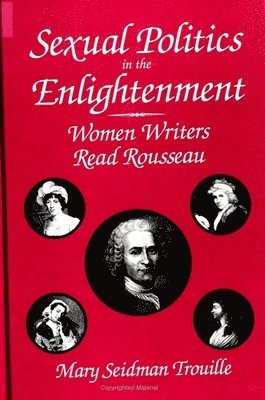
    Sexual Politics in the Enlightenment

    Women Writers Read Rousseau

    AvMary Seidman Trouille

    Häftad, Engelska, 1997

    Del i serien SUNY series, The Margins of Literature

    561 kr

    Beställningsvara. Skickas inom 5-8 vardagar. Fri frakt över 249 kr.

    Fler format och utgåvor

    Inbunden

    Tillf. slut

    Beskrivning

    Explores the way seven women writers of the eighteenth century responded to Rousseau, and traces his crucial influence on their literary careers.Sexual Politics in the Enlightenment constitutes the first book-length feminist study of Rousseau's sexual politics and the reception of his works by women readers. By today's standards, Rousseau's sexual politics appear reactionary, paternalistic, even blatantly misogynist; yet, among his female contemporaries, his works often met with enthusiastic approval and had tremendous impact on their values and behavior. To probe Rousseau's paradoxical appeal to eighteenth-century readers, Mary Trouille examines how seven women authors responded to his writings and sexual politics and traces his influence on their lives and works. The writers include six Frenchwomen (Roland, d'Epinay, Stael, Genlis, Gouges, and an anonymous woman correspondent who called herself Henriette) and the English feminist Mary Wollstonecraft.The book constitutes an important contribution to French literature, women's studies, and eighteenth-century cultural studies. While a great deal has already been written on the individual women whom Trouille treats, what distinguishes this book is that it places multiple female subjects directly opposite Rousseau, and succeeds in showing that the relationship between mentor and student(s) is both multi-layered and fascinatingly complex.

    Produktinformation

    • Utgivningsdatum:1997-08-28
    • Mått:152 x 229 x 23 mm
    • Vikt:562 g
    • Format:Häftad
    • Språk:Engelska
    • Serie:SUNY series, The Margins of Literature
    • Antal sidor:422
    • Förlag:State University of New York Press
    • ISBN:9780791434901

    Utforska kategorier

    • Litteraturvetenskap inom Skönlitteratur

    Mer om författaren

    Mary Seidman Trouille is Associate Professor of French at Illinois State University. She is translator of The Writing of Melancholy: Modes of Opposition in Early French Modernism and of Les Lieux de Memoire.

    Recensioner i media

    "Other studies have discussed the sexual politics of Rousseau's writings, but this is the first book-length work to consider the influence and criticism of Rousseau's ideas specifically among his female readers. Also welcome are Trouille's discussion of the diverse reactions to Rousseau and her explanation of how historical and socio-economical forces helped condition such responses. The author does an admirable job of combining historical context analysis with close textual readings." — Julia Douthwaite, University of Notre Dame"The author is in total command of her material: she has produced a thoroughly researched and very interesting book. By bringing under one cover the responses of seven exceptional women to one of the greatest and most controversial figures of the eighteenth century, Trouille offers insights into how and why these women—all very strong individuals in their own right—could admire a man considered by most twentieth-century feminists to be a misogynist. In so doing, she offers a straightforward and fascinating story." — Suellen Diaconoff, Colby College

    Innehållsförteckning

    • Acknowledgments Introduction: Rousseau and His Women Readers 1 Rousseau's Views on Women Rousseau's Views on Women's Nature, Role, and DestinyThe Rousseauian Ideals of Motherhood and Enlightened DomesticityWomen's Education: Rousseau and les femmes savantesDiscontinuities in Rousseau's Portrayal of Women: The Paradox of Sophie and JulieRousseau's Sexual Politics in the Context of His Period: Traditionalist Undercurrents in His WorksFeminist and Reformist Undercurrents in JulieWomen's Response to Feminist and Reformist Undercurrents in JuliePseudo-Feminist and Misogynic Aspects of Rousseau's Writings on WomenConflicting Interpretations of Rousseau during the Revolutionary Era2 The Failings of Rousseau's Ideals of Domesticity and Sensibility: The Plight of Henriette Henriette's First Letter to RousseauHenriette's Challenge to EmileRousseau's Stern Reply: A Case of Mistaken IdentityHenriette's Contradictory ProtestRousseau's Blindness to Henriette's DilemmaRousseau's Repression of Henriette's Vocation as a WriterGoing Public: Henriette's Ironic Tribute to Her Mentor3 La Femme Mal Marine: Madame d'Epinay's Challenge to Julie and Emile The Life behind the WorksMadame d'Epinay and Rousseau: Les Affaires del'ErmitageHistoire de Madame de Montbrillant as a Literary Response and Challenge to JulieHistoire de Madame de Montbrillant as an Ideological Challenge to JulieD'Epinay's Response to Rousseau's View of the Ideal MotherEmilie vs. Emile: d'Epinay's Views on Women's EducationRousseau's Response to d'EpinayAn Eagle in a Cage of Gauze: d'Epinay's View of Herself as a WriterBreaking out of the Cage: The Emergence of a Feminine Voice in Histoire de Madame de Montbrillant4 Revolution in the Boudoir: Madame Roland's Subversion of Rousseau's Feminine Ideals A Passionate Disciple of RousseauRoland's Early Writings: The Specter of Emile and the Proper LadyThe Revolution's Impact: Breaking out of the Domestic MoldMadame Roland's Revolutionary Salon: The Fusion of Public and Private SpheresThe Virtuous Martyr: Reliving Julie's PassionRoland's Subversion of Rousseau's Feminine IdealsOn Trial: Misogynic Attacks by the Press and Revolutionary LeadersRoland's Memoirs: The Influence of Rousseau's ConfessionsCritical Response to Roland's Memoirs: Sainte-Beuve's AmbivalenceRousseau's Paradoxical Influence on Roland's Life and Writings5 Toward a Bold New Vision of Womanhood: Stall and Wollstonecraft Respond to Rousseau Staël's Lettres sur Rousseau: A Self-Serving Encomium to Genius?Conflicting Images of Rousseau in Staël's LettresStaël's Response to the Two Discourses and the Lettre à d'AlembertStaël's Response to JulieStaël's Response to Emile and Les SolitairesStaël's Ambivalence toward RousseauThe Second Preface of 1814Wollstonecraft's Review of Staeël's Lettres sur RousseauWollstonecraft's Attack on the Sexual Politics in EmileWollstonecraft's Second Response to StallIronic Parallels6 The Influence of Class and Politics on Women's Response to Rousseau: Steéphanie de Genlis and Olympe de Gouges Gouges's Paradoxical Tributes to RousseauGenlis's Challenge to Rousseau's Views on Female EducationGenlis's Ambivalence toward Rousseau and His WorksGenlis's Unlikely Friendship with RousseauGenlis's Later Writings on RousseauGenlis's and Gouges's Insecurity as WritersThe Challenge to Rousseau in Gouges's Déclaration des droits de la femmeWomen's Role in the Public Sphere through the Eyes of Genlis and GougesGenlis's Ambivalence toward Literary WomenReluctant Admirer and Unlikely DiscipleConclusion Engendering a Self: Rousseau's Influence on Women and Their Writing Differences in Outlook: The Impact of Upbringing and ClassRousseau's Influence on Women's WritingThe Stumbling Block of SensibilityStrategies of Self-Representation: The Influence of Rousseau's Confessions and the Woman Autobiographer's Double BindToward an Ecriture FéminineFrom Passionate Disciples to Resisting ReadersNotes Index