• Fri frakt över 249 kr
  • •
  • Snabba leveranser
  • •
  • Billiga böcker
Kundservice

Du är på sajten för privatpersoner.

Företag, bibliotek eller offentlig verksamhet?

Du handlar på classic.bokus.com, där alla dina funktioner finns intakta.
Till classic.bokus.com
Bokus logotyp. Gå till startsidan.
  • Erbjudanden
  • Nyheter
  • Student
  • Topplistor
  • Barn & ungdom
  • Bokus Play
  • E-böcker
  • Pocketböcker
  • Spel & pussel

10% rabatt på allt med kod: NYSTART10 →

Sidfot

Mina sidor

    Hjälp

    • Kundservice
    • Vanliga frågor och svar
    • Frakt och leverans
    • Retur vid ångerrätt
    • Reklamera vara
    • Betalning
    • Köpvillkor
    • Allmänna villkor
    • Information om webbplatsens tillgänglighet

    Om Bokus

    • Om oss
    • Pressrum
    • För studenter
    • För företag
    • För bibliotek och offentlig verksamhet
    • För leverantörer
    • Hållbarhet

    Populärt

    • Aktuella erbjudanden
    • Presentkort
    • Studentlitteratur
    • Nya böcker
    • Topplistor
    • Signerade böcker
    • Engelska böcker

    Inspiration

    • Boktips
    • BookTok
    • Populära bokserier
    • Barnbokskaraktärer
    • Populära författare
    Logotyp för Bokus
    Följ oss på Facebook (extern länk)Följ oss på Instagram (extern länk)Följ oss på YouTube (extern länk)Följ oss på TikTok (extern länk)
    bokus @ CookiesAnpassa cookiesIntegritetspolicyKöpvillkor
    Till Citymail hemsida (extern länk)Till Budbee hemsida (extern länk)Till Postnord hemsida (extern länk)Till Schenker hemsida (extern länk)Till Early Bird hemsida (extern länk)Till Walleys hemsida (extern länk)
    1. Ekonomi och Ledarskap
    2. Nationalekonomi

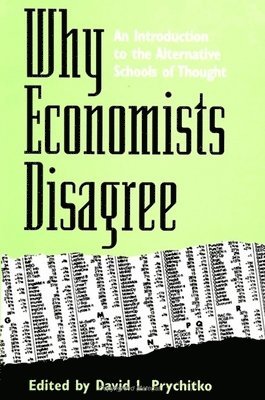
    Why Economists Disagree

    An Introduction to the Alternative Schools of Thought

    AvDavid L. Prychitko

    Häftad, Engelska, 1997

    Del i serien SUNY series, Diversity in Contemporary Economics

    436 kr

    Tillfälligt slut

    Beskrivning

    Provides a convenient introduction to heterodox alternatives to neoclassical economics.Economists disagree. They disagree over policy, prediction, and matters of pure theory. They even disagree over why they disagree. Why Economists Disagree demonstrates that the "crisis" of contemporary economics may actually be a sign of healthy disagreement and fresh thinking over the nature and scope of economic theory and policy.Since the 1980s, several dissenting schools of thought have emerged that offer serious methodological and theoretical challenges to mainstream economics. Why Economists Disagree provides a convenient introduction to Austrian, Post Keynesian, Institutionalist, Feminist, Marxist, and other heterodox alternatives to neoclassical economics. Written by eminent economists within each tradition, the book's chapters convey both the main characteristics, the controversies, and disagreement within each school of thought.Contributors include Jack Amariglio, Paul Davidson, William M. Dugger, Alfred S. Eichner, Roger W. Garrison, Albert O. Hirschman, Geoffrey M. Hodgson, Israel M. Kirzner, Arjo Klamer, J.A. Kregel, Ludwig M. Lachmann, Tony Lawson, Deirdre McCloskey, David F. Ruccio, Warren J. Samuels, Howard J. Sherman, William R. Waters, Thomas E. Weisskopf, and Frances R. Woolley.

    Produktinformation

    • Utgivningsdatum:1997-12-04
    • Mått:152 x 229 x 21 mm
    • Vikt:553 g
    • Format:Häftad
    • Språk:Engelska
    • Serie:SUNY series, Diversity in Contemporary Economics
    • Antal sidor:415
    • Förlag:State University of New York Press
    • ISBN:9780791435700

    Utforska kategorier

    • Nationalekonomi inom Ekonomi och Ledarskap

    Mer om författaren

    David L. Prychitko is Associate Professor, Department of Economics, Northern Michigan University. He is the author of Marxism and Workers' Self-Management: The Essential Tension. In addition, he edited Individuals, Institutions, Interpretations: Hermeneutics Applied to Economics; Producer Cooperatives and Labor-Managed Systems Vol. I: Theory and Vol. II: Case Studies (both with Jaroslav Vanek); and The Market Process: Essays in Contemporary Austrian Economics (with Peter J. Boettke).

    Recensioner i media

    "This book is an argument by counterexample. Following Friedman, Thurow, and others, most economists deny that substantial disagreement exists within the profession. Prychitko shows this simply isn't so. Economists do disagree, and they disagree over theory. By way of proof, the book presents a selection of heterodox articles." — Roger Koppl, Fairleigh Dickinson University

    Innehållsförteckning

    • Acknowledgments Introduction: Why Economists Disagree: The Role of the Alternative Schools of ThoughtDavid L. Prychitko Part I. Austrian Economics and the Market Process 1. Time and Money: The Universals of Macroeconomic TheorizingRoger W. Garrison 2. The Driving Force of the Market: The Idea of "Competition" in Contemporary Economic Theory and in the Austrian Theory of the Market ProcessIsrael M. Kirzner 3. From Mises to Shackle: An Essay on Austrian Economics and the Kaleidic SocietyLudwig M. Lachmann Part II. Post-Keynesian Economics for an Uncertain World 4. Reviving Keynes's RevolutionPaul Davidson 5. An Essay on Post-Keynesian Theory: A New Paradigm on EconomicsAlfred S. Eichner and J.A. Kregel 6. The Nature of Post Keynesianism and Its Links to Other TraditionsTony Lawson Part III. Beyond the Market: Social and Institutional Economics 7. Institutional Economic Theory: The Old Versus the NewGeoffrey M. Hodgson 8. Social Economics: A Solidarist PerspectiveWilliam R. Waters 9. Comparison of Marxism and InstitutionalismWilliam M. Dugger and Howard J. Sherman Part IV. The Changing Face of Radical Political Economy 10. Postmodernism, Marxism, and the Critique of Modern Economic ThoughtJack Amariglio and David F. Ruccio 11. Toward a Socialism for the Future, in the Wake of the Demise of the Socialism of the PastThomas E. Weisskopf Part V. Where Do We Go From Here? New Philosophical Issues 12. The Feminist Challenge to Neoclassical EconomicsFrances R. Woolley 13. Against Parsimony: Three Ways of Complicating Some Categories of Economic DiscourseAlbert O. Hirschman 14. The Methodology of Economics and the Case for Policy Diffidence and RestraintWarren J. Samuels 15. The Rhetoric of DisagreementArjo Klamer and Deirdre McCloskey Further Readings in the Alternative Schools of Thought: A Bibliographic EssayDavid L. Prychitko Contributors Index