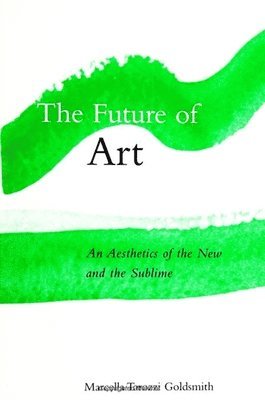
Future of Art
An Aesthetics of the New and the Sublime
Del i serien SUNY series in Aesthetics and the Philosophy of Art
405 kr
Tillfälligt slut
Du är på sajten för privatpersoner.
Del i serien SUNY series in Aesthetics and the Philosophy of Art
405 kr
Tillfälligt slut
Marcella Tarozzi Goldsmith , an independent scholar, is the author of Nonrepresentational Forms of the Comic: Humor, Irony, and Jokes.
"The originality of this work, its broad scope, and the author's familiarity with the work of contemporary European and American aestheticians and philosophers make this work a valuable asset to those interested in aesthetics." — symplokeu"I like the introduction of the idea of the sublime as a crucial factor in art, which then allows the author to criticize Nietzsche's nihilism. The book has the courage to object to several 'politically correct' views of art: art as purely subjective, art as style, art as valueless and thus part of the nihilist movement." — Wilfried Ver Eecke, Georgetown University"The author knowledgeably discusses an extremely wide range both of aesthetic theories spanning continental and 'analytic' traditions and of art works from antiquity to the most recent postmodern experiments. She addresses many of the most important issues in aesthetic theory and she writes with consummate style. Although the literature in aesthetics is vast, Goldsmith's book manages to address a wider array of aesthetic theory than other contemporary accounts." — Richard Dien Winfield, author of Stylistics: Rethinking the Artforms After Hegel
Du är på sajten för privatpersoner.
Del i serien SUNY series in Aesthetics and the Philosophy of Art
405 kr
Tillfälligt slut
Marcella Tarozzi Goldsmith , an independent scholar, is the author of Nonrepresentational Forms of the Comic: Humor, Irony, and Jokes.
"The originality of this work, its broad scope, and the author's familiarity with the work of contemporary European and American aestheticians and philosophers make this work a valuable asset to those interested in aesthetics." — symplokeu"I like the introduction of the idea of the sublime as a crucial factor in art, which then allows the author to criticize Nietzsche's nihilism. The book has the courage to object to several 'politically correct' views of art: art as purely subjective, art as style, art as valueless and thus part of the nihilist movement." — Wilfried Ver Eecke, Georgetown University"The author knowledgeably discusses an extremely wide range both of aesthetic theories spanning continental and 'analytic' traditions and of art works from antiquity to the most recent postmodern experiments. She addresses many of the most important issues in aesthetic theory and she writes with consummate style. Although the literature in aesthetics is vast, Goldsmith's book manages to address a wider array of aesthetic theory than other contemporary accounts." — Richard Dien Winfield, author of Stylistics: Rethinking the Artforms After Hegel