• Fri frakt över 249 kr
  • •
  • Snabba leveranser
  • •
  • Billiga böcker
Kundservice

Du är på sajten för privatpersoner.

Företag, bibliotek eller offentlig verksamhet?

Du handlar på classic.bokus.com, där alla dina funktioner finns intakta.
Till classic.bokus.com
Bokus logotyp. Gå till startsidan.
  • Erbjudanden
  • Nyheter
  • Student
  • Topplistor
  • Barn & ungdom
  • Bokus Play
  • E-böcker
  • Pocketböcker
  • Spel & pussel

10% rabatt på allt med kod: NYSTART10 →

Sidfot

Mina sidor

    Hjälp

    • Kundservice
    • Vanliga frågor och svar
    • Frakt och leverans
    • Retur vid ångerrätt
    • Reklamera vara
    • Betalning
    • Köpvillkor
    • Allmänna villkor
    • Information om webbplatsens tillgänglighet

    Om Bokus

    • Om oss
    • Pressrum
    • För studenter
    • För företag
    • För bibliotek och offentlig verksamhet
    • För leverantörer
    • Hållbarhet

    Populärt

    • Aktuella erbjudanden
    • Presentkort
    • Studentlitteratur
    • Nya böcker
    • Topplistor
    • Signerade böcker
    • Engelska böcker

    Inspiration

    • Boktips
    • BookTok
    • Populära bokserier
    • Barnbokskaraktärer
    • Populära författare
    Logotyp för Bokus
    Följ oss på Facebook (extern länk)Följ oss på Instagram (extern länk)Följ oss på YouTube (extern länk)Följ oss på TikTok (extern länk)
    bokus @ CookiesAnpassa cookiesIntegritetspolicyKöpvillkor
    Till Citymail hemsida (extern länk)Till Budbee hemsida (extern länk)Till Postnord hemsida (extern länk)Till Schenker hemsida (extern länk)Till Early Bird hemsida (extern länk)Till Walleys hemsida (extern länk)
    1. Samhälle och politik
    2. Sociologi och antropologi

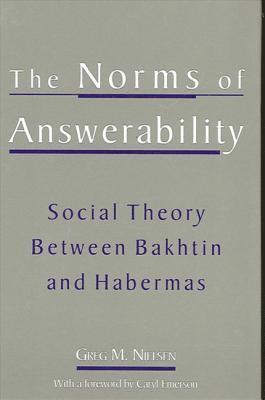
    Norms of Answerability

    Social Theory Between Bakhtin and Habermas

    AvGreg M. Nielsen

    Inbunden, Engelska, 2002

    1 079 kr

    Tillfälligt slut

    Fler format och utgåvor

    Häftad

    Tillf. slut

    Beskrivning

    Explores the relevance of Bakhtin's thought to social theory.Greg M. Nielsen brings Mikhail Bakhtin's ethics and aesthetics into a dialogue with social theory that responds to the sense of ambivalence and uncertainty at the core of modern societies. Nielsen situates a social theory between Bakhtin's norms of answerability and Jürgen Habermas's sociology, ethics, and discourse theory of democracy in a way that emphasizes the creative dimension in social action without reducing explanation to the emotional and volitional impulse of the individual or collective actor. Some of the classical sources that support this mediated position are traced to Alexander Vvedenskij's and Georg Simmel's critiques of Kant's ethics, Hermann Cohen's philosophy of fellowship, and Max Weber's and George Herbert Mead's theories of action. In the shift from Bakhtin's theory of interpersonal relations to a dialogic theory of societal events that defends the bold claim that law and politics should not be completely separated from the specificity of ethical and cultural communities, a study of citizenship and national identity is developed.

    Produktinformation

    • Utgivningsdatum:2002-01-24
    • Mått:153 x 229 x 14 mm
    • Vikt:481 g
    • Format:Inbunden
    • Språk:Engelska
    • Antal sidor:272
    • Förlag:State University of New York Press
    • Medarbetare:Caryl Emerson
    • ISBN:9780791452271

    Utforska kategorier

    • Sociologi och antropologi inom Samhälle och politik

    Mer om författaren

    Greg M. Nielsen is Associate Professor of Sociology at Concordia University and Adjunct Professor in the Graduate Programme in Social and Political Thought at York University. He is also the author of Le Canada de Radio-Canada: Sociologie Critique et Dialogisme Culturel.

    Recensioner i media

    "Bakhtin is a hot topic, and the Bakhtin scholarship behind this book is first rate. This book also makes an original contribution to discussions on post-national democracy." — Brian C. J. Singer, author of Society, Theory, and the French Revolution: Studies in the Revolutionary Imaginary"I think the author's use of Bakhtin's dialogism in order to provide a basis for negotiating between the extremes of ethnos and demos is an original and intellectually important contribution to social-political philosophy in an age that recognizes diversity as a major resource and problem for society." — Fred Evans, author of Psychology and Nihilism: A Genealogical Critique of the Computational Model of Mind

    Innehållsförteckning

    • Foreword Acknowledgments Introduction: Theory on the Borders of Sociology Syncrisis and Anacrisis: The State of Bakhtin StudiesCreativity and General Sociological TheoryThe Bridge between Culture and the Political 1. Diversity and Transcultural Ethics Disciplinary OrientationsDecentered Subjects and Critiques of Discourse EthicsThe Creative Side of the NormativeThe Normative Side of CreativityBetween the Creativity and the Normativity of the Act 2. Communicative Action or Dialogue? Communicative Action and Moral DevelopmentThe Limits of Universal ReasonDialogism: Mixing the Word and Style 3. The World of Other's Words Bakhtin and Voloshinov on the Subject of the UtteranceSocial and Ethical Worlds of Dialogue in DostoevskyThe Frankfurt TraditionHabermas's BreakGenres of Discourse in Literature and in TheoryFrom Dostoevsky to CalvinoConvergence and Difference 4. On the Sources of Young Bakhtin's Ethics (Kant, Vvedenskij, Simmel, Cohen ) Kant's Three PostulatesVvedenskij's Fourth PostulateSimmel's ShadowBakhtin and the Formal OughtCohen's "Discovery of Man as Fellowman"Influences and Steps 5. Action and Eros (Kant-Weber-Bakhtin ) Kant: Duties Toward the Body Concerning the Sexual ImpulseWeber: Action, Ethics, and ErosBakhtin: The Fourth Postulate and Body-DialogueEros and Action Today 6. Reflexive Subjectivity (Mead-Bakhtin) Philosophical and Disciplinary OrientationsBetween Consciousness and Language: The Ambiguity of ExperienceMurder, Confession, and CommunityWhy the Subject Is Behind UsAction Inside and Outside the Subject 7. Citizenship and National Identity On the Dialogue Between Ethnos and DemosIdentityFor and against the Nation 8. A Dialogue on the Nation in Postnational Time The Nation as a Sociology of Culture: The Quebec CaseHabermas: The Nation as Subjectless CommunicationTaylor: The Nation as a Politics of ConcessionKymlicka: On National MinoritiesAssociational Sovereignty: Fourth Way? 9. Conclusion: On Culture and the Political Notes Bibliography Index