• Fri frakt över 249 kr
  • •
  • Snabba leveranser
  • •
  • Billiga böcker
Kundservice

Du är på sajten för privatpersoner.

Företag, bibliotek eller offentlig verksamhet?

Du handlar på classic.bokus.com, där alla dina funktioner finns intakta.
Till classic.bokus.com
Bokus logotyp. Gå till startsidan.
  • Erbjudanden
  • Nyheter
  • Student
  • Topplistor
  • Barn & ungdom
  • Bokus Play
  • E-böcker
  • Pocketböcker
  • Spel & pussel

10% rabatt på allt med kod: NYSTART10 →

Sidfot

Mina sidor

    Hjälp

    • Kundservice
    • Vanliga frågor och svar
    • Frakt och leverans
    • Retur vid ångerrätt
    • Reklamera vara
    • Betalning
    • Köpvillkor
    • Allmänna villkor
    • Information om webbplatsens tillgänglighet

    Om Bokus

    • Om oss
    • Pressrum
    • För studenter
    • För företag
    • För bibliotek och offentlig verksamhet
    • För leverantörer
    • Hållbarhet

    Populärt

    • Aktuella erbjudanden
    • Presentkort
    • Studentlitteratur
    • Nya böcker
    • Topplistor
    • Signerade böcker
    • Engelska böcker

    Inspiration

    • Boktips
    • BookTok
    • Populära bokserier
    • Barnbokskaraktärer
    • Populära författare
    Logotyp för Bokus
    Följ oss på Facebook (extern länk)Följ oss på Instagram (extern länk)Följ oss på YouTube (extern länk)Följ oss på TikTok (extern länk)
    bokus @ CookiesAnpassa cookiesIntegritetspolicyKöpvillkor
    Till Citymail hemsida (extern länk)Till Budbee hemsida (extern länk)Till Postnord hemsida (extern länk)Till Schenker hemsida (extern länk)Till Early Bird hemsida (extern länk)Till Walleys hemsida (extern länk)
    1. Medicin
    2. Andra medicinska specialiteter
    3. Olycksfalls- och akutmedicin

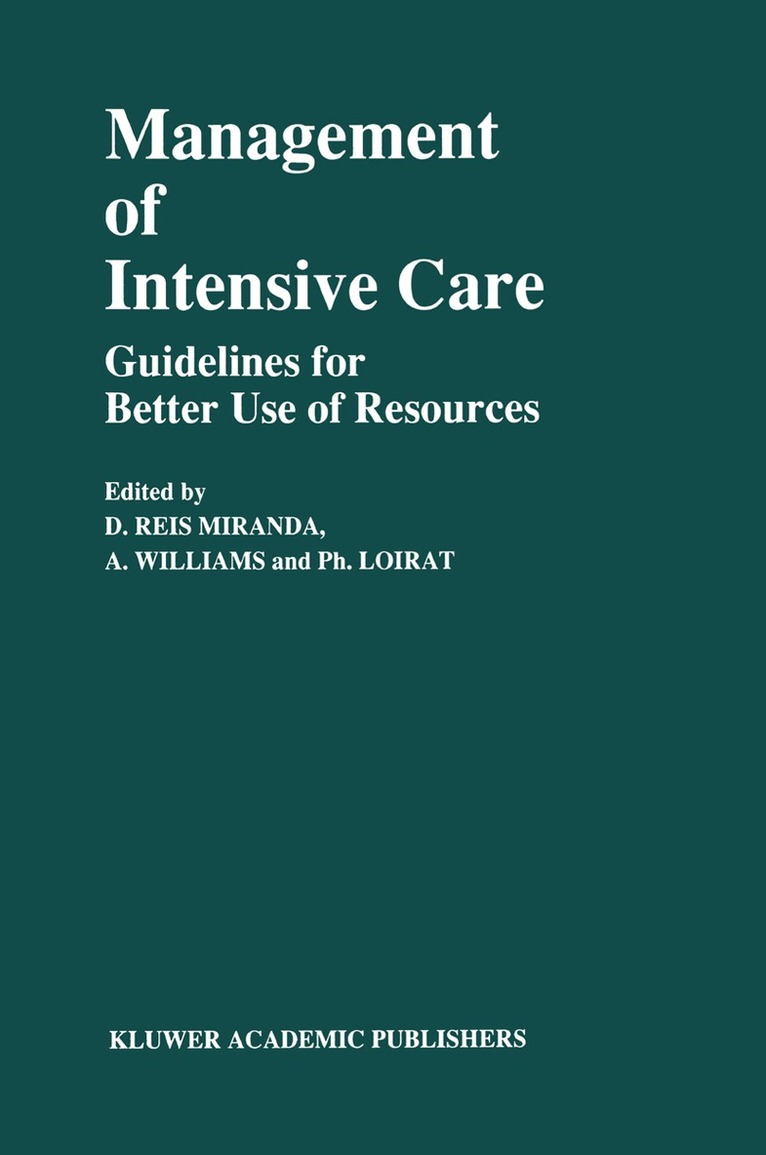
    Management of Intensive Care

    Guidelines for Better Use of Resources

    AvD. Reis Miranda,A. Williams

    Inbunden, Engelska, 1990

    Del i serien Developments in Critical Care Medicine and Anaesthesiology

    2 229 kr

    Beställningsvara. Skickas inom 10-15 vardagar. Fri frakt över 249 kr.

    Beskrivning

    Intensive Care Medicine has been continuously growing and expanding, culturally, technically and geographically. Monitoring and instrumentation are continuously improving and more and more hospitals are getting Intensive Care facilities. The costs have proportionally increased over the years, so that ICUs represent today a major cost for health structures. Since the available resources are limited, a real need is emerging to set the limits and indications of Intensive Care. It is understood that the problem not only involves medical considerations, but also ethical and economical aspects of the utmost importance. For the first time in Europe, this book edited by Reis Miranda and his colleagues tackles systematically the many structural aspects of the European Intensive Care. The organisation and financing of health care in the Old Continent is deeply different from the American one, and the results and consequent proposals obtained in the USA cannot simply be transferred to this side of the Atlantic Ocean. Weare extremely pleased to welcome this first European attempt to discuss the Intensive Care problem. It lays no claims to giving definite replies in a continuously developing field, but it will surely become the basis for future discussions and proposals. I am particularly happy that this work has mainly developed within the European Society of Intensive Care, whose final target is to ensure a common standard of therapy in our old Europe, beyond national differences. We warmly congratulate the authors, and I am sure that their work will find wide diffusion and consent.

    Produktinformation

    • Utgivningsdatum:1990-05-31
    • Mått:156 x 234 x 23 mm
    • Vikt:572 g
    • Format:Inbunden
    • Språk:Engelska
    • Serie:Developments in Critical Care Medicine and Anaesthesiology
    • Antal sidor:246
    • Upplaga:1990
    • Förlag:Kluwer Academic Publishers
    • ISBN:9780792307549

    Utforska kategorier

    • Olycksfalls- och akutmedicin inom Medicin

    Innehållsförteckning

    • I: Introduction.- 1. Intensive Care Medicine.- 2. Guidelines for Intensive Care Medicine.- II: The Patients.- 1. Introduction.- 2. Measuring the type of patients.- 3. Measuring the previous health status and the severity of illness.- 4. Measuring the workload.- 5. Measuring the evolution of severity of illness.- 6. Stratification of patient related data.- References.- Tables.- III: The Facilities.- 1. Introduction.- 2. ICUs in Europe: The great diversity.- 3. The type and size of Intensive Care facilities.- 4. General standard for ICUs.- 5. Staffing.- 6. Comparing facilities.- Addendum I.- Addendum II.- Addendum III.- Addendum IV.- References.- IV: National and Regional Organisation.- 1. Introduction.- 2. Estimating the total number of ICU beds required.- 3. Factors influencing regional planning.- 4. Levels of care.- 5. Calculating manpower needs.- 6. Conclusions.- References.- V: Management Control in the ICU.- 1. Planning and control.- 2. The ICU: Expense or responsibility centre?.- 3. Performance criteria.- 4. Incentives and constraints of ICU performance.- 5. Conclusions.- References.- VI: Education and Training.- 1. Introduction.- 2. The actual education and training of Intensive Care Medicine.- 3. General recommendations.- 4. Conclusions.- Addendum I. Present situation in European countries.- Addendum II. Basic education.- Addendum III. Special education.- Addendum IV. Catalogue of skills for special Intensive Care Medicine training.- Addendum V. General Intensive Care nursing for registered general nurses.- Addendum VI. Special Intensive Care training for nurses in West-Germany.- VII: Evaluation in Intensive Care.- 1. What should or could be evaluated.- 2. Who should evaluate?.- 3 Intensivists should try to adopt common definitions and classifications.- 4. Evaluation studies must have a proper scientific design.- 5. The proper judgement criteria must be employed.- 6. Long term evaluation of Intensive Care: Health status and quality of life.- 7. Economic evaluation of intensive care utilisation.- References.- Table 1. Data for Evaluation of ICM.- Table 2. Components of the Activity of Daily Living.- Table 3. Elements of the Sickness Impact Profile.- Table 4. Components of the Quality of Well Being.- Table 5. Components of the Perceived Quality of Life Index.- Table 6. Costs and Benefits of Intensive Care.- Table 7. Cost Accounting in the ICU.- VIII: Epilogue.- 1. Introduction.- 2. Quantification.- 3. Regionalisation.- 4. Professionalisation.- 5. Levels of responsibility.- 6. Intensive Care Medicine societies.- 7. Concluding comments.- Directory of Intensive Care Organisations.- Subject Index and Abbreviations.- Nigel Turner.