• Fri frakt över 249 kr
  • •
  • Snabba leveranser
  • •
  • Billiga böcker
Kundservice

Du är på sajten för privatpersoner.

Företag, bibliotek eller offentlig verksamhet?

Du handlar på classic.bokus.com, där alla dina funktioner finns intakta.
Till classic.bokus.com
Bokus logotyp. Gå till startsidan.
  • Erbjudanden
  • Nyheter
  • Student
  • Topplistor
  • Barn & ungdom
  • Bokus Play
  • E-böcker
  • Pocketböcker
  • Spel & pussel

10% rabatt på allt med kod: NYSTART10 →

Sidfot

Mina sidor

    Hjälp

    • Kundservice
    • Vanliga frågor och svar
    • Frakt och leverans
    • Retur vid ångerrätt
    • Reklamera vara
    • Betalning
    • Köpvillkor
    • Allmänna villkor
    • Information om webbplatsens tillgänglighet

    Om Bokus

    • Om oss
    • Pressrum
    • För studenter
    • För företag
    • För bibliotek och offentlig verksamhet
    • För leverantörer
    • Hållbarhet

    Populärt

    • Aktuella erbjudanden
    • Presentkort
    • Studentlitteratur
    • Nya böcker
    • Topplistor
    • Signerade böcker
    • Engelska böcker

    Inspiration

    • Boktips
    • BookTok
    • Populära bokserier
    • Barnbokskaraktärer
    • Populära författare
    Logotyp för Bokus
    Följ oss på Facebook (extern länk)Följ oss på Instagram (extern länk)Följ oss på YouTube (extern länk)Följ oss på TikTok (extern länk)
    bokus @ CookiesAnpassa cookiesIntegritetspolicyKöpvillkor
    Till Citymail hemsida (extern länk)Till Budbee hemsida (extern länk)Till Postnord hemsida (extern länk)Till Schenker hemsida (extern länk)Till Early Bird hemsida (extern länk)Till Walleys hemsida (extern länk)
    1. Medicin
    2. Klinisk medicin och internmedicin
    3. Oftalmologi

    History of Ophthalmology

    Sub auspiciis Academiae Ophthalmologicae Internationalis

    Häftad, Engelska, 1990

    Del 3 i serien History of Ophthalmology

    563 kr

    Beställningsvara. Skickas inom 10-15 vardagar. Fri frakt över 249 kr.

    Beskrivning

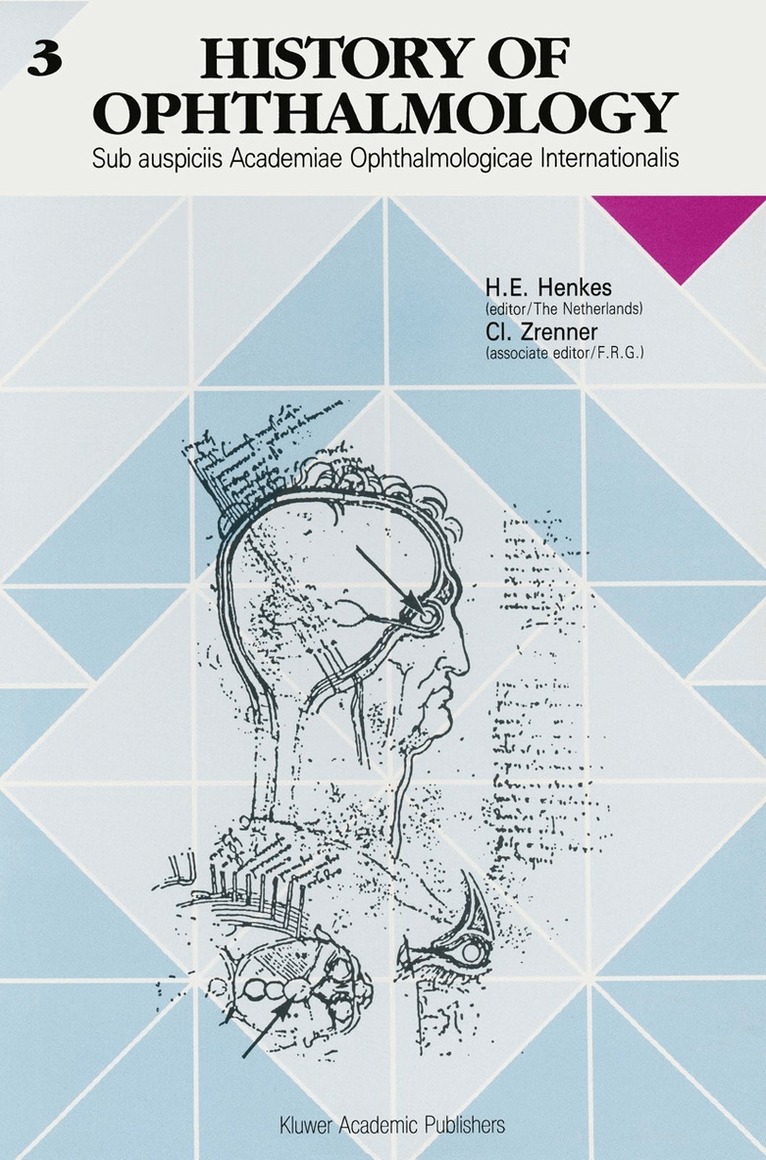
    When the eyeball is indented in total darkness, within less than 200 mil­ liseconds an oval or quarter-moon shaped spot of light is perceived in the part of the visual field corresponding to the indented region of the retina. In the seconds following, this phosphene extends across the whole visual field and alters in structure during further eyeball indentation. It is then seen as irregular large bright spots of light, finely structured moving light grains ('light nebula') and stationary bright stars. Regular geometrical patterns appear only when both eyes are indented simultaneously [1]. When the eyeball deformation is released, part of the retina again lights up for another one or two seconds and curved light lines are seen following the course of the larger retinal vessels (Fig. 1). In the following we will review the history of this phenomenon, which played an important role during the first 2200 years of vision theories and in the development of models to explain normal vision. 2. Pre-Socratic philosophers, Plato and Aristotle Alcmaeon of Croton (6-5th century B. C. ), who was a member of the Pythagoraean sect and one of the founders of Greek medicine, was the first to describe mechanical deformation of the eyeball leading to light sensa­ tions. According to Aristotle's pupil Theophrast of Eresos, Alcmaeon report­ ed that 'the eye obviously has fire within,for when the eye is struckfireflashes out' [2, p. 88].

    Produktinformation

    • Utgivningsdatum:1990-06-30
    • Mått:155 x 235 x 9 mm
    • Vikt:254 g
    • Format:Häftad
    • Språk:Engelska
    • Serie:History of Ophthalmology
    • Antal sidor:150
    • Förlag:Kluwer Academic Publishers
    • ISBN:9780792308263

    Utforska kategorier

    • Oftalmologi inom Medicin

    Innehållsförteckning

    • Osler and ophthalmology.- Life, eye disease and work of Joseph Plateau.- The ophthalmology of Fabricius Hildanus in the 17th century.- Ophthalmological ideas of the Byzantine author Meletius.- Ophthalmology according to Aetius Amidenus.- Father Waclaw Szuniewicz, M.D., an ophthalmologist of unusual courage and devotion.- On the history of deformation phosphenes and the idea of internal light generated in the eye for the purpose of vision.- Antonie Cramer’s explanation of accommodation.- 19th Century mechanical models of eye movements, Donders’ law, Listing’s law and Helmholtz’ direction circles.- Ocular manifestations during the French travels of discovery to Australia from Lapérouse (1741–1788) to Dumont D’Urville (1790–1842).- The blind Belisar as beggar.- Eye references in the Homeric Epics.- Eye votives in the Asklepieion of ancient Corinth.- King Sivi and Doctor Sil.