• Fri frakt över 249 kr
  • •
  • Snabba leveranser
  • •
  • Billiga böcker
Kundservice

Du är på sajten för privatpersoner.

Företag, bibliotek eller offentlig verksamhet?

Du handlar på classic.bokus.com, där alla dina funktioner finns intakta.
Till classic.bokus.com
Bokus logotyp. Gå till startsidan.
  • Erbjudanden
  • Nyheter
  • Student
  • Topplistor
  • Barn & ungdom
  • Bokus Play
  • E-böcker
  • Pocketböcker
  • Spel & pussel

10% rabatt på allt med kod: NYSTART10 →

Sidfot

Mina sidor

    Hjälp

    • Kundservice
    • Vanliga frågor och svar
    • Frakt och leverans
    • Retur vid ångerrätt
    • Reklamera vara
    • Betalning
    • Köpvillkor
    • Allmänna villkor
    • Information om webbplatsens tillgänglighet

    Om Bokus

    • Om oss
    • Pressrum
    • För studenter
    • För företag
    • För bibliotek och offentlig verksamhet
    • För leverantörer
    • Hållbarhet

    Populärt

    • Aktuella erbjudanden
    • Presentkort
    • Studentlitteratur
    • Nya böcker
    • Topplistor
    • Signerade böcker
    • Engelska böcker

    Inspiration

    • Boktips
    • BookTok
    • Populära bokserier
    • Barnbokskaraktärer
    • Populära författare
    Logotyp för Bokus
    Följ oss på Facebook (extern länk)Följ oss på Instagram (extern länk)Följ oss på YouTube (extern länk)Följ oss på TikTok (extern länk)
    bokus @ CookiesAnpassa cookiesIntegritetspolicyKöpvillkor
    Till Citymail hemsida (extern länk)Till Budbee hemsida (extern länk)Till Postnord hemsida (extern länk)Till Schenker hemsida (extern länk)Till Early Bird hemsida (extern länk)Till Walleys hemsida (extern länk)
    1. Naturvetenskap och teknik
    2. Matematik och naturvetenskap
    3. Kemi
    4. Fysikalisk kemi

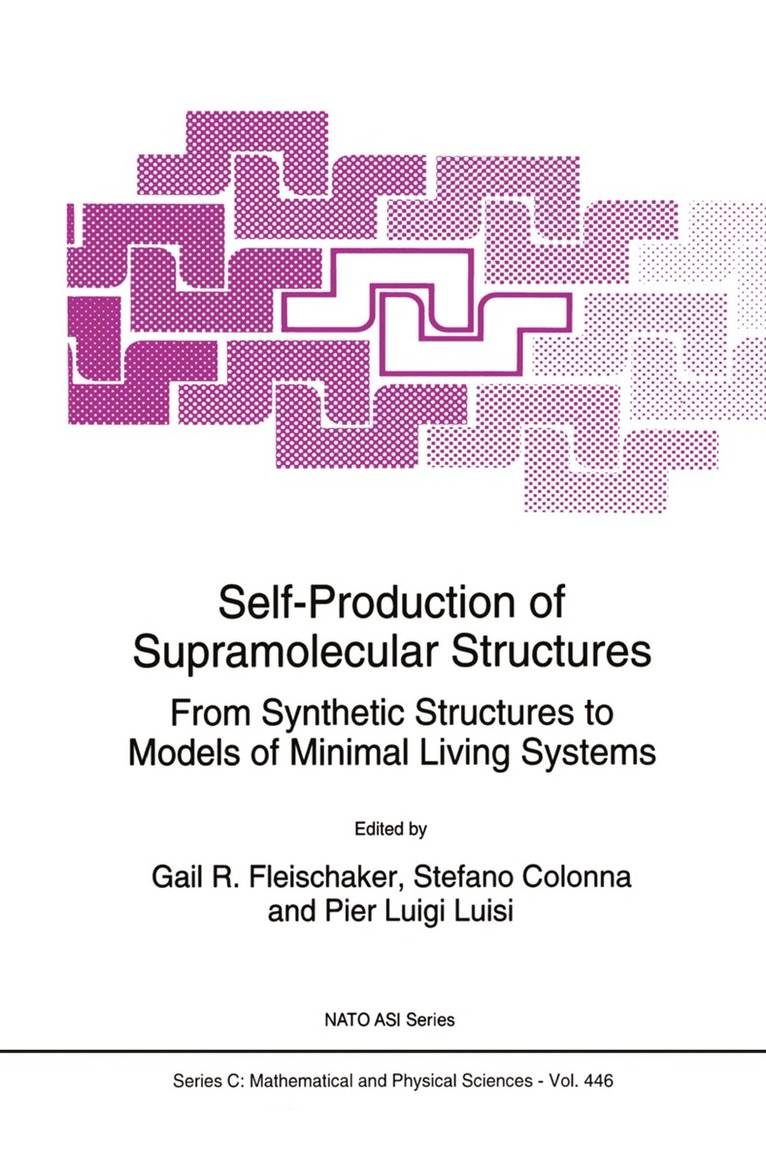
    Self-Production of Supramolecular Structures

    From Synthetic Structures to Models of Minimal Living Systems

    AvGail R. Fleischaker,S. Colonna

    Inbunden, Engelska, 1994

    Del i serien Nato Science Series C:

    1 625 kr

    Beställningsvara. Skickas inom 10-15 vardagar. Fri frakt över 249 kr.

    Beskrivning

    How did life begin on the Earth? The units of life are cells, which can be defined as bounded systems of molecules that capture energy and nutrients from the environment -- systems that expand, reproduce, and evolve over time, often into more complex systems. This book is the proceedings of a unique meeting, sponsored by NATO and held in Maratea, Italy, that brought together for the first time an international group of investigators who share an interest in how molecules self-assemble into supramolecular structures, and how those structures may have contributed to the origin of life. The book is written at a moderately technical level, appropriate for use by researchers and by students in upper-level undergraduate and graduate courses in biochemistry and molecular biology. The overall interest of its subject matter provides an excellent introduction for students who wish to understand how the foundational knowledge of chemistry and physics can be applied to one of the most fundamental questions now facing the scientific community. The editors are pioneers in defining what we mean by the living state, particularly the manner in which simple molecular systems can assume complex associations and functions, including the ability to reproduce. Each chapter of the book presents an up-to-date report of highly significant research. Two of the authors received medals from the National Academy of Science USA in 1994, and other research reported in the book has been featured in internationally recognized journals such Scientific American, Time, and Discover.

    Produktinformation

    • Utgivningsdatum:1994-10-31
    • Mått:170 x 244 x 23 mm
    • Vikt:676 g
    • Format:Inbunden
    • Språk:Engelska
    • Serie:Nato Science Series C:
    • Antal sidor:317
    • Upplaga:1994
    • Förlag:Kluwer Academic Publishers
    • ISBN:9780792331636

    Utforska kategorier

    • Fysikalisk kemi inom Naturvetenskap och teknik
    • Organisk kemi inom Naturvetenskap och teknik

    Innehållsförteckning

    • Historical and Philosophical Perspectives.- Historical overview to the quest of self-reproduction and artificial life.- On defining life.- A few precautionary words concerning terminology.- Template Chemistry.- Molecular replication: From minimal to complex systems.- Self-replication and reproduction: From molecules to protocells.- Extrabiotic replication and self-assembly.- The prebiotic synthesis and replication of RNA oligomers: The transition from prebiotic molecules to the RNA world.- Template-directed synthesis of oligomers: Kinetic vs. thermodynamic control.- Chirality and Replication.- Chirality and the first self-replicating molecules.- Are peptides possible support for self-amplification of sequence information?.- The RNA World.- Minimonsters: Evolutionary by-products of in vitro RNA amplification.- Models for the autocatalytic replication of RNA.- RNA species that multiply indefinitely with RNA polymerase.- Chemical oscillations and non-linear chemical kinetics.- The Cell View and Cell Models.- The chemical implementation of autopoiesis.- Molecular recognition in micelles.- Self-reproducing vesicles.- Sources and syntheses of prebiotic amphiphiles.- Ancient paralogous duplications and the search for Archean cells.- Posters.- Self-replication of oligonucleotides in reverse micelles.- Liposomes from lipidonucleotides and from lipidopeptides.- Dendritic luminescent and redox-active supermolecules made of transition metal complexes.- Layer-by-layer adsorption: The solid/liquid-interface as a template for the controlled growth of well-defined nanostructures of polyelectrolytes, proteins, DNA and polynucleotides.- Molecular recognition of amino acids by RNA.- Towards nature’s structural guidelines: Conclusions on the unsolved structures of RNA-dependent RNApolymerases.- A self-catalyzed (autopoietic) synthesis of an anionic surfactant: Experimental evidence and theoretical modeling.- Competition, reciprocity, and mutation at the molecular level: Irradiation of a synthetic replicator generates a superior species.- Giant vesicles.