• Fri frakt över 249 kr
  • •
  • Snabba leveranser
  • •
  • Billiga böcker
Kundservice

Du är på sajten för privatpersoner.

Företag, bibliotek eller offentlig verksamhet?

Du handlar på classic.bokus.com, där alla dina funktioner finns intakta.
Till classic.bokus.com
Bokus logotyp. Gå till startsidan.
  • Erbjudanden
  • Nyheter
  • Student
  • Topplistor
  • Barn & ungdom
  • Bokus Play
  • E-böcker
  • Pocketböcker
  • Spel & pussel

10% rabatt på allt med kod NYSTART10 →

Sidfot

Mina sidor

    Hjälp

    • Kundservice
    • Vanliga frågor och svar
    • Frakt och leverans
    • Retur vid ångerrätt
    • Reklamera vara
    • Betalning
    • Köpvillkor
    • Allmänna villkor
    • Information om webbplatsens tillgänglighet

    Om Bokus

    • Om oss
    • Pressrum
    • För studenter
    • För företag
    • För bibliotek och offentlig verksamhet
    • För leverantörer
    • Hållbarhet

    Populärt

    • Aktuella erbjudanden
    • Presentkort
    • Studentlitteratur
    • Nya böcker
    • Topplistor
    • Signerade böcker
    • Engelska böcker

    Inspiration

    • Boktips
    • BookTok
    • Populära bokserier
    • Barnbokskaraktärer
    • Populära författare
    Logotyp för Bokus
    Följ oss på Facebook (extern länk)Följ oss på Instagram (extern länk)Följ oss på YouTube (extern länk)Följ oss på TikTok (extern länk)
    bokus @ CookiesAnpassa cookiesIntegritetspolicyKöpvillkor
    Till Citymail hemsida (extern länk)Till Budbee hemsida (extern länk)Till Postnord hemsida (extern länk)Till Schenker hemsida (extern länk)Till Early Bird hemsida (extern länk)Till Walleys hemsida (extern länk)
    1. Naturvetenskap och teknik
    2. Matematik och naturvetenskap
    3. Matematik
    4. Matematikens grunder

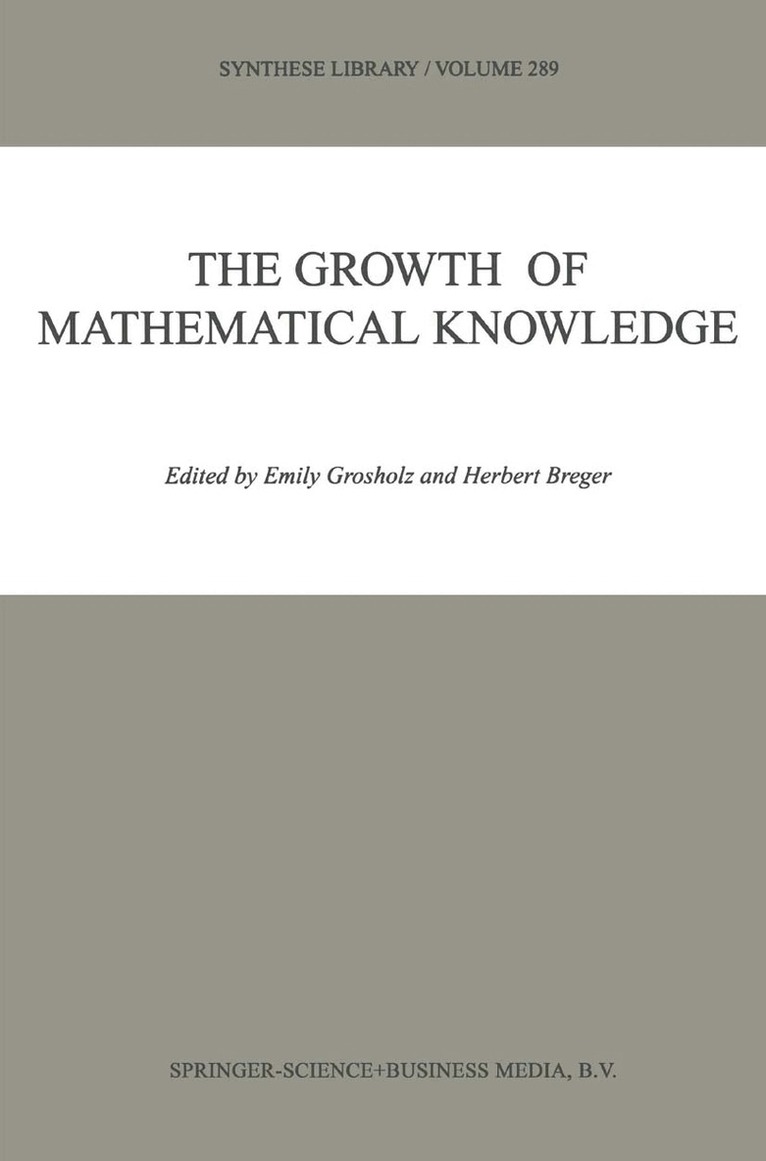
    Growth of Mathematical Knowledge

    AvEmily Grosholz,Herbert Breger

    Inbunden, Engelska, 2000

    Del i serien Synthese Library

    2 380 kr

    Beställningsvara. Skickas inom 10-15 vardagar. Fri frakt över 249 kr.

    Beskrivning

    Mathematics has stood as a bridge between the Humanities and the Sciences since the days of classical antiquity. For Plato, mathematics was evidence of Being in the midst of Becoming, garden variety evidence apparent even to small children and the unphilosophical, and therefore of the highest educational significance. In the great central similes of The Republic it is the touchstone ofintelligibility for discourse, and in the Timaeus it provides in an oddly literal sense the framework of nature, insuring the intelligibility ofthe material world. For Descartes, mathematical ideas had a clarity and distinctness akin to the idea of God, as the fifth of the Meditations makes especially clear. Cartesian mathematicals are constructions as well as objects envisioned by the soul; in the Principles, the work ofthe physicist who provides a quantified account ofthe machines of nature hovers between description and constitution. For Kant, mathematics reveals the possibility of universal and necessary knowledge that is neither the logical unpacking ofconcepts nor the record of perceptual experience. In the Critique ofPure Reason, mathematics is one of the transcendental instruments the human mind uses to apprehend nature, and by apprehending to construct it under the universal and necessary lawsofNewtonian mechanics.

    Produktinformation

    • Utgivningsdatum:2000-01-31
    • Mått:155 x 235 x 30 mm
    • Vikt:875 g
    • Format:Inbunden
    • Språk:Engelska
    • Serie:Synthese Library
    • Antal sidor:416
    • Upplaga:2000
    • Förlag:Kluwer Academic Publishers
    • ISBN:9780792361510

    Utforska kategorier

    • Matematikens grunder inom Naturvetenskap och teknik
    • Matematikens filosofi inom Naturvetenskap och teknik

    Recensioner i media

    'The print and paper are of highly quality. Overall it is a rich and thought-provoking contribution to a relatively undeveloped area of research. The philosophy of the growth of mathematical knowledge has few canonical texts as yet. This book may become one.' Philosophia Mathematica, 10:1 (2002)

    Innehållsförteckning

    • Knowledge of Functions in the Growth of Mathematical Knowledge.- Huygens and the Pendulum: From Device to Mathematical Relation.- An Empiricist Philosophy of Mathematics and Its Implications for the History of Mathematics.- The Mathematization of Chance in the Middle of the 17th Century.- Mathematical Empiricism and the Mathematization of Chance: Comment on Gillies and Schneider.- The Partial Unification of Domains, Hybrids, and the Growth of Mathematical Knowledge.- Hamilton-Jacobi Methods and Weierstrassian Field Theory in the Calculus of Variations.- On Mathematical Explanation.- Mathematics and the Reelaboration of Truths.- Penrose and Platonism.- On the Mathematics of Spilt Milk.- The Growth of Mathematical Knowledge: An Open World View.- Controversies about Numbers and Functions.- Epistemology, Ontology, and the Continuum.- Tacit Knowledge and Mathematical Progress.- The Quadrature of Parabolic Segments 1635–1658: A Response to Herbert Breger.- Mathematical Progress: Ariadne’s Thread.- Voir-Dire in the Case of Mathematical Progress.- The Nature of Progress in Mathematics: the Significance of Analogy.- Analogy and the Growth of Mathematical Knowledge.- Evolution of the Modes of Systematization of Mathematical Knowledge.- Geometry, the First Universal Language of Mathematics.- Mathematical Progress.- Some Remarks on Mathematical Progress from a Structuralist’s Perspective.- Scientific Progress and Changes in Hierarchies of Scientific Disciplines.- On the Progress of Mathematics.- Attractors of Mathematical Progress: the Complex Dynamics of Mathematical Research.- On Some Determinants of Mathematical Progress.