• Fri frakt över 249 kr
  • •
  • Snabba leveranser
  • •
  • Billiga böcker
Kundservice

Du är på sajten för privatpersoner.

Företag, bibliotek eller offentlig verksamhet?

Du handlar på classic.bokus.com, där alla dina funktioner finns intakta.
Till classic.bokus.com
Bokus logotyp. Gå till startsidan.
  • Erbjudanden
  • Student
  • Topplistor
  • Barn & ungdom
  • Bokus Play
  • E-böcker
  • Ljudböcker
  • Pocketböcker
  • Spel & pussel

Upp till 25% på utvalda nyheter →

Sidfot

Mina sidor

    Hjälp

    • Kundservice
    • Vanliga frågor och svar
    • Frakt och leverans
    • Retur vid ångerrätt
    • Reklamera vara
    • Betalning
    • Köpvillkor
    • Allmänna villkor
    • Information om webbplatsens tillgänglighet

    Om Bokus

    • Om oss
    • Pressrum
    • För studenter
    • För företag
    • För bibliotek och offentlig verksamhet
    • För leverantörer
    • Hållbarhet

    Populärt

    • Aktuella erbjudanden
    • Presentkort
    • Studentlitteratur
    • Nya böcker
    • Topplistor
    • Signerade böcker
    • Engelska böcker

    Inspiration

    • Boktips
    • BookTok
    • Populära bokserier
    • Barnbokskaraktärer
    • Populära författare
    Logotyp för Bokus
    Följ oss på Facebook (extern länk)Följ oss på Instagram (extern länk)Följ oss på YouTube (extern länk)Följ oss på TikTok (extern länk)
    bokus @ CookiesAnpassa cookiesIntegritetspolicyKöpvillkor
    Till Citymail hemsida (extern länk)Till Budbee hemsida (extern länk)Till Postnord hemsida (extern länk)Till Schenker hemsida (extern länk)Till Early Bird hemsida (extern länk)Till Walleys hemsida (extern länk)
    1. Data och IT
    2. Systemvetenskap och AI

    Qualitative Motion Understanding

    AvWilhelm Burger,Bir Bhanu

    Inbunden, Engelska, 1992

    Del 184 i serien Springer International Series in Engineering and Computer Science

    1 675 kr

    Beställningsvara. Skickas inom 10-15 vardagar. Fri frakt över 249 kr.

    Fler format och utgåvor

    Häftad

    1 626 kr

    Beskrivning

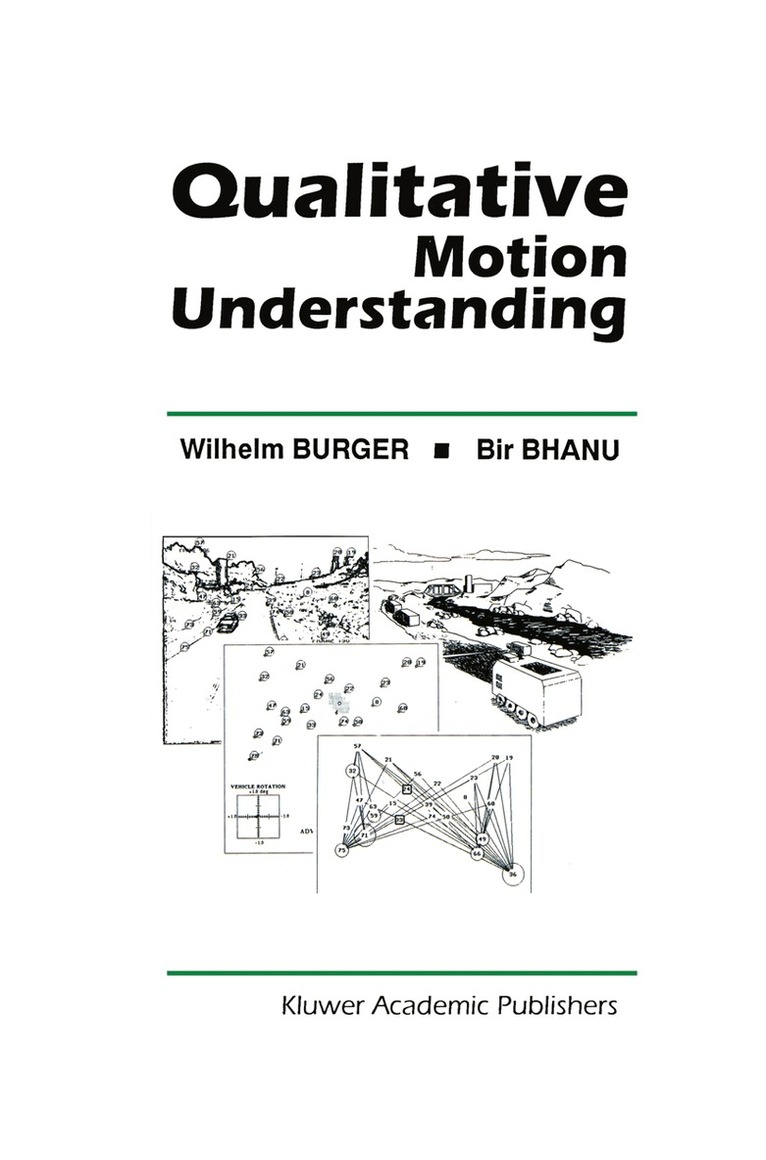
    Mobile robots operating in real-world, outdoor scenarios depend on dynamic scene understanding for detecting and avoiding obstacles, recognizing landmarks, acquiring models, and for detecting and tracking moving objects. Motion understanding has been an active research effort for more than a decade, searching for solutions to some of these problems; however, it still remains one of the more difficult and challenging areas of computer vision research. Qualitative Motion Understanding describes a qualitative approach to dynamic scene and motion analysis, called DRIVE (Dynamic Reasoning from Integrated Visual Evidence). The DRIVE system addresses the problems of (a) estimating the robot's egomotion, (b) reconstructing the observed 3-D scene structure; and (c) evaluating the motion of individual objects from a sequence of monocular images. The approach is based on the FOE (focus of expansion) concept, but it takes a somewhat unconventional route. The DRIVE system uses a qualitative scene model and a fuzzy focus of expansion to estimate robot motion from visual cues, to detect and track moving objects, and to construct and maintain a global dynamic reference model.

    Produktinformation

    • Utgivningsdatum:1992-06-30
    • Mått:155 x 235 x 17 mm
    • Vikt:506 g
    • Format:Inbunden
    • Språk:Engelska
    • Serie:Springer International Series in Engineering and Computer Science
    • Antal sidor:210
    • Upplaga:1992
    • Förlag:Kluwer Academic Publishers
    • ISBN:9780792392514

    Utforska kategorier

    • Systemvetenskap och AI inom Data och IT

    Innehållsförteckning

    • 1 Introduction.- 1.1 Aims of Motion Understanding.- 1.2 Autonomous Land Vehicle Navigation.- 1.3 Multi-Level Vision and Motion Analysis.- 1.4 Approaches to Motion Understanding.- 1.5 Outline of this Book.- 2 Framework for Qualitative Motion Understanding.- 2.1 Moving Through a Changing Environment.- 2.2 The “DRIVE” Approach.- 2.3 Low-Level Motion.- 2.4 Camera Motion and Scene Structure.- 2.5 Detecting 3-D Motion.- 2.6 Qualitative Modeling and Reasoning.- 3 Eli ECTS OF CAMERA MOTION.- 3.1 Viewing Geometry.- 3.2 Effects of Camera Rotation.- 3.3 Computing the Camera Rotation Angles.- 3.4 Effects of Camera Translation.- 3.5 Computing the Translation Parameters.- 4 Decomposing Image Motion.- 4.1 Motion Between Successive Frames.- 4.2 FOE from Rotations.- 4.3 Rotations from FOE.- 5 THE FUZZY FOE.- 5.1 Avoiding Unrealistic Precision.- 5.2 Defining the Fuzzy FOE.- 5.3 Computing the Fuzzy FOE.- 5.4 Experiments.- 6 Reasoning about Structure and Motion.- 6.1 Abstracting Image Events.- 6.2 Interpreting Image Events.- 6.3 Reasoning About 3-D Scene Structure.- 6.4 Reasoning About 3-D Motion.- 7 The Qualitative Scene Model.- 7.1 Basic Elements of the Model.- 7.2 Representing Multiple Interpretations.- 7.3 Conflict Resolution.- 7.4 Dynamic Evolution of the QSM.- 8 EXAMPLES.- 8.1 Simulated Data.- 8.2 Real Data.- 8.3 Implementation Issues.- 9 SUMMARY.- A.1 Geometric Constraint Method for Camera Motion.- A.2 Estimating Absolute Velocity.- REFERENCES.