• Fri frakt över 249 kr
  • •
  • Snabba leveranser
  • •
  • Billiga böcker
Kundservice

Du är på sajten för privatpersoner.

Företag, bibliotek eller offentlig verksamhet?

Du handlar på classic.bokus.com, där alla dina funktioner finns intakta.
Till classic.bokus.com
Bokus logotyp. Gå till startsidan.
  • Erbjudanden
  • Student
  • Topplistor
  • Barn & ungdom
  • Bokus Play
  • E-böcker
  • Ljudböcker
  • Pocketböcker
  • Spel & pussel

10% rabatt på allt med kod NYSTART10 →

Sidfot

Mina sidor

    Hjälp

    • Kundservice
    • Vanliga frågor och svar
    • Frakt och leverans
    • Retur vid ångerrätt
    • Reklamera vara
    • Betalning
    • Köpvillkor
    • Allmänna villkor
    • Information om webbplatsens tillgänglighet

    Om Bokus

    • Om oss
    • Pressrum
    • För studenter
    • För företag
    • För bibliotek och offentlig verksamhet
    • För leverantörer
    • Hållbarhet

    Populärt

    • Aktuella erbjudanden
    • Presentkort
    • Studentlitteratur
    • Nya böcker
    • Topplistor
    • Signerade böcker
    • Engelska böcker

    Inspiration

    • Boktips
    • BookTok
    • Populära bokserier
    • Barnbokskaraktärer
    • Populära författare
    Logotyp för Bokus
    Följ oss på Facebook (extern länk)Följ oss på Instagram (extern länk)Följ oss på YouTube (extern länk)Följ oss på TikTok (extern länk)
    bokus @ CookiesAnpassa cookiesIntegritetspolicyKöpvillkor
    Till Citymail hemsida (extern länk)Till Budbee hemsida (extern länk)Till Postnord hemsida (extern länk)Till Schenker hemsida (extern länk)Till Early Bird hemsida (extern länk)Till Walleys hemsida (extern länk)
    1. Naturvetenskap och teknik
    2. Teknik och industri
    3. Elektronik och kommunikationer

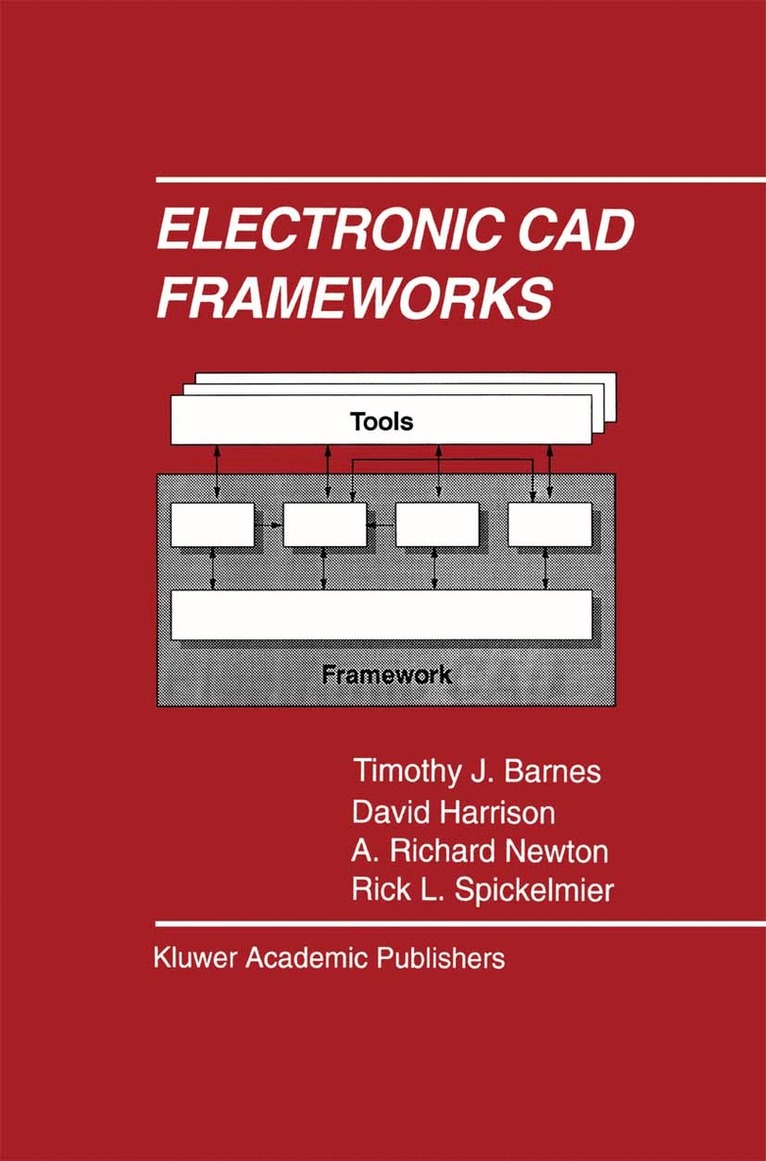
    Electronic CAD Frameworks

    AvTimothy J. Barnes,David Harrison

    Inbunden, Engelska, 1992

    Del 185 i serien Springer International Series in Engineering and Computer Science

    1 084 kr

    Beställningsvara. Skickas inom 10-15 vardagar. Fri frakt över 249 kr.

    Fler format och utgåvor

    Häftad

    1 084 kr

    Beskrivning

    When it comes to frameworks, the familiar story of the elephant and the six blind philosophers seems to apply. As each philoso­ pher encountered a separate part of the elephant, each pronounced his considered, but flawed judgement. One blind philosopher felt a leg and thought it a tree. Another felt the tail and thought he held a rope. Another felt the elephant's flank and thought he stood before a wall. We're supposed to learn about snap judgements from this alle­ gory, but its author might well have been describing design automation frameworks. For in the reality of today's product development requirements, a framework must be many things to many people. xiv CAD Frameworks: Integration Technology for CAD As the authors of this book note, framework design is an optimi­ zation problem. Somehow, it has to be both a superior rope for one and a tremendous tree for another. Somehow it needs to provide a standard environment for exploiting the full potential of computer-aided engineering tools. And, somehow, it has to make real such abstractions as interoperability and interchangeability. For years, we've talked about a framework as something that provides application-oriented services, just as an operating system provides system-level support. And for years, that simple statement has hid the tremendous complexity of actually providing those services.

    Produktinformation

    • Utgivningsdatum:1992-06-30
    • Mått:155 x 235 x 17 mm
    • Vikt:497 g
    • Format:Inbunden
    • Språk:Engelska
    • Serie:Springer International Series in Engineering and Computer Science
    • Antal sidor:195
    • Upplaga:1992
    • Förlag:Kluwer Academic Publishers
    • ISBN:9780792392521

    Utforska kategorier

    • Elektronik och kommunikationer inom Naturvetenskap och teknik

    Innehållsförteckning

    • 1: Introdution.- 1.1 The Nature of a CAD Framework.- 1.2 The Evolution of CAD Frameworks.- 1.3 CAD Frameworks and Openness.- 1.4 The Rise of Commercial CAD Frameworks.- 1.5 The Impact of Object-Oriented Techniques.- 1.6 The Standardization of CAD Frameworks.- 1.7 Organization of the Book.- 2: Major Components of an Engineering Framework.- 2.1 Overview.- 2.2 Operating System Services.- 2.3 Tool Integration and Encapsulation.- 2.4 Design Management.- 3: Data Representation.- 3.1 Introduction.- 3.2 Databases and Data Structures.- 3.3 Approaches to CAD Databases.- 3.4 Representational Issues.- 3.5 The Nature of Engineering Design Information.- 3.6 Hierarchy.- 4: Data Management.- 4.1 Introduction.- 4.2 Conventional Database Approaches.- 4.3 Physical Versus Logical Data Management.- 4.4 Managing the History of a Design.- 4.5 Managing Multiple Users of the Data.- 4.6 Concurrency Control.- 4.7 Compatibility with Change.- 5: Tool Management.- 5.1 Introduction.- 5.2 Tool Characterization.- 5.3 Tool Control.- 5.4 Other Tool Management Functions.- 6: Design Flow Management.- 6.1 Introduction.- 6.2 Benefits.- 6.3 DFM Dependencies.- 6.4 Existing Approaches.- 6.5 Describing the Design Flow.- 6.6 The Design Flow Engine.- 6.7 Standardization and Design Flow Management.- 7: User Interfaces.- 7.1 Introduction.- 7.2 History of Design Automation User Interface Systems.- 7.3 Modern Framework User Interfaces.- 7.4 Future Directions for CAD User Interfaces.- 8: Extension Languages.- 8.1 Introduction.- 8.2 Commercial Extension Languages in CAD.- 8.3 Extension Languages Prototypes.- 8.4 Extension Languages Requirements.- 8.5 Design Issues for Extension Languages.- 8.6 General Applications of Extension Languages.- 8.7 Language-Based Design.- 8.8 Benefits of an Extension Language.- 8.9 Future Directions.- 9: Implementing a CAD Framework.- 9.1 Introduction.- 9.2 The CODEM Approach.- 9.3 Commercial Frameworks.- 10: The CAD Framework Initiative.- 10.1 Introduction.- 10.2 The Origins of CFI.- 10.3 Goals and Deliverables.- 10.4 The CFI Organization.- 10.5 Tangible and Intangible Benefits.- 10.6 Technical Activities.- 10.7 CFI in the Future.- 11: Summary.- 11.1 Acknowledgments.- References.