• Fri frakt över 249 kr
  • •
  • Snabba leveranser
  • •
  • Billiga böcker
Kundservice

Du är på sajten för privatpersoner.

Företag, bibliotek eller offentlig verksamhet?

Du handlar på classic.bokus.com, där alla dina funktioner finns intakta.
Till classic.bokus.com
Bokus logotyp. Gå till startsidan.
  • Erbjudanden
  • Nyheter
  • Student
  • Topplistor
  • Barn & ungdom
  • Bokus Play
  • E-böcker
  • Pocketböcker
  • Spel & pussel

10% rabatt på allt med kod NYSTART10 →

Sidfot

Mina sidor

    Hjälp

    • Kundservice
    • Vanliga frågor och svar
    • Frakt och leverans
    • Retur vid ångerrätt
    • Reklamera vara
    • Betalning
    • Köpvillkor
    • Allmänna villkor
    • Information om webbplatsens tillgänglighet

    Om Bokus

    • Om oss
    • Pressrum
    • För studenter
    • För företag
    • För bibliotek och offentlig verksamhet
    • För leverantörer
    • Hållbarhet

    Populärt

    • Aktuella erbjudanden
    • Presentkort
    • Studentlitteratur
    • Nya böcker
    • Topplistor
    • Signerade böcker
    • Engelska böcker

    Inspiration

    • Boktips
    • BookTok
    • Populära bokserier
    • Barnbokskaraktärer
    • Populära författare
    Logotyp för Bokus
    Följ oss på Facebook (extern länk)Följ oss på Instagram (extern länk)Följ oss på YouTube (extern länk)Följ oss på TikTok (extern länk)
    bokus @ CookiesAnpassa cookiesIntegritetspolicyKöpvillkor
    Till Citymail hemsida (extern länk)Till Budbee hemsida (extern länk)Till Postnord hemsida (extern länk)Till Schenker hemsida (extern länk)Till Early Bird hemsida (extern länk)Till Walleys hemsida (extern länk)
    1. Data och IT
    2. Systemvetenskap och AI

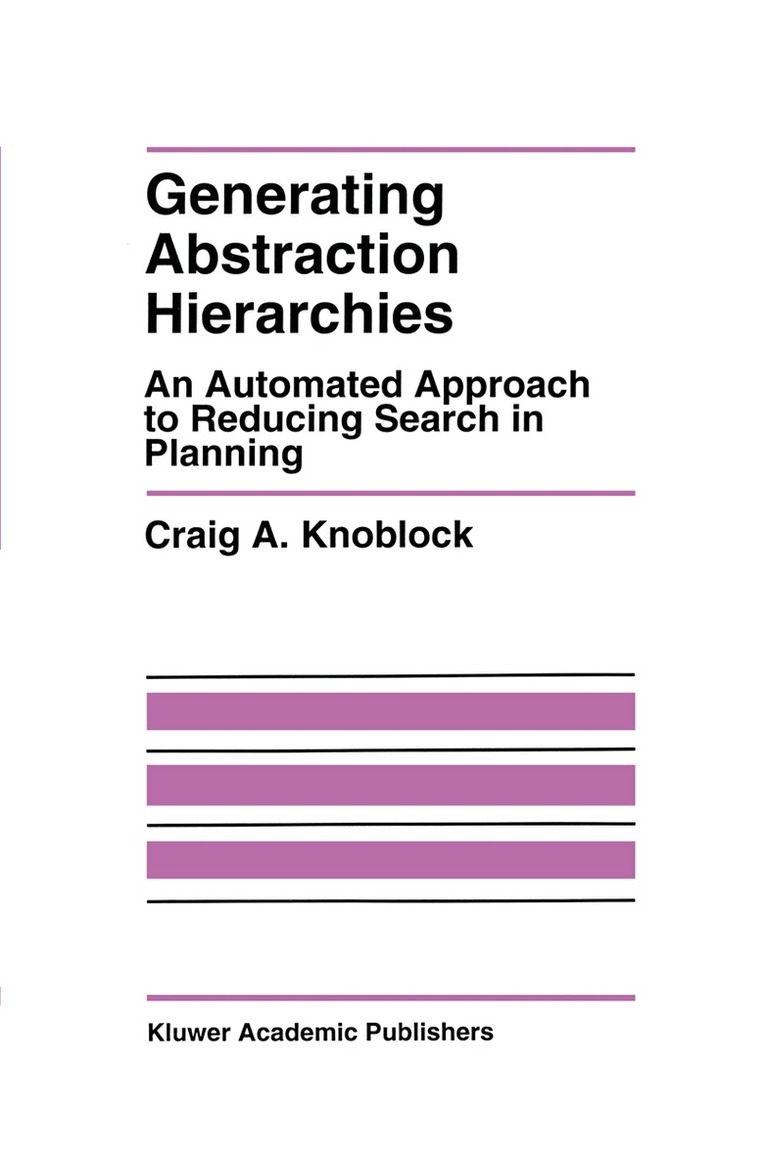
    Generating Abstraction Hierarchies

    An Automated Approach to Reducing Search in Planning

    AvCraig A. Knoblock

    Inbunden, Engelska, 1993

    Del i serien Springer International Series in Engineering and Computer Science

    1 673 kr

    Beställningsvara. Skickas inom 10-15 vardagar. Fri frakt över 249 kr.

    Fler format och utgåvor

    Häftad

    1 673 kr

    E-bok

    2 105 kr

    Beskrivning

    Generating Abstraction Hierarchies presents a completely automated approach to generating abstractions for problem solving. The abstractions are generated using a tractable, domain-independent algorithm whose only inputs are the definition of a problem space and the problem to be solved and whose output is an abstraction hierarchy that is tailored to the particular problem. The algorithm generates abstraction hierarchies that satisfy the `ordered monotonicity' property, which guarantees that the structure of an abstract solution is not changed in the process of refining it. An abstraction hierarchy with this property allows a problem to be decomposed such that the solution in an abstract space can be held invariant while the remaining parts of a problem are solved. The algorithm for generating abstractions is implemented in a system called ALPINE, which generates abstractions for a hierarchical version of the PRODIGY problem solver. Generating Abstraction Hierarchies formally defines this hierarchical problem solving method, shows that under certain assumptions this method can reduce the size of a search space from exponential to linear in the solution size, and describes the implementation of this method in PRODIGY. The abstractions generated by ALPINE are tested in multiple domains on large problem sets and are shown to produce shorter solutions with significantly less search than problem solving without using abstraction. Generating Abstraction Hierarchies will be of interest to researchers in machine learning, planning and problem reformation.

    Produktinformation

    • Utgivningsdatum:1993-01-31
    • Mått:155 x 235 x 17 mm
    • Vikt:400 g
    • Format:Inbunden
    • Språk:Engelska
    • Serie:Springer International Series in Engineering and Computer Science
    • Antal sidor:168
    • Upplaga:1993
    • Förlag:Kluwer Academic Publishers
    • ISBN:9780792393108

    Utforska kategorier

    • Systemvetenskap och AI inom Data och IT
    • Programmeringsböcker inom Data och IT

    Recensioner i media

    ' ... it is well-structured, and the material is presented logically, and in correct order; all the conclusions are convincing. ... The list of bibliography (97 entries) is also worth mentioning. I must confess that having read the book I understood my own way of thinking while solving problems better than before. This book can be recommended not only to the specialists working in automatic problem solving; it would be useful for engineers who want to improve their understanding of themselves and the world around them. ... ' Engineering Applications Artificial Intelligence, 7:3 (1994) 'I would go so far as to describe it as a beautiful book... I recommend the volume to anyone doing research in the area, or to anyone who might wish to apply the technology.' The Australian Computer Journal 26:1 1994 'This book can be recommended not only to the specialists working in automatic problem solving; is would be useful for engineers who want to improve their understanding of themselves and the world around them.' Eng. App. of Artificial Intelligence 7:3 1994

    Innehållsförteckning

    • 1 Introduction.- 1.1 Problem Solving.- 1.2 Hierarchical Problem Solving.- 1.3 Generating Abstraction Hierarchies.- 1.4 Closely Related Work.- 1.5 Contributions.- 1.6 Outline.- 2 Problem Solving.- 2.1 Definition of Problem Solving.- 2.2 Tower of Hanoi Example.- 2.3 Problem Solving in PRODIGY.- 3 Hierarchical Problem Solving.- 3.1 Abstraction Hierarchies.- 3.2 Hierarchical Problem Solving.- 3.3 Analysis of the Search Reduction.- 3.4 Tower of Hanoi Example.- 3.5 Hierarchical Problem Solving in PRODIGY.- 3.6 Discussion.- 4 Generating Abstractions.- 4.1 Properties of Abstraction Hierarchies.- 4.2 Generating Abstraction Hierarchies.- 4.3 Tower of Hanoi Example.- 4.4 Generating Abstractions in ALPINE.- 4.5 Discussion.- 5 Empirical Results.- 5.1 Search Reduction: Theory vs. Practice.- 5.2 Empirical Results for ALPINE.- 5.3 Comparison of ALPINE and EBL.- 5.4 Comparison of ALPINE and ABSTRIPS.- 6 Related Work.- 6.1 Using Abstractions for Problem Solving.- 6.2 Generating Abstractions for Problem Solving.- 6.3 Properties of Abstractions.- 7 Conclusion.- 7.1 Theory of Abstraction.- 7.2 Generating Abstractions.- 7.3 Using Abstractions.- 7.4 Discussion.