• Fri frakt över 249 kr
  • •
  • Snabba leveranser
  • •
  • Billiga böcker
Kundservice

Du är på sajten för privatpersoner.

Företag, bibliotek eller offentlig verksamhet?

Du handlar på classic.bokus.com, där alla dina funktioner finns intakta.
Till classic.bokus.com
Bokus logotyp. Gå till startsidan.
  • Erbjudanden
  • Nyheter
  • Student
  • Topplistor
  • Barn & ungdom
  • Bokus Play
  • E-böcker
  • Pocketböcker
  • Spel & pussel

10% rabatt på allt med kod: NYSTART10 →

Sidfot

Mina sidor

    Hjälp

    • Kundservice
    • Vanliga frågor och svar
    • Frakt och leverans
    • Retur vid ångerrätt
    • Reklamera vara
    • Betalning
    • Köpvillkor
    • Allmänna villkor
    • Information om webbplatsens tillgänglighet

    Om Bokus

    • Om oss
    • Pressrum
    • För studenter
    • För företag
    • För bibliotek och offentlig verksamhet
    • För leverantörer
    • Hållbarhet

    Populärt

    • Aktuella erbjudanden
    • Presentkort
    • Studentlitteratur
    • Nya böcker
    • Topplistor
    • Signerade böcker
    • Engelska böcker

    Inspiration

    • Boktips
    • BookTok
    • Populära bokserier
    • Barnbokskaraktärer
    • Populära författare
    Logotyp för Bokus
    Följ oss på Facebook (extern länk)Följ oss på Instagram (extern länk)Följ oss på YouTube (extern länk)Följ oss på TikTok (extern länk)
    bokus @ CookiesAnpassa cookiesIntegritetspolicyKöpvillkor
    Till Citymail hemsida (extern länk)Till Budbee hemsida (extern länk)Till Postnord hemsida (extern länk)Till Schenker hemsida (extern länk)Till Early Bird hemsida (extern länk)Till Walleys hemsida (extern länk)
    1. Data och IT
    2. Systemvetenskap och AI

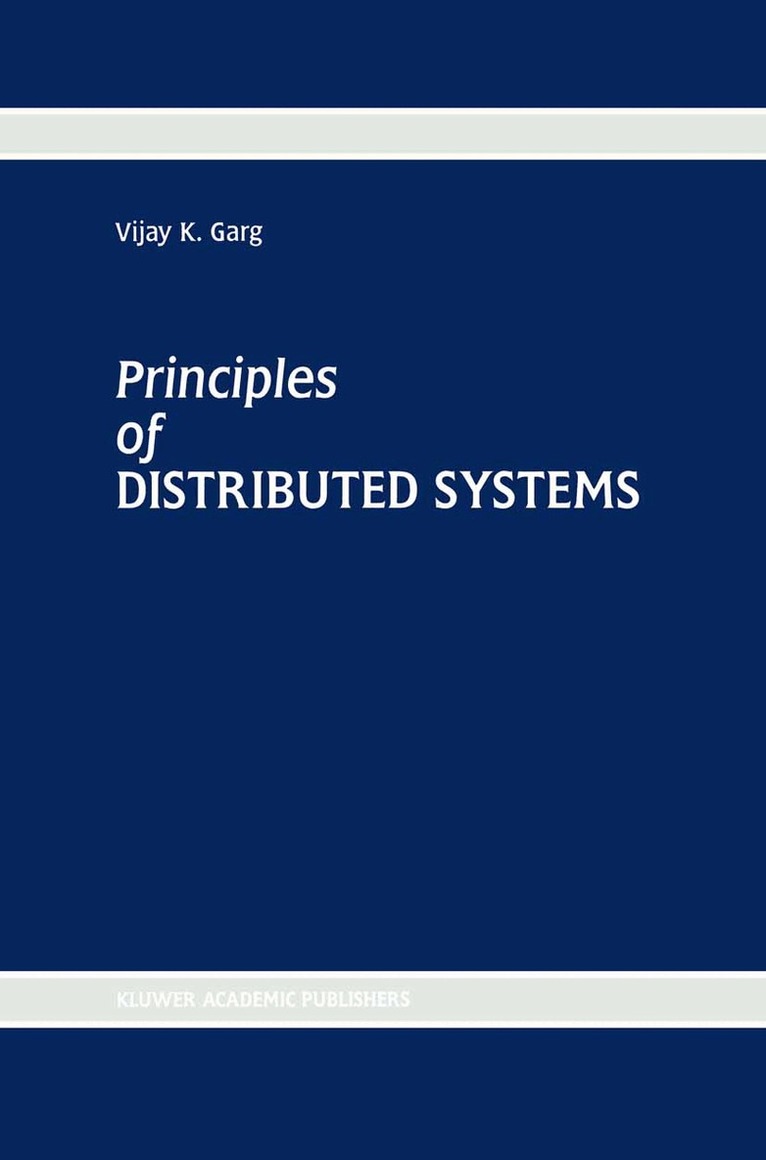
    Principles of Distributed Systems

    AvVijay K. Garg

    Inbunden, Engelska, 1995

    1 785 kr

    Beställningsvara. Skickas inom 10-15 vardagar. Fri frakt över 249 kr.

    Fler format och utgåvor

    Häftad

    1 785 kr

    E-bok

    2 273 kr

    Beskrivning

    Distributed computer systems are now widely available but, despite a number of recent advances, the design of software for these systems remains a challenging task, involving two main difficulties: the absence of a shared clock and the absence of a shared memory. The absence of a shared clock means that the concept of time is not useful in distributed systems. The absence of shared memory implies that the concept of a state of a distributed system also needs to be redefined. These two important concepts occupy a major portion of this book. Principles of Distributed Systems describes tools and techniques that have been successfully applied to tackle the problem of global time and state in distributed systems. The author demonstrates that the concept of time can be replaced by that of causality, and clocks can be constructed to provide causality information. The problem of not having a global state is alleviated by developing efficient algorithms for detecting properties and computing global functions. The author's major emphasis is in developing general mechanisms that can be applied to a variety of problems. For example, instead of discussing algorithms for standard problems, such as termination detection and deadlocks, the book discusses algorithms to detect general properties of a distributed computation. Also included are several worked examples and exercise problems that can be used for individual practice and classroom instruction. Audience: Can be used to teach a one-semester graduate course on distributed systems. Also an invaluable reference book for researchers and practitioners working on the many different aspects of distributed systems.

    Produktinformation

    • Utgivningsdatum:1995-12-31
    • Mått:155 x 235 x 23 mm
    • Vikt:568 g
    • Format:Inbunden
    • Språk:Engelska
    • Antal sidor:254
    • Förlag:Kluwer Academic Publishers
    • ISBN:9780792396680

    Utforska kategorier

    • Systemvetenskap och AI inom Data och IT

    Innehållsförteckning

    • to Distributed Systems.- Distributed Systems versus Parallel Systems.- Partial Orders.- Notation.- Overview of the book.- Exercises.- Bibliographic Remarks.- 1 Time.- 1.1 Introduction.- 1.2 Model of a distributed system.- 1.3 Logical Clocks.- 1.4 Vector Clocks.- 1.5 Direct Dependency Clocks.- 1.6 Higher Dimensional Clocks.- 1.7 Exercises.- 1.8 Bibliographic Remarks.- 2 Mutual Exclusion.- 2.1 Introduction.- 2.2 Problem.- 2.3 Lamport’s Algorithm.- 2.4 Ricart and Agrawala’s Algorithm.- 2.5 Centralized Algorithm.- 2.6 Dijkstra’s Self-stabilizing Algorithm.- 2.7 Exercises.- 2.8 Bibliographic Remarks.- 3 Global State.- 3.1 Introduction.- 3.2 Consistent Cuts.- 3.3 Global Snapshots of Processes.- 3.4 Global Snapshots of Processes and Channels.- 3.5 Global Snapshots for non-FIFO channels.- 3.6 Applications of Global Snapshot Algorithms.- 3.7 Exercises.- 3.8 Bibliographic Remarks.- 4 Possible Global Predicates.- 4.1 Introduction.- 4.2 Possibility of a Global Predicate.- 4.3 NP-Completeness of Global Predicate Detection.- 4.4 Linear Predicates.- 4.5 Semi-Linear Predicates.- 4.6 Exercises.- 4.7 Bibliographic Remarks.- 5 Conjunctive Possible Global Predicates.- 5.1 Introduction.- 5.2 Weak Conjunctive Predicates.- 5.3 A Vector Clock based Centralized Algorithm for WCP.- 5.4 A Direct Dependence based Centralized Algorithm for WCP.- 5.5 A Vector Clock based Distributed Algorithm for WCP.- 5.6 A Centralized Algorithm for Generalized Conjunctive Predicates.- 5.7 A Vector Clock based Distributed GCP Detection Algorithm.- 5.8 Exercises.- 5.9 Bibliographic Remarks.- 6 Relational Possible Global Predicates.- 6.1 Introduction.- 6.2 Relational Predicate with Two Integer Variables.- 6.3 Relational predicates with N Boolean Variables.- 6.4 Bounded Sum Predicates.- 6.5 Exercises.- 6.6Bibliographic Remarks.- 7 Inevitable Global Predicates.- 7.1 Introduction.- 7.2 Global Sequence.- 7.3 Logic for Global Predicates.- 7.4 Strong Conjunctive Predicates.- 7.5 Algorithms for Detecting SCP.- 7.6 Exercises.- 7.7 Bibliographic Remarks.- 8 Control Flow Predicates.- 8.1 Introduction.- 8.2 LRDAG Logic.- 8.3 Examples.- 8.4 Decentralized Detection Algorithm.- 8.5 Exercises.- 8.6 Bibliographic Remarks.- 9 Order.- 9.1 Introduction.- 9.2 Relationship among Message Orderings.- 9.3 FIFO Ordering of Messages.- 9.4 Causal Ordering Of Messages.- 9.5 Synchronous Ordering of Messages.- 9.6 Exercises.- 9.7 Bibliographic Remarks.- 10 Computation.- 10.1 Introduction.- 10.2 Global Functions.- 10.3 Repeated Computation.- 10.4 Exercises.- 10.5 Bibliographic Remarks.- References.