• Fri frakt över 249 kr
  • •
  • Snabba leveranser
  • •
  • Billiga böcker
Kundservice

Du är på sajten för privatpersoner.

Företag, bibliotek eller offentlig verksamhet?

Du handlar på classic.bokus.com, där alla dina funktioner finns intakta.
Till classic.bokus.com
Bokus logotyp. Gå till startsidan.
  • Erbjudanden
  • Nyheter
  • Student
  • Topplistor
  • Barn & ungdom
  • Bokus Play
  • E-böcker
  • Pocketböcker
  • Spel & pussel

10% rabatt på allt med kod NYSTART10 →

Sidfot

Mina sidor

    Hjälp

    • Kundservice
    • Vanliga frågor och svar
    • Frakt och leverans
    • Retur vid ångerrätt
    • Reklamera vara
    • Betalning
    • Köpvillkor
    • Allmänna villkor
    • Information om webbplatsens tillgänglighet

    Om Bokus

    • Om oss
    • Pressrum
    • För studenter
    • För företag
    • För bibliotek och offentlig verksamhet
    • För leverantörer
    • Hållbarhet

    Populärt

    • Aktuella erbjudanden
    • Presentkort
    • Studentlitteratur
    • Nya böcker
    • Topplistor
    • Signerade böcker
    • Engelska böcker

    Inspiration

    • Boktips
    • BookTok
    • Populära bokserier
    • Barnbokskaraktärer
    • Populära författare
    Logotyp för Bokus
    Följ oss på Facebook (extern länk)Följ oss på Instagram (extern länk)Följ oss på YouTube (extern länk)Följ oss på TikTok (extern länk)
    bokus @ CookiesAnpassa cookiesIntegritetspolicyKöpvillkor
    Till Citymail hemsida (extern länk)Till Budbee hemsida (extern länk)Till Postnord hemsida (extern länk)Till Schenker hemsida (extern länk)Till Early Bird hemsida (extern länk)Till Walleys hemsida (extern länk)
    1. Data och IT
    2. Systemvetenskap och AI

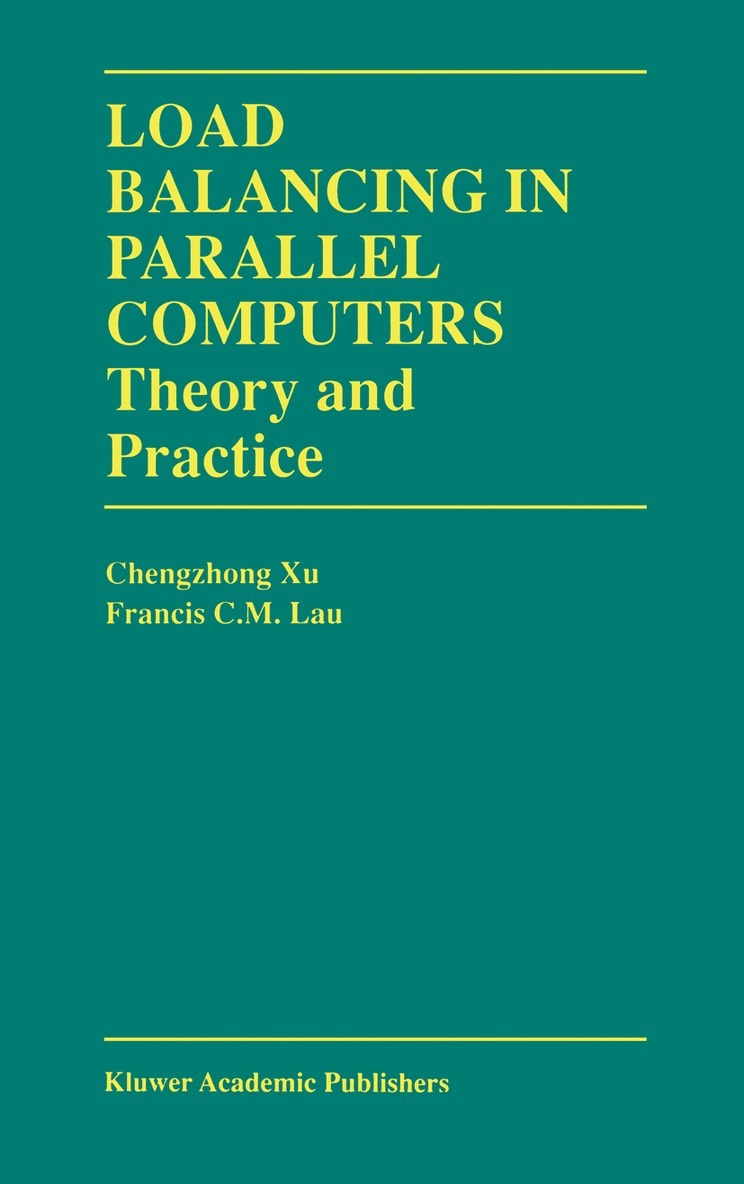
    Load Balancing in Parallel Computers

    Theory and Practice

    AvChenzhong Xu,Francis C.M. Lau

    Inbunden, Engelska, 1996

    Del 381 i serien Springer International Series in Engineering and Computer Science

    2 227 kr

    Beställningsvara. Skickas inom 10-15 vardagar. Fri frakt över 249 kr.

    Fler format och utgåvor

    Häftad

    2 559 kr

    Beskrivning

    Load Balancing in Parallel Computers: Theory and Practice is about the essential software technique of load balancing in distributed memory message-passing parallel computers, also called multicomputers. Each processor has its own address space and has to communicate with other processors by message passing. In general, a direct, point-to-point interconnection network is used for the communications. Many commercial parallel computers are of this class, including the Intel Paragon, the Thinking Machine CM-5, and the IBM SP2. Load Balancing in Parallel Computers: Theory and Practice presents a comprehensive treatment of the subject using rigorous mathematical analyses and practical implementations. The focus is on nearest-neighbor load balancing methods in which every processor at every step is restricted to balancing its workload with its direct neighbours only. Nearest-neighbor methods are iterative in nature because a global balanced state can be reached through processors' successive local operations. Since nearest-neighbor methods have a relatively relaxed requirement for the spread of local load information across the system, they are flexible in terms of allowing one to control the balancing quality, effective for preserving communication locality, and can be easily scaled in parallel computers with a direct communication network. Load Balancing in Parallel Computers: Theory and Practice serves as an excellent reference source and may be used as a text for advanced courses on the subject.

    Produktinformation

    • Utgivningsdatum:1996-11-30
    • Mått:155 x 235 x 18 mm
    • Vikt:524 g
    • Format:Inbunden
    • Språk:Engelska
    • Serie:Springer International Series in Engineering and Computer Science
    • Antal sidor:210
    • Förlag:Kluwer Academic Publishers
    • ISBN:9780792398196

    Utforska kategorier

    • Systemvetenskap och AI inom Data och IT

    Innehållsförteckning

    • A Survey of Nearest-Neighbor Load Balancing Algorithms.- The GDE Method.- GDE on Tori and Meshes.- The Diffusion Method.- GDE Versus Diffusion.- Termination Detection of Load Balancing.- Remapping With the GDE Method.- Load Distribution in Combinatorial Optimizations.- Conclusions.