• Fri frakt över 249 kr
  • •
  • Snabba leveranser
  • •
  • Billiga böcker
Kundservice

Du är på sajten för privatpersoner.

Företag, bibliotek eller offentlig verksamhet?

Du handlar på classic.bokus.com, där alla dina funktioner finns intakta.
Till classic.bokus.com
Bokus logotyp. Gå till startsidan.
  • Erbjudanden
  • Student
  • Topplistor
  • Barn & ungdom
  • Bokus Play
  • E-böcker
  • Ljudböcker
  • Pocketböcker
  • Spel & pussel

10% rabatt på allt med kod NYSTART10 →

Sidfot

Mina sidor

    Hjälp

    • Kundservice
    • Vanliga frågor och svar
    • Frakt och leverans
    • Retur vid ångerrätt
    • Reklamera vara
    • Betalning
    • Köpvillkor
    • Allmänna villkor
    • Information om webbplatsens tillgänglighet

    Om Bokus

    • Om oss
    • Pressrum
    • För studenter
    • För företag
    • För bibliotek och offentlig verksamhet
    • För leverantörer
    • Hållbarhet

    Populärt

    • Aktuella erbjudanden
    • Presentkort
    • Studentlitteratur
    • Nya böcker
    • Topplistor
    • Signerade böcker
    • Engelska böcker

    Inspiration

    • Boktips
    • BookTok
    • Populära bokserier
    • Barnbokskaraktärer
    • Populära författare
    Logotyp för Bokus
    Följ oss på Facebook (extern länk)Följ oss på Instagram (extern länk)Följ oss på YouTube (extern länk)Följ oss på TikTok (extern länk)
    bokus @ CookiesAnpassa cookiesIntegritetspolicyKöpvillkor
    Till Citymail hemsida (extern länk)Till Budbee hemsida (extern länk)Till Postnord hemsida (extern länk)Till Schenker hemsida (extern länk)Till Early Bird hemsida (extern länk)Till Walleys hemsida (extern länk)
    1. Naturvetenskap och teknik
    2. Matematik och naturvetenskap
    3. Fysik
    4. Tillämpad fysik

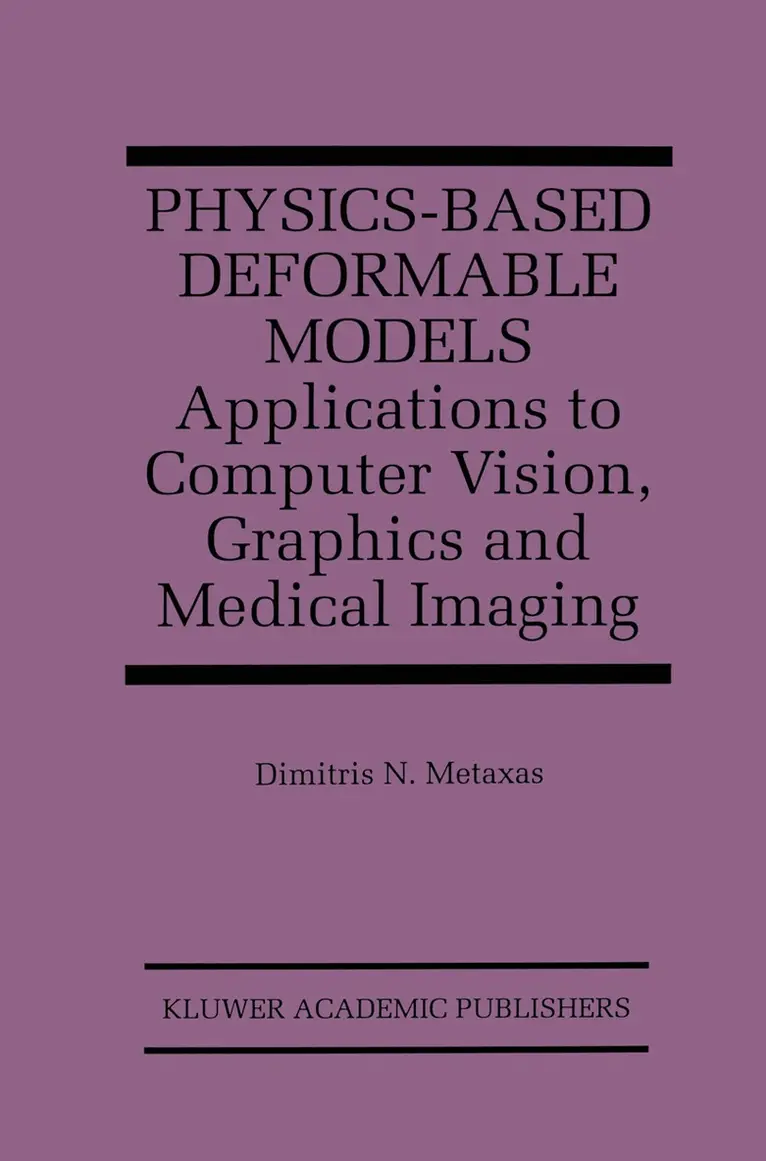
    Physics-Based Deformable Models

    Applications to Computer Vision, Graphics and Medical Imaging

    AvDimitris N. Metaxas

    Inbunden, Engelska, 1996

    Del i serien Springer International Series in Engineering and Computer Science

    1 623 kr

    Beställningsvara. Skickas inom 10-15 vardagar. Fri frakt över 249 kr.

    Fler format och utgåvor

    Häftad

    1 671 kr

    E-bok

    2 105 kr

    Beskrivning

    Physics-Based Deformable Models presents a systematic physics-based framework for modeling rigid, articulated, and deformable objects, their interactions with the physical world, and the estimate of their shape and motion from visual data. This book presents a large variety of methods and associated experiments in computer vision, graphics and medical imaging that help the reader better to understand the presented material. In addition, special emphasis has been given to the development of techniques with interactive or close to real-time performance. Physics-Based Deformable Models is suitable as a secondary text for graduate level courses in Computer Graphics, Computational Physics, Computer Vision, Medical Imaging, and Biomedical Engineering. In addition, this book is appropriate as a reference for researchers and practitioners in the above-mentioned fields.

    Produktinformation

    • Utgivningsdatum:1996-11-30
    • Mått:155 x 235 x 19 mm
    • Vikt:637 g
    • Format:Inbunden
    • Språk:Engelska
    • Serie:Springer International Series in Engineering and Computer Science
    • Antal sidor:308
    • Upplaga:1997
    • Förlag:Kluwer Academic Publishers
    • ISBN:9780792398400

    Utforska kategorier

    • Tillämpad fysik inom Naturvetenskap och teknik

    Innehållsförteckning

    • 1 Introduction.- 1.1 Illustrative Examples of Modeling and Estimation.- 1.2 Chapter Outline.- 2 Geometry of Deformable Models.- 2.1 Related Work.- 2.2 Hybrid Deformable Models.- 3 Kinematics and Dynamics.- 3.1 Kinematics.- 3.2 Dynamics.- 3.3 Choosing the Order of the Motion Equations.- 4 Finite Element Implementation.- 4.1 Choosing the Appropriate Elements.- 4.2 Various Model Tessellations.- 4.3C0Elements.- 4.4C1Triangular Elements.- 4.5 Approximation of the Lagrange Equations.- 5 Applied Forces.- 5.1 Computer Vision and Medical Imaging Applications.- 5.2 Computer Graphics Applications.- 5.3 Force–Based Estimation.- 6 Model Implementation.- 6.1 Integrating the Motion Equations.- 6.2 Model Initialization.- 6.3 Computer Vision Experiments.- 6.4 Computer Graphics Experiments.- 7 Constrained Nonrigid Motion.- 7.1 Holonomic Constraints and Lagrange Multipliers.- 7.2 Stabilized Constraints.- 7.3 Fast Constraint Force Computation for Multibody Objects.- 7.4 Experiments with Constraints.- 8 Shape and Nonrigid Motion Estimation.- 8.1 Recursive Estimation.- 8.2 Kalman Filter Implementation.- 8.3 Recursive Estimation of Shape and Nonrigid Motion.- 9 Multi–Level Shape Representation.- 9.1 Related Work.- 9.2 Deformable Models: Geometry and Dynamics.- 9.3 Locally Adaptive Finite Elements.- 9.4 Summary of Model Fitting to Range Data.- 9.5 Experiments.- 10 Topologically Adaptive Models Based on Blending.- 10.1 Related Work.- 10.2 Blended shapes.- 10.3 Reconstruction and evolution.- 10.4 Experiments.- 11 Integration of Qualitative Segmentation and Pbm Methods.- 11.1 Related Work.- 11.2 Qualitative Model Extraction.- 11.3 Quantitative Shape and Motion Recovery.- 12 Motion–Based Part Segmentation and Tracking.- 12.1 Related Prior Work.- 12.2 Deformable Models: Extensions.- 12.3Inferring structure in 2D.- 12.4 Two–dimensional human body model acquisition.- 12.5 Three–dimensional Human Body model acquisition.- 12.6 Human Body Tracking.- 12.7 Experimental Results.- 13 Volumetric Analysis of the Left Ventricular Wall Motion From Mri–Spamm.- 13.1 Related Work.- 13.2 Data Extraction Techniques for Cardiac Motion Studies.- 13.3 Volumetric Deformable Models with Parameter Functions.- 13.4 Model Force Computation.- 13.5 Model Parameters.- 13.6 Implementation of Model Fitting Procedure.- 13.7 Experimental Results.- 14 Visualizing Respiratory Mechanics Based on Anatomical and Physiological Modeling.- 14.1 Related Work.- 14.2 Basic Anatomy and Physiology.- 14.3 Methods.- 14.4 Results.- 15 Recursive Dynamics and Adaptive Control for Animating Articulated Figures.- 15.1 System Description.- 15.2 Efficient Forward Dynamics.- 15.3 Collision handling.- 15.4 Dynamic Control.- 15.5 Results.- 16 Animating Liquids.- 16.1 Navier–Stokes Equations.- 16.2 Solving the Navier–Stokes equations.- 16.3 Tracking fluid position.- 16.4 Buoyancy.- 16.5 Summary of the Navier–Stokes Algorithm.- 16.6 Control.- 16.7 Examples.- 17 Conclusions.- A.- References.