• Fri frakt över 249 kr
  • •
  • Snabba leveranser
  • •
  • Billiga böcker
Kundservice

Du är på sajten för privatpersoner.

Företag, bibliotek eller offentlig verksamhet?

Du handlar på classic.bokus.com, där alla dina funktioner finns intakta.
Till classic.bokus.com
Bokus logotyp. Gå till startsidan.
  • Erbjudanden
  • Nyheter
  • Student
  • Topplistor
  • Barn & ungdom
  • Bokus Play
  • E-böcker
  • Pocketböcker
  • Spel & pussel

10% rabatt på allt med kod NYSTART10 →

Sidfot

Mina sidor

    Hjälp

    • Kundservice
    • Vanliga frågor och svar
    • Frakt och leverans
    • Retur vid ångerrätt
    • Reklamera vara
    • Betalning
    • Köpvillkor
    • Allmänna villkor
    • Information om webbplatsens tillgänglighet

    Om Bokus

    • Om oss
    • Pressrum
    • För studenter
    • För företag
    • För bibliotek och offentlig verksamhet
    • För leverantörer
    • Hållbarhet

    Populärt

    • Aktuella erbjudanden
    • Presentkort
    • Studentlitteratur
    • Nya böcker
    • Topplistor
    • Signerade böcker
    • Engelska böcker

    Inspiration

    • Boktips
    • BookTok
    • Populära bokserier
    • Barnbokskaraktärer
    • Populära författare
    Logotyp för Bokus
    Följ oss på Facebook (extern länk)Följ oss på Instagram (extern länk)Följ oss på YouTube (extern länk)Följ oss på TikTok (extern länk)
    bokus @ CookiesAnpassa cookiesIntegritetspolicyKöpvillkor
    Till Citymail hemsida (extern länk)Till Budbee hemsida (extern länk)Till Postnord hemsida (extern länk)Till Schenker hemsida (extern länk)Till Early Bird hemsida (extern länk)Till Walleys hemsida (extern länk)
    1. Språk och ordböcker
    2. Språkvetenskap och lingvistik

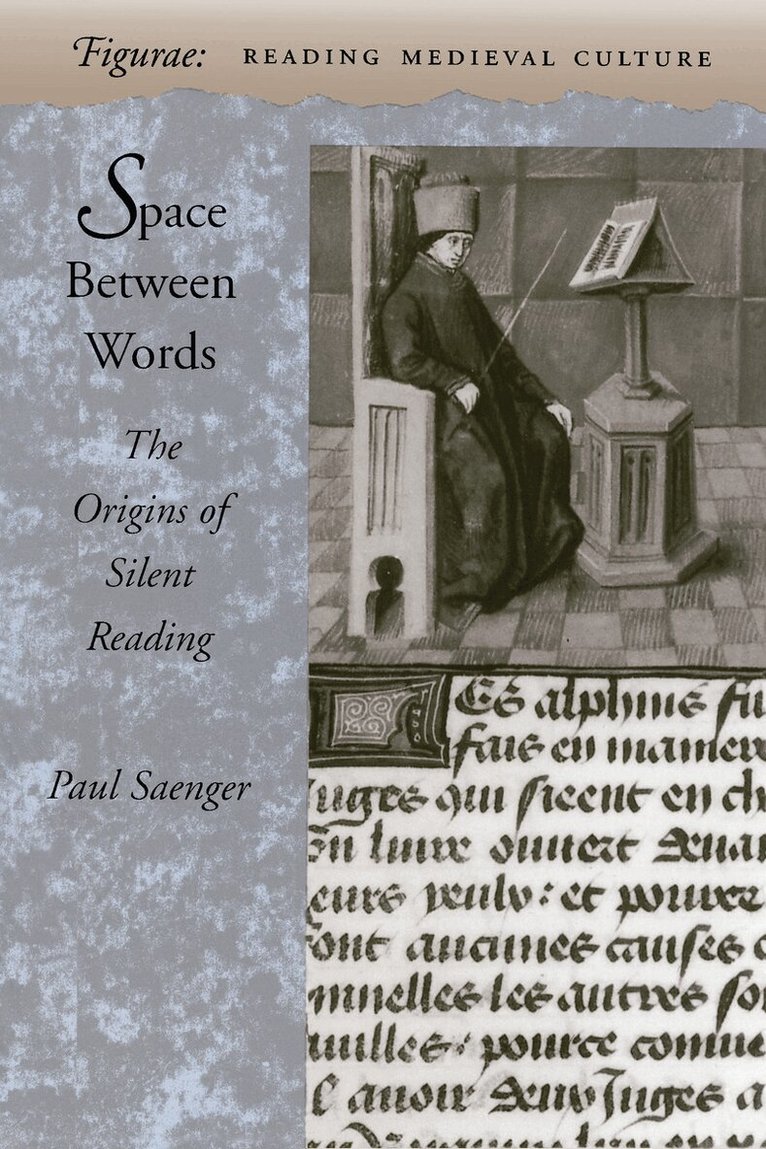
    Space Between Words

    The Origins of Silent Reading

    AvPaul Saenger

    Häftad, Engelska, 2000

    Del i serien Figurae: Reading Medieval Culture

    543 kr

    Beställningsvara. Skickas inom 5-8 vardagar. Fri frakt över 249 kr.

    Beskrivning

    Reading, like any human activity, has a history. Modern reading is a silent and solitary activity. Ancient reading was usually oral, either aloud, in groups, or individually, in a muffled voice. The text format in which thought has been presented to readers has undergone many changes in order to reach the form that the modern Western reader now views as immutable and nearly universal. This book explains how a change in writing—the introduction of word separation—led to the development of silent reading during the period from late antiquity to the fifteenth century. Over the course of the nine centuries following Rome's fall, the task of separating the words in continuous written text, which for half a millennium had been a function of the individual reader's mind and voice, became instead a labor of professional readers and scribes. The separation of words (and thus silent reading) originated in manuscripts copied by Irish scribes in the seventh and eighth centuries but spread to the European continent only in the late tenth century when scholars first attempted to master a newly recovered corpus of technical, philosophical, and scientific classical texts.Why was word separation so long in coming? The author finds the answer in ancient reading habits with their oral basis, and in the social context where reading and writing took place. The ancient world had no desire to make reading easier and swifter. For various reasons, what modern readers view as advantages—retrieval of reference information, increased ability to read "difficult" texts, greater diffusion of literacy—were not seen as advantages in the ancient world. The notion that a larger portion of the population should be autonomous and self-motivated readers was entirely foreign to the ancient world's elitist mentality.The greater part of this book describes in detail how the new format of word separation, in conjunction with silent reading, spread from the British Isles and took gradual hold in France, Germany, Italy, and Spain. The book concludes with the triumph of silent reading in the scholasticism and devotional practices of the late Middle Ages.

    Produktinformation

    • Utgivningsdatum:2000-01-01
    • Mått:152 x 229 x 27 mm
    • Vikt:644 g
    • Format:Häftad
    • Språk:Engelska
    • Serie:Figurae: Reading Medieval Culture
    • Antal sidor:504
    • Förlag:Stanford University Press
    • ISBN:9780804740166

    Utforska kategorier

    • Språkvetenskap och lingvistik inom Språk och ordböcker

    Mer om författaren

    Paul Saenger is George A. Poole III Curator of Rare Books at the Newberry Library, Chicago.

    Recensioner i media

    "Saenger outlined his revolutionary thesis 15 years ago in his famous essay 'Silent Reading'; the present magisterial book retells the story step by step. . . . Paleographic studies rarely command wide audiences, but Saenger tells so important a story that Space Between Words will interest all who are concerned with the history of reading or the book." —Choice "Saenger's remarkable new book . . . demonstrates that . . . the scribal innovations of medieval Europe were no less seminal and far-reaching thatn those of post-Gutenberg typesetters. . . . for the first time, we see the evolution of writing, print, and computing not as a succession of fitful revolutions but, rather, as a continuum of technological innovation."—College and Research Libraries "The work is, or should be, reading matter for every medievalist, not only for its impeccable scholarship and the information it contains, but also for Saenger's readiness to include neurophysiological evidence in support of his argument"—Written Language and Literacy "Very solid and convincing. . . . a first rate analysis of how word separation emerged in the seventh and eigth centuries and eventually spread all over Europe."—Mediaevistik "This is an impressive, fascinating, and exasperating work of scholarship..." Language in Society

    Innehållsförteckning

    • Contents Chapter 1 Chapter 2 Chapter 3 Chapter 4 Chapter 5 Chapter 6 Chapter 7 Chapter 8 Chapter 9 Chapter 10 Chapter 11 Chapter 12 Chapter 13 Chapter 14 Chapter 15 Appendix: