• Fri frakt över 249 kr
  • •
  • Snabba leveranser
  • •
  • Billiga böcker
Kundservice

Du är på sajten för privatpersoner.

Företag, bibliotek eller offentlig verksamhet?

Du handlar på classic.bokus.com, där alla dina funktioner finns intakta.
Till classic.bokus.com
Bokus logotyp. Gå till startsidan.
  • Erbjudanden
  • Nyheter
  • Student
  • Topplistor
  • Barn & ungdom
  • Bokus Play
  • E-böcker
  • Pocketböcker
  • Spel & pussel

10% rabatt på allt med kod: NYSTART10 →

Sidfot

Mina sidor

    Hjälp

    • Kundservice
    • Vanliga frågor och svar
    • Frakt och leverans
    • Retur vid ångerrätt
    • Reklamera vara
    • Betalning
    • Köpvillkor
    • Allmänna villkor
    • Information om webbplatsens tillgänglighet

    Om Bokus

    • Om oss
    • Pressrum
    • För studenter
    • För företag
    • För bibliotek och offentlig verksamhet
    • För leverantörer
    • Hållbarhet

    Populärt

    • Aktuella erbjudanden
    • Presentkort
    • Studentlitteratur
    • Nya böcker
    • Topplistor
    • Signerade böcker
    • Engelska böcker

    Inspiration

    • Boktips
    • BookTok
    • Populära bokserier
    • Barnbokskaraktärer
    • Populära författare
    Logotyp för Bokus
    Följ oss på Facebook (extern länk)Följ oss på Instagram (extern länk)Följ oss på YouTube (extern länk)Följ oss på TikTok (extern länk)
    bokus @ CookiesAnpassa cookiesIntegritetspolicyKöpvillkor
    Till Citymail hemsida (extern länk)Till Budbee hemsida (extern länk)Till Postnord hemsida (extern länk)Till Schenker hemsida (extern länk)Till Early Bird hemsida (extern länk)Till Walleys hemsida (extern länk)
    1. Samhälle och politik
    2. Politik och statsskick
    3. Politisk aktivism

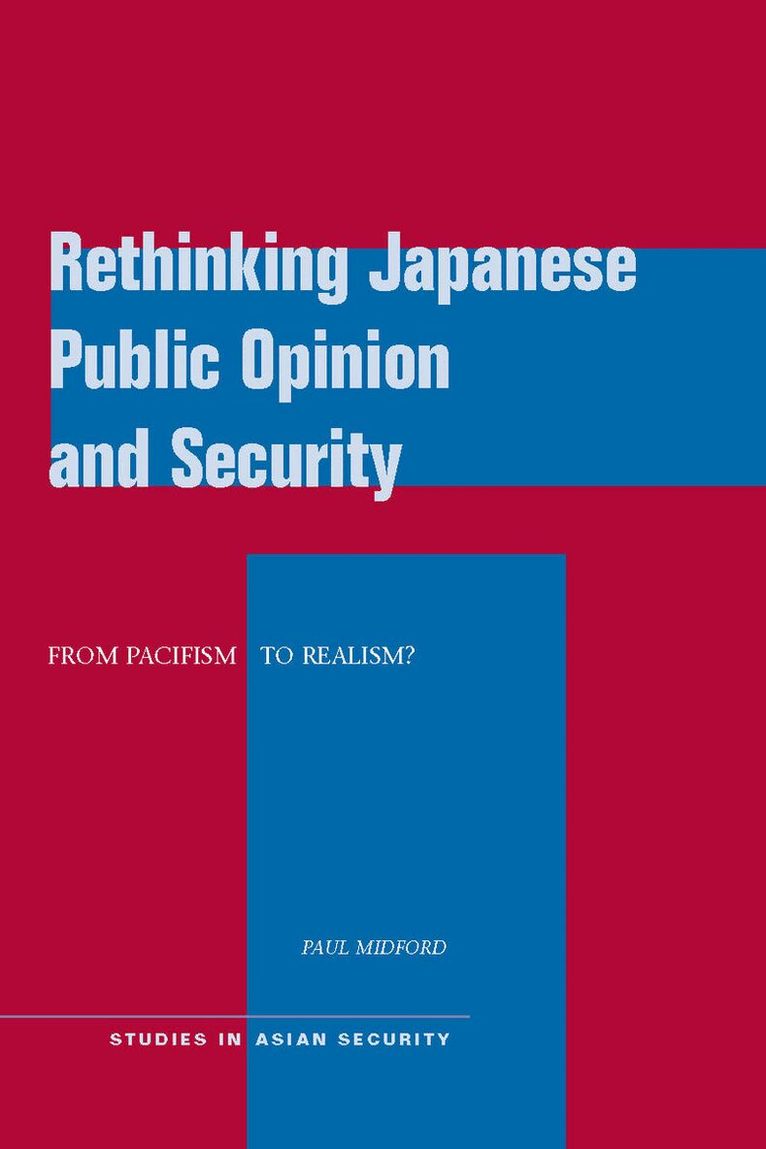
    Rethinking Japanese Public Opinion and Security

    From Pacifism to Realism?

    AvPaul Midford

    Häftad, Engelska, 2011

    Del i serien Studies in Asian Security

    299 kr

    Beställningsvara. Skickas inom 10-15 vardagar. Fri frakt över 249 kr.

    Fler format och utgåvor

    Inbunden

    886 kr

    E-bok

    352 kr

    Beskrivning

    In this book, Paul Midford engages claims that since 9/11 Japanese public opinion has turned sharply away from pacifism and toward supporting normalization of Japan's military power, in which Japanese troops would fight alongside their American counterparts in various conflicts worldwide. Midford argues that Japanese public opinion has never embraced pacifism. It has, instead, contained significant elements of realism, in that it has acknowledged the utility of military power for defending national territory and independence, but has seen offensive military power as ineffective for promoting other goals—such as suppressing terrorist networks and WMD proliferation, or promoting democracy overseas.Over several decades, these realist attitudes have become more evident as the Japanese state has gradually convinced its public that Tokyo and its military can be trusted with territorial defense, and even with noncombat humanitarian and reconstruction missions overseas. On this basis, says Midford, we should re-conceptualize Japanese public opinion as attitudinal defensive realism.

    Produktinformation

    • Utgivningsdatum:2011-01-24
    • Mått:152 x 229 x 17 mm
    • Vikt:399 g
    • Format:Häftad
    • Språk:Engelska
    • Serie:Studies in Asian Security
    • Antal sidor:272
    • Förlag:Stanford University Press
    • ISBN:9780804772174

    Utforska kategorier

    • Politisk aktivism inom Samhälle och politik

    Mer om författaren

    Paul Midford is Associate Professor in the Department of Political Science and Sociology and Director of the Japan Program at the Norwegian University for Science and Technology in Trondheim. His books include Japanese Public Opinion and the War on Terrorism: Implications for Japan's Security Strategy.

    Recensioner i media

    "This book is an important textbook not just for students and scholars in international relations, political science, and Asian studies, but for policy makers in Japan and the United States as well. This book should be on the reading list of anyone wanting to understand the changes in Japan's security policy over the last two decades and how it might influence Japan's future security policy."—Alon Levkowitz, H-Net "The influence of public opinion on Japanese foreign and security policy has not been deeply studied up to this point. By providing a clearly structured and meticulous analysis of the problem Paul Midford has thereby done scholars of the "Japan puzzle" a valuable service. . . [This] volume represents the outstanding work on the topic of public opinion/security policy in Japan and is indispensible for specialists working in this area."—Thomas S. Wilkins, Pacific Affairs "[I]ndispensable . . . Midford's book should be read by all scholars and students of Japanese security policy. It is path breaking, if not yet definitive, in setting out a systematic understanding of how Japanese public opinion can affect security policy and offers up another sophisticated categorization—one that other scholars must engage—of the trajectory of Japanese security policy in the shape of 'Defensive Realism.'"—Christopher W. Hughes, Journal of Japanese Studies "Midford needs to be praised for collecting such a large number of opinion data and bringing them together in an easy-to-read narrative, illustrating the shifts and changes in public opinion, the original and then changing government narrative, and how public attitudes shaped these changes . . . Overall, this book is an important contribution not only to Japanese security studies, but also to the study of Japanese democracy."—Wilhelm M. Vosse, International Relations of the Asia-Pacific "Paul Midford has written a ground breaking study that provides vital perspective on a much neglected dimension of Japanese foreign and security policy making. At a time when confusion abounds over the long-term orientation of Japanese policy, Midford's study provides valuable insight on the underlying structures that set the parameters for decision makers in Tokyo. It deserves to be read by anyone interested in Japan, the international relations of East Asia, and US policy in the region."—Thomas U. Berger, Department of International Relations, Boston University