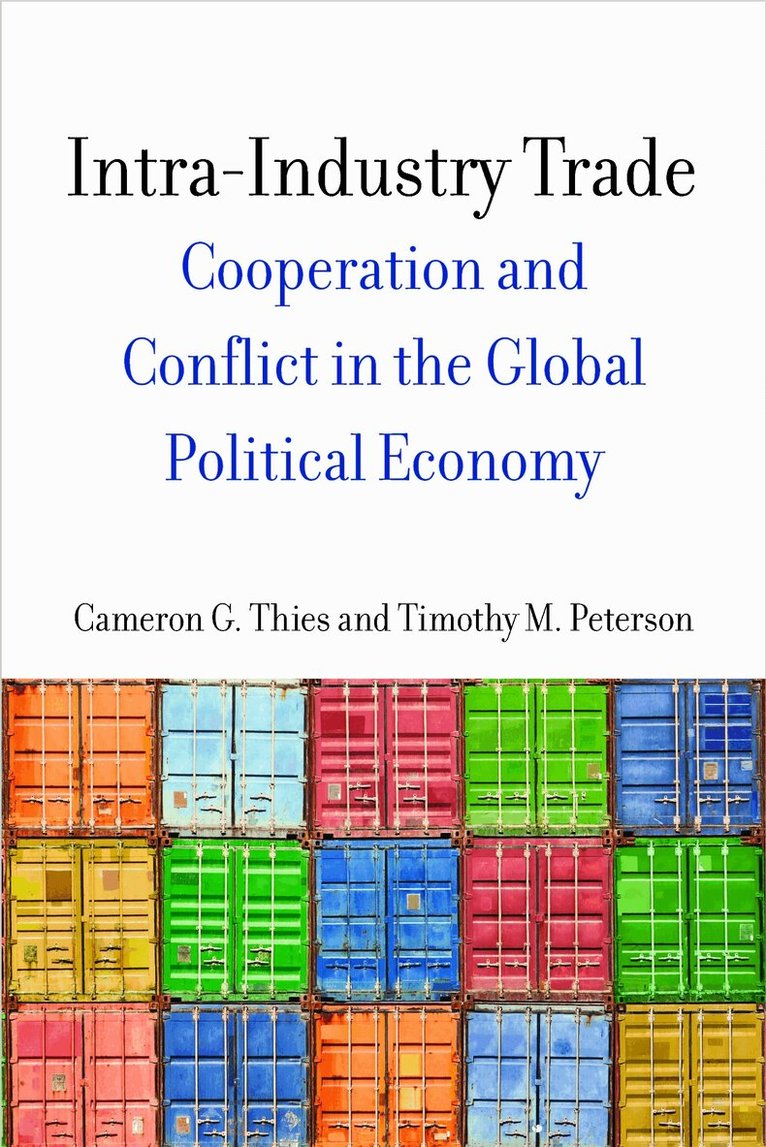
Intra-Industry Trade
Cooperation and Conflict in the Global Political Economy
AvCameron Thies,Timothy M. Peterson
Del i serien Emerging Frontiers in the Global Economy
869 kr
Beställningsvara. Skickas inom 10-15 vardagar. Fri frakt över 249 kr.
Du är på sajten för privatpersoner.
AvCameron Thies,Timothy M. Peterson
Del i serien Emerging Frontiers in the Global Economy
869 kr
Beställningsvara. Skickas inom 10-15 vardagar. Fri frakt över 249 kr.
Cameron G. Thies is Professor of Political Science and Director of the School of Politics and Global Studies at Arizona State University. Timothy M. Peterson is an Associate Professor of Political Science at the University of South Carolina.
"In this essential book, Thies and Peterson carefully assess the consequences of the growth of intra-industry trade, which now accounts for the majority of total trade flows. Their brilliant analysis compels us to completely reconsider our understanding of international trade and its political effects."—Anna Lanoszka, University of Windsor "Cameron Thies and Timothy Peterson convincingly make the case that trade remains important for international cooperation and conflict. Their study is the first to do full justice, both theoretically and empirically, to the increasing importance of intra-industry trade. Well-informed, cogently argued, and methodologically sophisticated, their book is bound to guide key debates in International Political Economy and International Relations."—Han Dorussen, University of Essex "The nature of trade is changing. Cameron Thies and Timothy Peterson provide an admirable demonstration of how an expansion of intra-industry trade can be a powerful force for peace. Social scientists and policy makers will learn a great deal from reading this book."—Solomon W. Polachek, State University of New York at Binghamton "The political implications of trade have been studied for centuries, and it is rare that a book comes along that is able to shed new light on such a well-covered topic. Thies and Peterson manage to do just that by focusing on the particular consequences of intraindustry trade on the phenomena of cooperation and conflict in world politics....[T]his is a book that balances empirical rigor with accessible arguments suitable for any student of political science or global studies....[T]he research here provides a roadmap for how to improve upon the way we study the complex but not incomprehensible link between trade and political outcomes such as conflict and cooperation."—Mark Crescenzi, International Studies Review "A key contribution of the book is the recommendation of a new theory that suggests a clear, causal relationship between trade and international cooperation. Although economists have developed models and theories that explain the composition of trade, there has been little or no research on the impact of such composition on global politics....[T]he new findings concerning the composition of trade are worth reading."—Douglas Mugabe, Review of Regional Studies
Du är på sajten för privatpersoner.
AvCameron Thies,Timothy M. Peterson
Del i serien Emerging Frontiers in the Global Economy
869 kr
Beställningsvara. Skickas inom 10-15 vardagar. Fri frakt över 249 kr.
Cameron G. Thies is Professor of Political Science and Director of the School of Politics and Global Studies at Arizona State University. Timothy M. Peterson is an Associate Professor of Political Science at the University of South Carolina.
"In this essential book, Thies and Peterson carefully assess the consequences of the growth of intra-industry trade, which now accounts for the majority of total trade flows. Their brilliant analysis compels us to completely reconsider our understanding of international trade and its political effects."—Anna Lanoszka, University of Windsor "Cameron Thies and Timothy Peterson convincingly make the case that trade remains important for international cooperation and conflict. Their study is the first to do full justice, both theoretically and empirically, to the increasing importance of intra-industry trade. Well-informed, cogently argued, and methodologically sophisticated, their book is bound to guide key debates in International Political Economy and International Relations."—Han Dorussen, University of Essex "The nature of trade is changing. Cameron Thies and Timothy Peterson provide an admirable demonstration of how an expansion of intra-industry trade can be a powerful force for peace. Social scientists and policy makers will learn a great deal from reading this book."—Solomon W. Polachek, State University of New York at Binghamton "The political implications of trade have been studied for centuries, and it is rare that a book comes along that is able to shed new light on such a well-covered topic. Thies and Peterson manage to do just that by focusing on the particular consequences of intraindustry trade on the phenomena of cooperation and conflict in world politics....[T]his is a book that balances empirical rigor with accessible arguments suitable for any student of political science or global studies....[T]he research here provides a roadmap for how to improve upon the way we study the complex but not incomprehensible link between trade and political outcomes such as conflict and cooperation."—Mark Crescenzi, International Studies Review "A key contribution of the book is the recommendation of a new theory that suggests a clear, causal relationship between trade and international cooperation. Although economists have developed models and theories that explain the composition of trade, there has been little or no research on the impact of such composition on global politics....[T]he new findings concerning the composition of trade are worth reading."—Douglas Mugabe, Review of Regional Studies