• Fri frakt över 249 kr
  • •
  • Snabba leveranser
  • •
  • Billiga böcker
Kundservice

Du är på sajten för privatpersoner.

Företag, bibliotek eller offentlig verksamhet?

Du handlar på classic.bokus.com, där alla dina funktioner finns intakta.
Till classic.bokus.com
Bokus logotyp. Gå till startsidan.
  • Erbjudanden
  • Nyheter
  • Student
  • Topplistor
  • Barn & ungdom
  • Bokus Play
  • E-böcker
  • Pocketböcker
  • Spel & pussel

Må bättre, för mindre! Upp till 50% rabatt på hälsoböcker

Sidfot

Mina sidor

    Hjälp

    • Kundservice
    • Vanliga frågor och svar
    • Frakt och leverans
    • Retur vid ångerrätt
    • Reklamera vara
    • Betalning
    • Köpvillkor
    • Allmänna villkor
    • Information om webbplatsens tillgänglighet

    Om Bokus

    • Om oss
    • Pressrum
    • För studenter
    • För företag
    • För bibliotek och offentlig verksamhet
    • För leverantörer
    • Hållbarhet

    Populärt

    • Aktuella erbjudanden
    • Presentkort
    • Studentlitteratur
    • Nya böcker
    • Topplistor
    • Signerade böcker
    • Engelska böcker

    Inspiration

    • Boktips
    • BookTok
    • Populära bokserier
    • Barnbokskaraktärer
    • Populära författare
    Logotyp för Bokus
    Följ oss på Facebook (extern länk)Följ oss på Instagram (extern länk)Följ oss på YouTube (extern länk)Följ oss på TikTok (extern länk)
    bokus @ CookiesAnpassa cookiesIntegritetspolicyKöpvillkor
    Till Citymail hemsida (extern länk)Till Budbee hemsida (extern länk)Till Postnord hemsida (extern länk)Till Schenker hemsida (extern länk)Till Early Bird hemsida (extern länk)Till Walleys hemsida (extern länk)
    1. Samhälle och politik
    2. Samhälle och kultur
    3. Sociala och etiska frågor

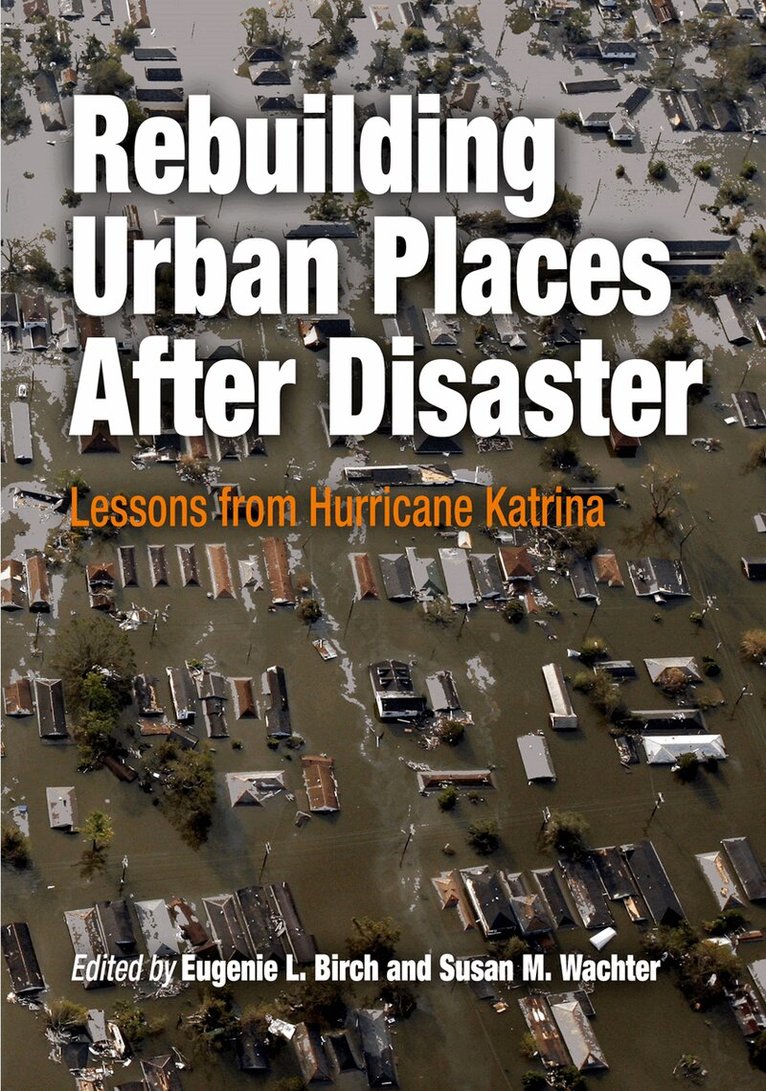
    Rebuilding Urban Places After Disaster

    Lessons from Hurricane Katrina

    AvEugenie L. Birch,Susan M. Wachter

    E-bok
    Engelska, 2013

    Del i serien City in the Twenty-First Century

    1 184 kr

    Läs direkt i Bokus Reader – eller ladda ned till din enhet

    Beskrivning

    Disasters-natural ones, such as hurricanes, floods, or earthquakes, and unnatural ones such as terrorist attacks-are part of the American experience in the twenty-first century. The challenges of preparing for these events, withstanding their impact, and rebuilding communities afterward require strategic responses from different levels of government in partnership with the private sector and in accordance with the public will.Disasters have a disproportionate effect on urban places. Dense by definition, cities and their environs suffer great damage to their complex, interdependent social, environmental, and economic systems. Social and medical services collapse. Long-standing problems in educational access and quality become especially acute. Local economies cease to function. Cultural resources disappear. The plight of New Orleans and several smaller Gulf Coast cities exemplifies this phenomenon.This volume examines the rebuilding of cities and their environs after a disaster and focuses on four major issues: making cities less vulnerable to disaster, reestablishing economic viability, responding to the permanent needs of the displaced, and recreating a sense of place. Success in these areas requires that priorities be set cooperatively, and this goal poses significant challenges for rebuilding efforts in a democratic, market-based society. Who sets priorities and how? Can participatory decision-making be organized under conditions requiring focused, strategic choices? How do issues of race and class intersect with these priorities? Should the purpose of rebuilding be restoration or reformation? Contributors address these and other questions related to environmental conditions, economic imperatives, social welfare concerns, and issues of planning and design in light of the lessons to be drawn from Hurricane Katrina.

    Produktinformation

    • Utgivningsdatum:2013-01-09
    • Språk:Engelska
    • Antal sidor:416
    • Filformat:EPUB
    • Kopieringsskydd:LCP
    • ISBN:9780812204483
    • Förlag:University of Pennsylvania Press
    • Serie:City in the Twenty-First Century

    Utforska kategorier

    • Sociala och etiska frågor inom Samhälle och politik

    Mer om författaren

    Eugenie L. Birch is Professor and Chair of the Department of City and Regional Planning at the University of Pennsylvania School of Design. Susan M. Wachter is the Albert Sussman Professor of Real Estate and Professor of Finance, The Wharton School; Professor of City and Regional Planning, School of Design; and Co-Director, Penn Institute for Urban Research, at the University of Pennsylvania.

    Recensioner i media

    "Invaluable... Essential."-Choice "This book reveals fresh and insightful approaches to the challenges of facing natural disaster. Contributions from the fields of regionalism and environmental planning are positive and prospective, offering new ways to understand how the places we call home are interconnected with each other and with the land. I'm particularly struck by the thoughtful writings about the individuality of these places, where cultural expressions in music and architecture are irrepressible, even amidst debris and discouragement."-Marilyn Jordan Taylor, Partner, Skidmore, Owings & Merrill LLP and Chairman, Urban Land Institute "After reading Rebuilding Urban Places one comes away with an understanding of how complex a process it is to restore our urban communities after experiencing such a catastrophe ... and an understanding of the leaps this country must take to help and protect our citizens."-John Timoney, Chief of Police, Miami "No elected official or planning professional should miss this book. Birch and Wachter have collected essays spanning every dimension of rebuilding. From historical lessons to cutting-edge practices, there is so much to learn."-Brent Warr, Mayor, City of Gulfport, Mississippi "A remarkable collection of essays."-Journal of the American Planning Association

    Innehållsförteckning

    • Foreword-Amy GutmannIntroduction-Eugenie L. Birch and Susan M. WachterI. MAKING PLACES LESS VULNERABLE1. Physical Constraints on Reconstructing New Orleans-Robert Giegengack and Kenneth R. Foster2. Negotiating a Fluid Terrain-Anuradha Mathur and Dilip da Cunha3. The Problems of Containment and the Promise of Planning-Raymond J. Burby, Arthur C. Nelson, and Thomas W. Sanchez4. Mapping for Sustainable Resilience-Frederick Steiner, Barbara Faga, James Sipes, and Robert Yaro5. Natural Hazards Science-A Matter of Public Safety-P. Patrick LeahyII. RETURNING URBAN PLACES TO ECONOMIC VIABILITY6. Measuring Katrina's Impact on the Gulf Megapolitan Area-Robert E. Lang7. Restarting the Economy-Mark Zandi, Steven Cochrane, Fillip Ksiazkiewicz, and Ryan Sweet8. Rebuilding Transportation-Rachel Weinberger9. Learning from Past Disasters-Eugenie L. Birch10. Restoring Urban Viability-Lawrence J. Vale11. Housing Displaced Families-Jeffrey Lubell12. Assessing The University's Role-Lester A. Lefton and Yvette JonesIII. RESPONDING TO THE NEEDS OF THE DISPLACED: ISSUES OF CLASS, RACE, AND RECOVERY13. Inadequate Reponses, Limited Expectations-Elijah Anderson14. Educational Equity in Postdisaster New Orleans-Vivian L. Gadsden15. The Lost and Forgotten-Richard J. Gelles16. Temporary Housing Blues-Gary Hack17. Lessons from Sri Lanka-Thomas L. Daniels and Harris SteinbergV. RECREATING A SENSE OF PLACE18. Promoting Cultural Preservation-Randall Mason19. Understanding New Orleans's Architectural Ecology-Dell Upton20. Reconstructing New Orleans: A Progress Report-Jonathan Barnett and John Beckman21. Rebuilding the "Land of Dreams" with Music-Nick Spitzer22. Walking to Wal-Mart: Planning for Mississippi and Beyond-Sandy Sorlien and Leland R. SpeedAfterword-Ronald J. Daniels