• Fri frakt över 249 kr
  • •
  • Snabba leveranser
  • •
  • Billiga böcker
Kundservice

Du är på sajten för privatpersoner.

Företag, bibliotek eller offentlig verksamhet?

Du handlar på classic.bokus.com, där alla dina funktioner finns intakta.
Till classic.bokus.com
Bokus logotyp. Gå till startsidan.
  • Erbjudanden
  • Student
  • Topplistor
  • Barn & ungdom
  • Bokus Play
  • E-böcker
  • Ljudböcker
  • Pocketböcker
  • Spel & pussel

10% rabatt på allt med kod NYSTART10 →

Sidfot

Mina sidor

    Hjälp

    • Kundservice
    • Vanliga frågor och svar
    • Frakt och leverans
    • Retur vid ångerrätt
    • Reklamera vara
    • Betalning
    • Köpvillkor
    • Allmänna villkor
    • Information om webbplatsens tillgänglighet

    Om Bokus

    • Om oss
    • Pressrum
    • För studenter
    • För företag
    • För bibliotek och offentlig verksamhet
    • För leverantörer
    • Hållbarhet

    Populärt

    • Aktuella erbjudanden
    • Presentkort
    • Studentlitteratur
    • Nya böcker
    • Topplistor
    • Signerade böcker
    • Engelska böcker

    Inspiration

    • Boktips
    • BookTok
    • Populära bokserier
    • Barnbokskaraktärer
    • Populära författare
    Logotyp för Bokus
    Följ oss på Facebook (extern länk)Följ oss på Instagram (extern länk)Följ oss på YouTube (extern länk)Följ oss på TikTok (extern länk)
    bokus @ CookiesAnpassa cookiesIntegritetspolicyKöpvillkor
    Till Citymail hemsida (extern länk)Till Budbee hemsida (extern länk)Till Postnord hemsida (extern länk)Till Schenker hemsida (extern länk)Till Early Bird hemsida (extern länk)Till Walleys hemsida (extern länk)
    1. Skönlitteratur
    2. Litteraturvetenskap
    3. Litteraturvetenskap

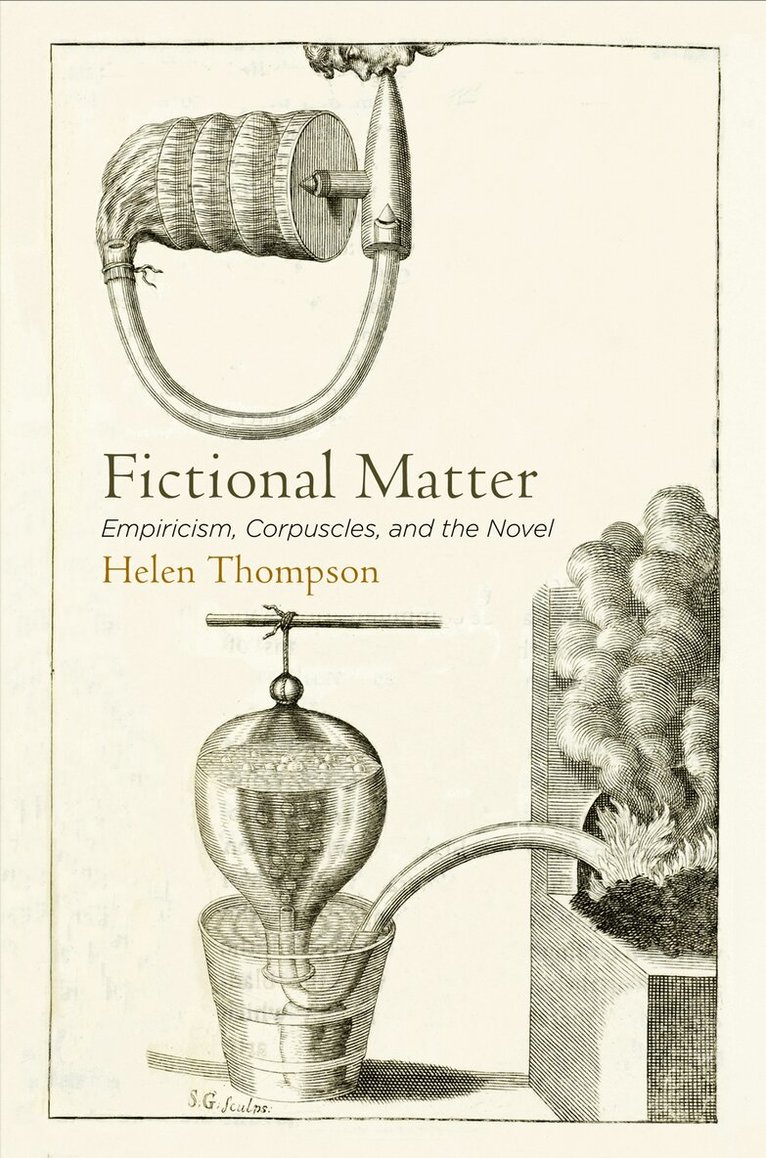
    Fictional Matter

    Empiricism, Corpuscles, and the Novel

    AvHelen Thompson

    E-bok
    PDF, Engelska, 2016

    1 360 kr

    Läs direkt i Bokus Reader – eller ladda ned till din enhet (PDF kräver ofta zoom och scroll på små skärmar).

    Fler format och utgåvor

    Inbunden

    964 kr

    Beskrivning

    In a groundbreaking study of the relationship between chemistry and literary history, Helen Thompson explores the ways in which chemical conceptions of matter shaped eighteenth-century British culture. Although the scientific revolution championed experimental, sense-based knowledge, chemists claimed that perceptible bodies were made of invisible particles or "corpuscles." Neither modern elements nor classical atoms, corpuscles were reactive, divisible units of matter. Imperceptible but real, the corpuscle transformed empirical knowledge in early modern science and the novel.Thompson offers new analyses of the chemistry, alchemy, color theory, physiology, environmental science, and medicine pioneered by Robert Boyle, Isaac Newton, Stephen Hales, John Mitchell, John Arbuthnot, and Thomas Sydenham to argue that they shaped cultural conceptions of racial, class, sex, and species identity. Juxtaposing science with readings of novels by Daniel Defoe, Eliza Haywood, Jonathan Swift, Samuel Richardson, Henry Fielding, William Rufus Chetwood, and Penelope Aubin, she shows how, at the level of form as well as character, novels represent perceptual knowledge that refers not to innate essence but to dynamic and unstable relations.The realist narrative mode that experimental science bequeaths to literary history, Fictional Matter argues, does not transparently mirror perceptible objects. Instead, novels represent the forms and relations through which imperceptible particles stimulate sensory experience. In this lucid, revisionary analysis of corpuscular chemistry, Thompson advances a new account of the influence of experimental science and empirical knowledge on the emergent realist novel.

    Produktinformation

    • Utgivningsdatum:2016-12-02
    • Språk:Engelska
    • Antal sidor:368
    • Filformat:PDF
    • Kopieringsskydd:LCP
    • ISBN:9780812293531
    • Förlag:University of Pennsylvania Press

    Utforska kategorier

    • Litteraturvetenskap inom Skönlitteratur

    Mer om författaren

    Helen Thompson is Professor of English at Northwestern University. She is author of Ingenuous Subjection: Compliance and Power in the Eighteenth-Century Domestic Novel, also available from the University of Pennsylvania Press.

    Recensioner i media

    "Confidently moves corpuscular chemistry into a closer relationship with literature than might be apparent from a first impression." (Times Literary Supplement) "Fictional Matter exemplifies much of what is best about present-day cultural studies, reading across a wide range of texts even as it makes reading itself, the act of interpretation in the absence of certitude, a subject of thematic concern. This is a book of considerable scope, intelligence, and forthrightness . . . [It] is a substantive and far-reaching book that ranges widely across eighteenth-century literature and science. For that reason, it has much to offer scholars and students of eighteenth-century studies. But it also has much to teach us about the deep history of the materialist fixations of the present era." (Modern Philology) "Displaying an impressive command of early modern science in her engaging and highly inter-disciplinary Fictional Matter, Helen Thompson strives to (re)assert the central place of 'Corpuscularian Philosophy' in the history of seventeenth-and eighteenth-century British culture. In Thompson's compelling account, the corpuscle hypothesized by Robert Boyle and variously deployed by Isaac Newton, John Locke, and some of the period's novelists postulates that all matter is made up of miniscule parts that cannot be sensed directly. Instead, the corpuscle's existence can only be established relationally; consequently, it produces knowledge in the perceiving subject despite-or, more accurately,because of-its evasion of the viewer's senses." (Journal of British Studies) "Fictional Matter: is a bold and truly interdisciplinary study. Thompson's arguments are as subtle and as ingenious as the corpuscles that inform them, which makes for an invigorating and occasionally daunting read. The scholarship, however, is worth the intellectual commitment: Fictional Matter should be a necessary influence on current and future studies of literature and science." (Ambix) "An intellectually and imaginatively riveting book. Helen Thompson's original and erudite study of the 'chymical' underpinnings of the ostensibly modern representational practices that were reified in the eighteenth-century novel dramatically reorients our understanding not just of that genre but of the conditions of its existence." (Jayne Lewis, University of California, Irvine) "The intellectual qualities of Fictional Matter are formidable: dense yet highly articulate writing, a deep understanding of Boyle's, Locke's, and Newton's thought, conceptual precision, and analytic brilliance. This is required reading for anyone thinking about the relationship between science and literature." (Wolfram Schmidgen, Washington University in St. Louis)