• Fri frakt över 249 kr
  • •
  • Snabba leveranser
  • •
  • Billiga böcker
Kundservice

Du är på sajten för privatpersoner.

Företag, bibliotek eller offentlig verksamhet?

Du handlar på classic.bokus.com, där alla dina funktioner finns intakta.
Till classic.bokus.com
Bokus logotyp. Gå till startsidan.
  • Erbjudanden
  • Nyheter
  • Student
  • Topplistor
  • Barn & ungdom
  • Bokus Play
  • E-böcker
  • Pocketböcker
  • Spel & pussel

10% rabatt på allt med kod: NYSTART10 →

Sidfot

Mina sidor

    Hjälp

    • Kundservice
    • Vanliga frågor och svar
    • Frakt och leverans
    • Retur vid ångerrätt
    • Reklamera vara
    • Betalning
    • Köpvillkor
    • Allmänna villkor
    • Information om webbplatsens tillgänglighet

    Om Bokus

    • Om oss
    • Pressrum
    • För studenter
    • För företag
    • För bibliotek och offentlig verksamhet
    • För leverantörer
    • Hållbarhet

    Populärt

    • Aktuella erbjudanden
    • Presentkort
    • Studentlitteratur
    • Nya böcker
    • Topplistor
    • Signerade böcker
    • Engelska böcker

    Inspiration

    • Boktips
    • BookTok
    • Populära bokserier
    • Barnbokskaraktärer
    • Populära författare
    Logotyp för Bokus
    Följ oss på Facebook (extern länk)Följ oss på Instagram (extern länk)Följ oss på YouTube (extern länk)Följ oss på TikTok (extern länk)
    bokus @ CookiesAnpassa cookiesIntegritetspolicyKöpvillkor
    Till Citymail hemsida (extern länk)Till Budbee hemsida (extern länk)Till Postnord hemsida (extern länk)Till Schenker hemsida (extern länk)Till Early Bird hemsida (extern länk)Till Walleys hemsida (extern länk)
    1. Kultur
    2. Scenkonst och film
    3. Film

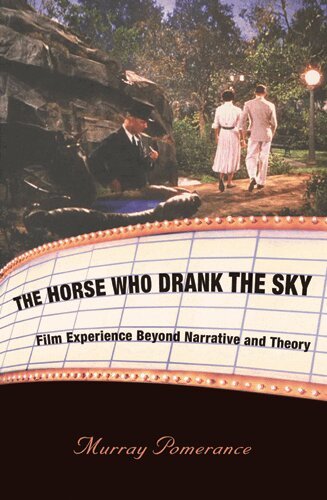
    Horse Who Drank the Sky

    Film Experience Beyond Narrative and Theory

    AvMurray Pomerance

    Häftad, Engelska, 2008

    443 kr

    Beställningsvara. Skickas inom 5-8 vardagar. Fri frakt över 249 kr.

    Beskrivning

    What is most important about cinema is that we are alive with it. For all its dramatic, literary, political, sociological, and philosophical weight, film is ultimately an art that provokes, touches, and riddles the viewer through an image that transcends narrative and theory. In The Horse Who Drank the Sky, Murray Pomerance brings attention to the visceral dimension of movies and presents a new and unanticipated way of thinking about what happens when we watch them.By looking at point of view, the gaze, the voice from nowhere, diegesis and its discontents, ideology, the system of the apparatus, invisible editing, and the technique of overlapping sound, he argues that it is often the minuscule or transitional moments in motion pictures that penetrate most deeply into viewers' experiences. In films that include Rebel Without a Cause, Dead Man, Chinatown, The Graduate, North by Northwest, Dinner at Eight, Jaws, M, Stage Fright, Saturday Night Fever, The Band Wagon, The Bourne Identity, and dozens more, Pomerance invokes complexities that many of the best of critics have rarely tackled and opens a revealing view of some of the most astonishing moments in cinema.

    Produktinformation

    • Utgivningsdatum:2008-04-24
    • Mått:152 x 229 x 20 mm
    • Vikt:397 g
    • Format:Häftad
    • Språk:Engelska
    • Antal sidor:278
    • Förlag:Rutgers University Press
    • ISBN:9780813543284

    Utforska kategorier

    • Film inom Kultur

    Mer om författaren

    MURRAY POMERANCE is an independent film scholar in Toronto and the author or editor of more than a dozen books, including Johnny Depp Starts Here and City That Never Sleeps: New York and the Filmic Imagination (both Rutgers University Press).

    Recensioner i media

    A testament to the critical force of cinephilia, this book moves effortlessly across a dazzling array of films and ways of reading them. Pomerance counts among the most compelling writers on cinema in the contemporary field. - Tom Conley (Harvard University) A testament to the critical force of cinephilia, this book moves effortlessly across a dazzling array of films and ways of reading them. Pomerance counts among the most compelling writers on cinema in the contemporary field. - Tom Conley (Harvard University) "Pomerance’s joy in celebrating the cinematic moment, whether visual or sonic, does not obscure his knack for sophisticated film analysis." - John Fidler (Senses of Cinema) Today, the introduction of new media and non-theatrical viewing intersect with traditional theoretical approaches, making Pomerance's polemic all the more poignant. - Jennifer L. Fleeger (Quarterly Review of Film and Video)

    Innehållsförteckning

    • AcknowledgmentsOvertureThinking about the studios Neubabelsberg, The Dreamers, Doris Day, and the predicament of the "onlooker," Now, Voyager, and Dead Man1. A Voluptuous GazeThinking about a dream of Sandra Oh, Short Cuts, Safe, Sideways, The Lookout, Disturbia, The Dead Zone, the gaze or the glance, turning away from film, the "cinema of attractions," glancing at plot, Magnolia, battle effects, Rebecca, Requiem for a Heavyweight, Gojira, "panoramic perception," and vertiginous games2. The Hero in the China SeaThinking about Nicholas Ray's filmmaking, storylines and lines of action, performance and continuity, and Rebel Without a Cause3. A Great FaceThinking about Alfred Hitchcock, North by Northwest, monuments and legalities, Mount Rushmore, stereopticons and the rear-projection process, Gary Cooper, George W. Bush, James Stewart, and Cary Grant4. The Smoke and the KnifeThinking about Fritz Lang's M, police procedure, craft thieving, the rationality of smoke, women in Weimar Germany, motherhood and surveillance, severing and civilization5. A Call from EverywhereThinking about On the Beach, The Exorcist, acousmetre: the voice that cannot be seen, The Wizard of Oz, And the Ship Sails On..., The Man Who Knew Too Much, Pan's Labyrinth, Trafic, narrative and de-acousmatization, and Stage Fright6. As Time Goes ByThinking about cinematic transitions, Close Encounters of the Third Kind, Lawrence of Arabia and the pre-lap, The Passenger, Blackmail, The Graduate, "faux pre-lap" in Chinatown, Three Days of the Condor, The Conversation, the upholstering buffer, the acousmetre passe, the "gasp" and the "turn," From Russia with Love, The Bourne Identity, Saturday Night Fever, editing and sound in the 1970s, Stanley Kubrick and Nestor Almendros7. The Speaking EyeThinking about the speaking eye, the democratic screen, Jaws, animal performance, acting authenticity, falling out of role, cinematic realism and cinematic reality, My Man Godfrey, Mischa Auer, "reading" the screen, the morality and politics of watching, the "doctrine of natural expression," the filmmaker's will, and cinematic "importance"8. Not an Unusual StoryThinking about Vertigo, Dinner at Eight, the sound revolution, John Barrymore, The Last Laugh, class structure and the comedy of manners, modernity and social collapse, The Great Depression and ressentiment, writing that obliterates the writer, "looking marvelous," performance and biography, and the acting of Marie Dressler9. The Horse Who Drank the SkyThinking about the cinematic sense of place, fragmentation, shellshock, explosions in cinema, Babel, Until the End of the World, Royal Wedding, extraterritoriality and television, Fahrenheit 451, the coup d'oeil, Sergeant York, "Invisible landscapes," theater design and "marginal appreciation," mental vertigo, The Bourne Supremacy, Tourettic cinema, Blow-Up, color, and The Band WagonWorks Cited and ConsultedIndex