• Fri frakt över 249 kr
  • •
  • Snabba leveranser
  • •
  • Billiga böcker
Kundservice

Du är på sajten för privatpersoner.

Företag, bibliotek eller offentlig verksamhet?

Du handlar på classic.bokus.com, där alla dina funktioner finns intakta.
Till classic.bokus.com
Bokus logotyp. Gå till startsidan.
  • Erbjudanden
  • Nyheter
  • Student
  • Topplistor
  • Barn & ungdom
  • Bokus Play
  • E-böcker
  • Pocketböcker
  • Spel & pussel

10% studentrabatt med kod TERM26

Sidfot

Mina sidor

    Hjälp

    • Kundservice
    • Vanliga frågor och svar
    • Frakt och leverans
    • Retur vid ångerrätt
    • Reklamera vara
    • Betalning
    • Köpvillkor
    • Allmänna villkor
    • Information om webbplatsens tillgänglighet

    Om Bokus

    • Om oss
    • Pressrum
    • För studenter
    • För företag
    • För bibliotek och offentlig verksamhet
    • För leverantörer
    • Hållbarhet

    Populärt

    • Aktuella erbjudanden
    • Presentkort
    • Studentlitteratur
    • Nya böcker
    • Topplistor
    • Signerade böcker
    • Engelska böcker

    Inspiration

    • Boktips
    • BookTok
    • Populära bokserier
    • Barnbokskaraktärer
    • Populära författare
    Logotyp för Bokus
    Följ oss på Facebook (extern länk)Följ oss på Instagram (extern länk)Följ oss på YouTube (extern länk)Följ oss på TikTok (extern länk)
    bokus @ CookiesAnpassa cookiesIntegritetspolicyKöpvillkor
    Till Citymail hemsida (extern länk)Till Budbee hemsida (extern länk)Till Postnord hemsida (extern länk)Till Schenker hemsida (extern länk)Till Early Bird hemsida (extern länk)Till Walleys hemsida (extern länk)
    1. Medicin
    2. Andra medicinska specialiteter
    3. Klinisk psykologi

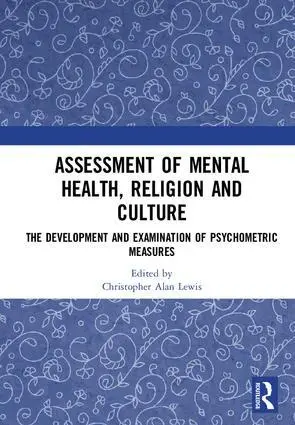
    Assessment of Mental Health, Religion and Culture

    The Development and Examination of Psychometric Measures

    AvChristopher Alan Lewis

    Inbunden, Engelska, 2018

    2 506 kr

    Beställningsvara. Skickas inom 10-15 vardagar. Fri frakt över 249 kr.

    Beskrivning

    Assessment of mental health, religion and culture: The development and examination of psychometric measures focuses on questionnaires that are of practical value for researchers interested in examining the relationship between the constructs of mental health, religion, and culture. Three particular areas of development and evaluation are represented within this volume: firstly, the psychometric properties of recently developed new questionnaires; secondly, the psychometric properties of established questionnaires that have been translated into other languages; and thirdly, the psychometric properties of questionnaires employed in various cultural contexts and religious samples. The research in this book is authored by a wide range of international scholars working on diverse samples and in a variety of different cultures. In doing so, the book facilitates future research in the area of mental health, religion, and culture. This book was originally published as two special issues of Mental Health, Religion & Culture.

    Produktinformation

    • Utgivningsdatum:2018-06-05
    • Mått:174 x 246 x 21 mm
    • Vikt:612 g
    • Format:Inbunden
    • Språk:Engelska
    • Antal sidor:240
    • Förlag:Taylor & Francis Inc
    • ISBN:9780815383192

    Utforska kategorier

    • Klinisk psykologi inom Medicin
    • Socialpsykologi och gruppsykologi inom Psykologi och pedagogik
    • Psykologisk metod inom Psykologi och pedagogik

    Mer om författaren

    Christopher Alan Lewis is Professor of Psychology, and the Director of the Alister Hardy Religious Experience Research Centre, at Glyndŵr University, Wrexham, United Kingdom. He is also a Distinguished Visiting Professor at Bashkir State University, Ufa, Russia. He is co-editor of the Mental Health, Religion & Culture journal.

    Innehållsförteckning

    • Introduction 1. Development and validation of Vikaras Hindi Scale 2. The psychometric properties of the Sahin-Francis Scale of Attitude towards Islam revised among Sunni students in Malaysia 3. Development and validation of the Buddhist Patience Questionnaire 4. Development and validation of Religious Attribution Scale: in association with religiosity and meaning in life among economically disadvantaged adolescents in Indonesia 5. Belief into Action Scale: psychometric properties of the Farsi version 6. Validation of Meaning in Life Questionnaire in Hindi (MLQ-H) 7. Urdu translation of the Sahin–Francis Scale of Attitude toward Islam Revised: a response and update to Francis, Tekke, and Robbins (2016) 8. A confirmatory factor analysis of the Spiritual Transcendence Index: assessing spirituality in a sample of Latino college students 9. Dreaming mystical experience among Christians and Hindus: the impact of culture, language, and religious participation on responses to the Dreaming Mysticism Scale 10. Psychometric properties of the Arabic version of the Belief into Action Scale 11. The psychometric properties of the Italian translation of the Purpose in Life Scale (PILS) in Italy among a sample of Italian adults 12. Effects of secularisation on the psychometric properties of the Post Critical Belief Scale 13. Meditative insight: validation of a French version of Ireland’s Insight Scale (2012) and exploration of relationships between meditative insight and perceived stress 14. Intrinsic and extrinsic religious orientation in Portuguese Catholics 15. Factor analysis and validation of the Brief Religious Coping Scale (Brief-RCOPE) in Iranian university students 16. The internal consistency reliability and construct validity of the Santosh–Francis Scale of Attitude toward Hinduism among students in India 17. Faith, spirituality, and values among Asian-American older adults: an exploratory factor analysis of the Multidimensional Measures of Religion and Spirituality 18. Religious experience and religious motivation among Catholic and mainstream Protestant churchgoers in Australia: testing and applying five short measures 19. Validating the Flourishing Scale and the Scale of Positive and Negative Experience in India 20. The measurement of attitude toward Islam in Pakistan – more positives than negatives?: a response to Hamid et al. (2016)