• Fri frakt över 249 kr
  • •
  • Snabba leveranser
  • •
  • Billiga böcker
Kundservice

Du är på sajten för privatpersoner.

Företag, bibliotek eller offentlig verksamhet?

Du handlar på classic.bokus.com, där alla dina funktioner finns intakta.
Till classic.bokus.com
Bokus logotyp. Gå till startsidan.
  • Erbjudanden
  • Nyheter
  • Student
  • Topplistor
  • Barn & ungdom
  • Bokus Play
  • E-böcker
  • Pocketböcker
  • Spel & pussel

10% rabatt på allt med kod NYSTART10 →

Sidfot

Mina sidor

    Hjälp

    • Kundservice
    • Vanliga frågor och svar
    • Frakt och leverans
    • Retur vid ångerrätt
    • Reklamera vara
    • Betalning
    • Köpvillkor
    • Allmänna villkor
    • Information om webbplatsens tillgänglighet

    Om Bokus

    • Om oss
    • Pressrum
    • För studenter
    • För företag
    • För bibliotek och offentlig verksamhet
    • För leverantörer
    • Hållbarhet

    Populärt

    • Aktuella erbjudanden
    • Presentkort
    • Studentlitteratur
    • Nya böcker
    • Topplistor
    • Signerade böcker
    • Engelska böcker

    Inspiration

    • Boktips
    • BookTok
    • Populära bokserier
    • Barnbokskaraktärer
    • Populära författare
    Logotyp för Bokus
    Följ oss på Facebook (extern länk)Följ oss på Instagram (extern länk)Följ oss på YouTube (extern länk)Följ oss på TikTok (extern länk)
    bokus @ CookiesAnpassa cookiesIntegritetspolicyKöpvillkor
    Till Citymail hemsida (extern länk)Till Budbee hemsida (extern länk)Till Postnord hemsida (extern länk)Till Schenker hemsida (extern länk)Till Early Bird hemsida (extern länk)Till Walleys hemsida (extern länk)
    1. Skönlitteratur
    2. Litteraturvetenskap
    3. Litteraturvetenskap

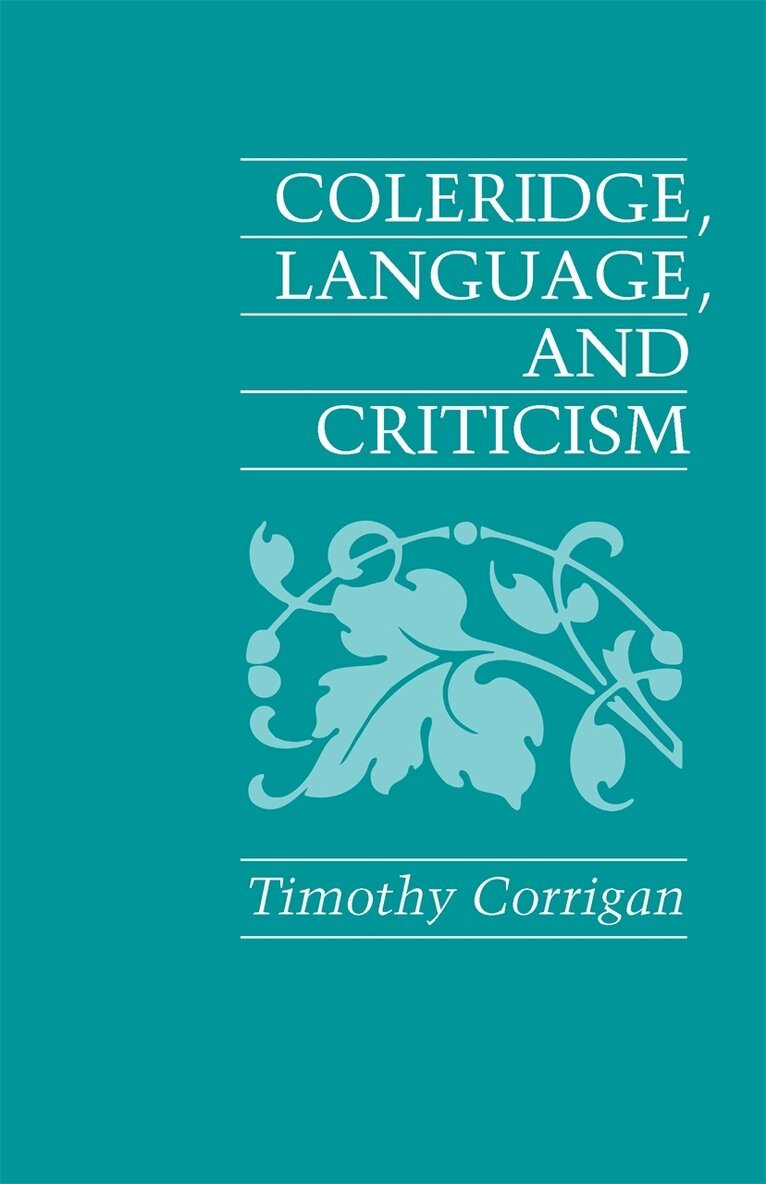
    Coleridge, Language and Criticism

    AvTimothy Corrigan

    Häftad, Engelska, 2008

    516 kr

    Beställningsvara. Skickas inom 5-8 vardagar. Fri frakt över 249 kr.

    Beskrivning

    Long celebrated as a great aesthetic idealist and champion of the imagination, Coleridge is now beginning to be understood as a literary critic with many other dimensions, with exciting and far-reaching insights into language, and with detailed notions about the psychological, historical, and linguistic demands of the literary experience.In this study, Timothy Corrigan sees Coleridge's criticism as "the product of an actively self-conscious reader, of a precise user of language, and, most of all, of a historical man involved with the demands of his day." Specifically he studies the relationship between the language of Coleridge's criticism and his interests in politics, psychology, science, and theology.Corrigan concludes that Coleridge's work is not a closed and strictly defined system but an extraordinarily diverse one that responds sympathetically to new angles of research. His study is first and foremost an investigation of Coleridge's criticism based on Coleridge's own ideas about language and reading. While taking its particular direction from a variety of contemporary literary theories, the book is most concerned with how Coleridge's critical prose and theoretical positions anticipate these in an exceptionally complex way.

    Produktinformation

    • Utgivningsdatum:2008-04-01
    • Mått:140 x 216 x 13 mm
    • Vikt:454 g
    • Format:Häftad
    • Språk:Engelska
    • Antal sidor:232
    • Förlag:University of Georgia Press
    • ISBN:9780820332406

    Utforska kategorier

    • Litteraturvetenskap inom Skönlitteratur
    • Poesi inom Skönlitteratur

    Mer om författaren

    TIMOTHY CORRIGAN is a professor of cinema studies, English, and history of art at the University of Pennsylvania. Besides a range of essays on Hazlitt, Keats, and De Quincey, his books include New German Film: The Displaced Image, The Films of Werner Herzog: Between Mirage and History, Writing About Film, A Cinema Without Walls: Movies and Culture After Vietnam, Film and Literature: An Introduction and Reader, and The Film Experience. His articles have appeared in Philological Quarterly, the Journal of the History of Ideas, and numerous film journals. His most recent project, The Essay Film, returns to his earlier work in British romanticism to trace the evolution of the essayistic in contemporary film practices.