• Fri frakt över 249 kr
  • •
  • Snabba leveranser
  • •
  • Billiga böcker
Kundservice

Du är på sajten för privatpersoner.

Företag, bibliotek eller offentlig verksamhet?

Du handlar på classic.bokus.com, där alla dina funktioner finns intakta.
Till classic.bokus.com
Bokus logotyp. Gå till startsidan.
  • Erbjudanden
  • Nyheter
  • Student
  • Topplistor
  • Barn & ungdom
  • Bokus Play
  • E-böcker
  • Pocketböcker
  • Spel & pussel

Må bättre, för mindre! Upp till 50% rabatt på hälsoböcker

Sidfot

Mina sidor

    Hjälp

    • Kundservice
    • Vanliga frågor och svar
    • Frakt och leverans
    • Retur vid ångerrätt
    • Reklamera vara
    • Betalning
    • Köpvillkor
    • Allmänna villkor
    • Information om webbplatsens tillgänglighet

    Om Bokus

    • Om oss
    • Pressrum
    • För studenter
    • För företag
    • För bibliotek och offentlig verksamhet
    • För leverantörer
    • Hållbarhet

    Populärt

    • Aktuella erbjudanden
    • Presentkort
    • Studentlitteratur
    • Nya böcker
    • Topplistor
    • Signerade böcker
    • Engelska böcker

    Inspiration

    • Boktips
    • BookTok
    • Populära bokserier
    • Barnbokskaraktärer
    • Populära författare
    Logotyp för Bokus
    Följ oss på Facebook (extern länk)Följ oss på Instagram (extern länk)Följ oss på YouTube (extern länk)Följ oss på TikTok (extern länk)
    bokus @ CookiesAnpassa cookiesIntegritetspolicyKöpvillkor
    Till Citymail hemsida (extern länk)Till Budbee hemsida (extern länk)Till Postnord hemsida (extern länk)Till Schenker hemsida (extern länk)Till Early Bird hemsida (extern länk)Till Walleys hemsida (extern länk)
    1. Skönlitteratur
    2. Essäer

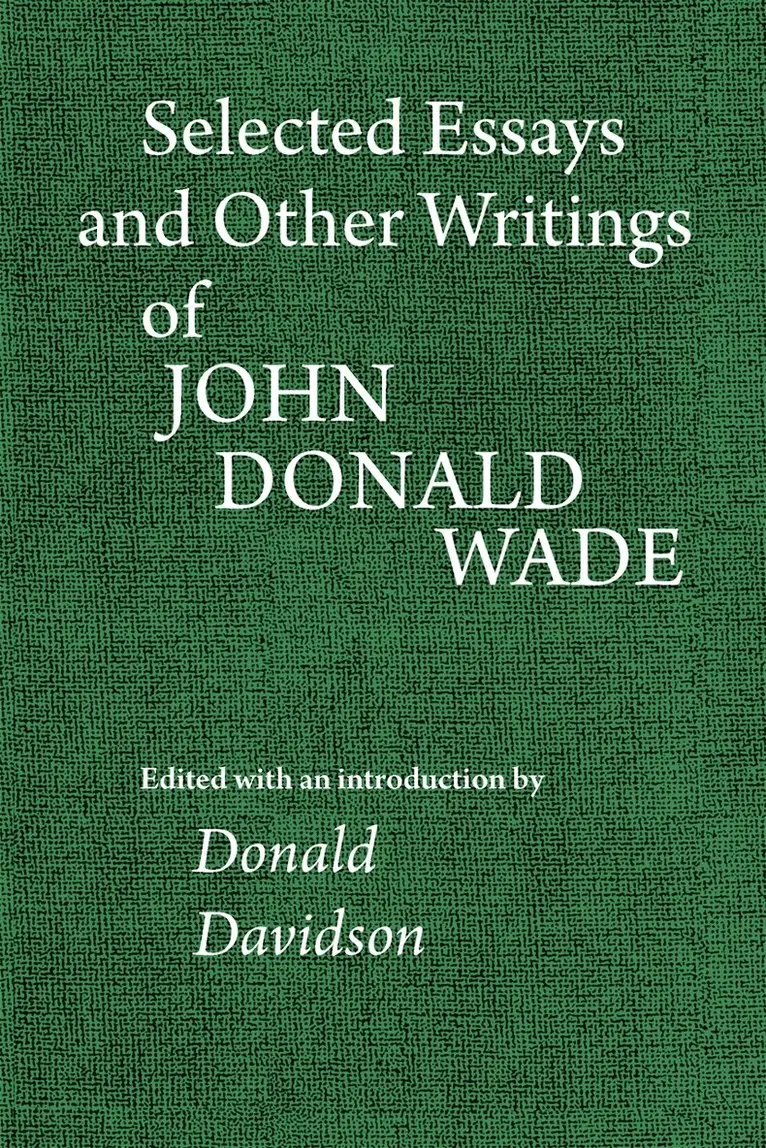
    Selected Essays and Other Writings of John Donald Wade

    AvJohn Donald Wade,Donald Davidson

    Häftad, Engelska, 2010

    516 kr

    Beställningsvara. Skickas inom 5-8 vardagar. Fri frakt över 249 kr.

    Beskrivning

    One of the most important of the Southern magazines in the 1920s was The Fugitive, a magazine of verse and brief commentaries on literature in general. Among its contributors were John Crowe Ransom, Allen Tate, Robert Penn Warren, Donald Davidson, and Merrill Moore. Publication began in April 1922 and ended in December 1925. Soon thereafter, the “Fugitive” writers and some others became profoundly concerned with the materialism of American life and its effect upon the South. The group became known as “Agrarians.” Their thinking and discussion culminated in a symposium, I’ll Take My Stand, published in 1930.In his first two lectures Davidson describes the underlying nature and aims of the Fugitive and Agrarian movements. He brings to the discussion his intimate and thorough knowledge of Southern life and letters. The third lecture deals with the place of the writer in the modern university, posing the questions of whether the writer needs the university and whether the university needs or wants the writer.

    Produktinformation

    • Utgivningsdatum:2010-12-01
    • Mått:152 x 229 x 14 mm
    • Vikt:454 g
    • Format:Häftad
    • Språk:Engelska
    • Antal sidor:248
    • Förlag:University of Georgia Press
    • ISBN:9780820338149

    Utforska kategorier

    • Essäer inom Skönlitteratur
    • Litteraturvetenskap inom Skönlitteratur

    Mer om författaren

    John Donald Wade (Author) JOHN DONALD WADE (1892-1963) was a noted biographer, essayist, and literary scholar. He was a member of the Vanderbilt Agrarian movement and a contributor to its manifesto, I'll Take My Stand. Wade was also the founder of the Georgia Review.Donald Davidson (Editor) DONALD DAVIDSON (1893–1968) was an English professor at Vanderbilt until his retirement in 1964. As a critic, poet, and essayist he was a leader in the Agrarian movement and an integral contributor to I’ll Take My Stand.

    Recensioner i media

    Davidson has only begun to tell us the things he could about himself and his colleagues. The best part of this fine little volume is the intimate descriptions of the early meetings of the Fugitives, the personalities, the ‘insignificant’ little details that together give us an insight into what it must have been like to have been writing poetry and talking about it at Vanderbilt just before and during the early 1920s, when the Fugitives were taking shape.