Inbunden, Engelska, 2000
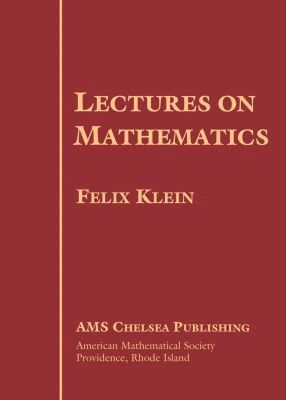
Lectures on Mathematics
Av American Mathematical Society
832 kr
Beställningsvara. Skickas inom 5-8 vardagar. Fri frakt över 249 kr.
Beskrivning
In the late summer of 1893, following the Congress of Mathematicians held in Chicago, Felix Klein gave two weeks of lectures on the current state of mathematics. Rather than offering a universal perspective, Klein presented his personal view of the most important topics of the time. It is remarkable how most of the topics continue to be important today. Originally published in 1893 and reissued by the AMS in 1911, we are pleased to bring this work into print once more with this new edition. Klein begins by highlighting the works of Clebsch and of Lie. In particular, he discusses Clebsch's work on Abelian functions and compares his approach to the theory with Riemann's more geometrical point of view. Klein devotes two lectures to Sophus Lie, focussing on his contributions to geometry, including sphere geometry and contact geometry.Klein's ability to connect different mathematical disciplines clearly comes through in his lectures on mathematical developments. For instance, he discusses recent progress in non-Euclidean geometry by emphasizing the connections to projective geometry and the role of transformation groups. In his descriptions of analytic function theory and of recent work in hyperelliptic and Abelian functions, Klein is guided by Riemann's geometric point of view. He discusses Galois theory and solutions of algebraic equations of degree five or higher by reducing them to normal forms that might be solved by non-algebraic means. Thus, as discovered by Hermite and Kronecker, the quintic can be solved 'by elliptic functions'.This also leads to Klein's well-known work connecting the quintic to the group of the icosahedron. Klein expounds on the roles of intuition and logical thinking in mathematics. He reflects on the influence of physics and the physical world on mathematics and, conversely, on the influence of mathematics on physics and the other natural sciences. The discussion is strikingly similar to today's discussions about 'physical mathematics'. There are a few other topics covered in the lectures which are somewhat removed from Klein's own work. For example, he discusses Hilbert's proof of the transcendence of certain types of numbers (including $\pi$ and $e$), which Klein finds much simpler than the methods used by Lindemann to show the transcendence of $\pi$.Also, Klein uses the example of quadratic forms (and forms of higher degree) to explain the need for a theory of ideals as developed by Kummer. Klein's look at mathematics at the end of the 19th Century remains compelling today, both as history and as mathematics. It is delightful and fascinating to observe from a one-hundred year retrospect, the musings of one of the masters of an earlier era.
Produktinformation
- Utgivningsdatum: 2000-09-30
- Mått: 236 x 158 x 12 mm
- Vikt: 355 g
- Format: Inbunden
- Språk: Engelska
- Serie: Chelsea Publications
- Förlag: American Mathematical Society
- ISBN: 9780821827338
Utforska kategorier
Betyg & recensioner
0 recensioner
Inga recensioner tillgängliga.