• Fri frakt över 249 kr
  • •
  • Snabba leveranser
  • •
  • Billiga böcker
Kundservice

Du är på sajten för privatpersoner.

Företag, bibliotek eller offentlig verksamhet?

Du handlar på classic.bokus.com, där alla dina funktioner finns intakta.
Till classic.bokus.com
Bokus logotyp. Gå till startsidan.
  • Erbjudanden
  • Nyheter
  • Student
  • Topplistor
  • Barn & ungdom
  • Bokus Play
  • E-böcker
  • Pocketböcker
  • Spel & pussel

10% rabatt på allt med kod NYSTART10 →

Sidfot

Mina sidor

    Hjälp

    • Kundservice
    • Vanliga frågor och svar
    • Frakt och leverans
    • Retur vid ångerrätt
    • Reklamera vara
    • Betalning
    • Köpvillkor
    • Allmänna villkor
    • Information om webbplatsens tillgänglighet

    Om Bokus

    • Om oss
    • Pressrum
    • För studenter
    • För företag
    • För bibliotek och offentlig verksamhet
    • För leverantörer
    • Hållbarhet

    Populärt

    • Aktuella erbjudanden
    • Presentkort
    • Studentlitteratur
    • Nya böcker
    • Topplistor
    • Signerade böcker
    • Engelska böcker

    Inspiration

    • Boktips
    • BookTok
    • Populära bokserier
    • Barnbokskaraktärer
    • Populära författare
    Logotyp för Bokus
    Följ oss på Facebook (extern länk)Följ oss på Instagram (extern länk)Följ oss på YouTube (extern länk)Följ oss på TikTok (extern länk)
    bokus @ CookiesAnpassa cookiesIntegritetspolicyKöpvillkor
    Till Citymail hemsida (extern länk)Till Budbee hemsida (extern länk)Till Postnord hemsida (extern länk)Till Schenker hemsida (extern länk)Till Early Bird hemsida (extern länk)Till Walleys hemsida (extern länk)
    1. Språk och ordböcker
    2. Språkvetenskap och lingvistik

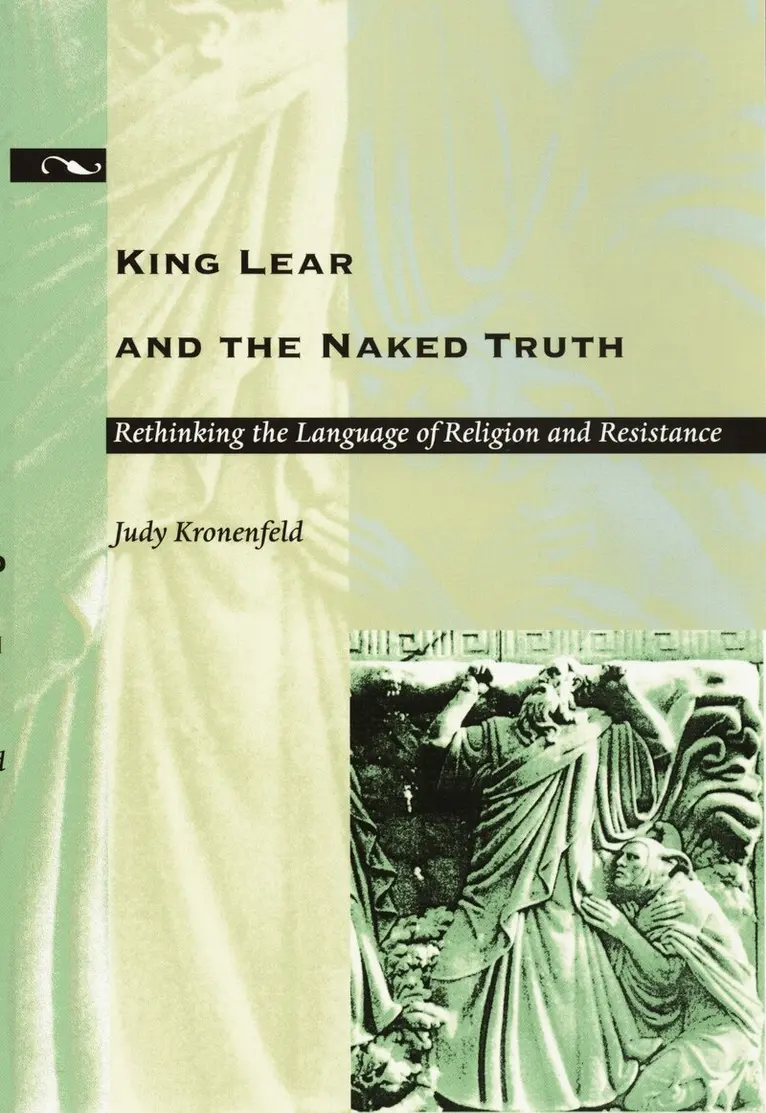
    King Lear and the Naked Truth

    Rethinking the Language of Religion and Resistance

    AvJudy Kronenfeld

    Häftad, Engelska, 1998

    496 kr

    Beställningsvara. Skickas inom 5-8 vardagar. Fri frakt över 249 kr.

    Beskrivning

    Taking King Lear as her central text, Judy Kronenfeld seriously questions the critical assumptions of much of today’s most fashionable Shakespeare scholarship. Charting a new course beyond both New Historicist and deconstructionist critics, she suggests a theory of language and interpretation that provides essential historical and linguistic contexts for the key terms and concepts of the play. Opening the play up to the implications of these contexts and this interpretive theory, she reveals much about Lear, English Reformation religious culture, and the state of contemporary criticism. Kronenfeld’s focus expands from the text of Shakespeare’s play to a discussion of a shared Christian culture-a shared language and set of values-a common discursive field that frames the social ethics of the play. That expanded focus is used to address the multiple ways that clothing and nakedness function in the play, as well as the ways that these particular images and terms are understood in that shared context. As Kronenfeld moves beyond Lear to uncover the complex resonances of clothing and nakedness in sermons, polemical tracts, legislation, rhetoric, morality plays, and actual or alleged practices such as naked revolts by Anabaptists and the Adamians’ ritual disrobing during religious services, she demonstrates that many key terms and concepts of the period cannot be tied to a single ideology. Instead, they represent part of an intricate network of thought shared by people of seemingly opposite views, and it is within such shared cultural networks that dissent, resistance, and creativity can emerge. Warning her readers not to take the language of literary texts out of the linguistic context within which it first appeared, Kronenfeld has written a book that reinterprets the linguistic model that has been the basis for much poststructuralist criticism.

    Produktinformation

    • Utgivningsdatum:1998-04-20
    • Mått:157 x 236 x 30 mm
    • Vikt:739 g
    • Format:Häftad
    • Språk:Engelska
    • Antal sidor:400
    • Förlag:Duke University Press
    • ISBN:9780822320388

    Utforska kategorier

    • Språkvetenskap och lingvistik inom Språk och ordböcker
    • Litteraturvetenskap inom Skönlitteratur

    Mer om författaren

    Judy Kronenfeld is a Lecturer in the Creative Writing Department at the University of California, Riverside.

    Recensioner i media

    “[A] learned, intelligent, and interesting book. . . . [A] wide-ranging knowledge of Renaissance religious and political commentary and of current criticism is made available in a lucid and persuasive argument.” - Edward Pechter, Journal of English and Germanic Philology “Kronenfeld’s achievement here is enormous, particularly in providing a necessary corrective to versions of historicism that seem Old in all but political slant.” - Andrew James Hartley, Christianity and Literature “To read [this] book . . . is to encounter a mind capable of tackling the most sophisticated of historical and theoretical topics with both grace and reason. Kronenfeld takes us on a tour both of history and of Shakespeare’s text in a way that finally leaves each seeming at once extremely complex but also much more readily comprehensible. She manages the difficult feat of clarifying without simplifying, and for that reason alone her book is well worth the attention of any serious student of Lear, Shakespeare, the Renaissance, and literary theory.” - Ben Jonson Journal “King Lear and the Naked Truth is richly researched, deeply learned, and largely achieves what it sets out to do. This is an important study from which all readers will learn.” - Ronald Knowles, Renaissance Quarterly “Judy Kronenfeld’s book on political criticism and King Lear makes some important points and provides a rich florilegium of quotations from sixteenth- and seventeenth-century homiletic texts (along with an excellent bibliography). It is a book anyone doing sociohistorical or political criticism of Shakespeare, or of any Elizabethan or Jacobean texts, should take seriously.” - Richard Strier, Shakespeare Quarterly “Kronenfeld’s painstaking reconstruction of English Reformed thought on subjects such as charity, rank, and the family deserves a wide audience. . . . Her thoughtful and challenging critique of new historical readings of Lear also merits consideration.” - Kenneth J. E. Graham, Modern Philology "This is a most impressive book, one that is sure to have an impact, raise questions, and create controversy."-Herbert Lindenberger, Stanford University “King Lear and the Naked Truth is richly researched, deeply learned, and largely achieves what it sets out to do. This is an important study from which all readers will learn.” - Ronald Knowles (Renaissance Quarterly) “[A] learned, intelligent, and interesting book. . . . [A] wide-ranging knowledge of Renaissance religious and political commentary and of current criticism is made available in a lucid and persuasive argument.” - Edward Pechter (Journal of English and Germanic Philology) “Judy Kronenfeld’s book on political criticism and King Lear makes some important points and provides a rich florilegium of quotations from sixteenth- and seventeenth-century homiletic texts (along with an excellent bibliography). It is a book anyone doing sociohistorical or political criticism of Shakespeare, or of any Elizabethan or Jacobean texts, should take seriously.” - Richard Strier (Shakespeare Quarterly) “Kronenfeld’s achievement here is enormous, particularly in providing a necessary corrective to versions of historicism that seem Old in all but political slant.” - Andrew James Hartley (Christianity and Literature) “Kronenfeld’s painstaking reconstruction of English Reformed thought on subjects such as charity, rank, and the family deserves a wide audience. . . . Her thoughtful and challenging critique of new historical readings of Lear also merits consideration.” - Kenneth J. E. Graham (Modern Philology) “To read [this] book . . . is to encounter a mind capable of tackling the most sophisticated of historical and theoretical topics with both grace and reason. Kronenfeld takes us on a tour both of history and of Shakespeare’s text in a way that finally leaves each seeming at once extremely complex but also much more readily comprehensible. She manages the difficult feat of clarifying without simplifying, and for that reason alone her book is well worth the attention of any serious student of Lear, Shakespeare, the Renaissance, and literary theory.” (Ben Jonson Journal)