• Fri frakt över 249 kr
  • •
  • Snabba leveranser
  • •
  • Billiga böcker
Kundservice

Du är på sajten för privatpersoner.

Företag, bibliotek eller offentlig verksamhet?

Du handlar på classic.bokus.com, där alla dina funktioner finns intakta.
Till classic.bokus.com
Bokus logotyp. Gå till startsidan.
  • Erbjudanden
  • Student
  • Topplistor
  • Barn & ungdom
  • Bokus Play
  • E-böcker
  • Ljudböcker
  • Pocketböcker
  • Spel och pussel

Pocketfynda! Hundratals böcker för 49 kr/st →

Sidfot

Mina sidor

    Hjälp

    • Kundservice
    • Vanliga frågor och svar
    • Frakt och leverans
    • Retur vid ångerrätt
    • Reklamera vara
    • Betalning
    • Köpvillkor
    • Allmänna villkor
    • Information om webbplatsens tillgänglighet

    Om Bokus

    • Om oss
    • Pressrum
    • För studenter
    • För företag
    • För bibliotek och offentlig verksamhet
    • För leverantörer
    • Hållbarhet

    Populärt

    • Aktuella erbjudanden
    • Presentkort
    • Studentlitteratur
    • Nya böcker
    • Topplistor
    • Signerade böcker
    • Engelska böcker

    Inspiration

    • Boktips
    • BookTok
    • Barnbokskaraktärer
    • Populära författare
    Logotyp för Bokus
    Följ oss på Facebook (extern länk)Följ oss på Instagram (extern länk)Följ oss på YouTube (extern länk)Följ oss på TikTok (extern länk)
    bokus @ CookiesAnpassa cookiesIntegritetspolicyKöpvillkor
    Till Citymail hemsida (extern länk)Till Budbee hemsida (extern länk)Till Postnord hemsida (extern länk)Till Schenker hemsida (extern länk)Till Early Bird hemsida (extern länk)Till Walleys hemsida (extern länk)
    1. Samhälle och politik
    2. Sociologi och antropologi
    3. Antropologi

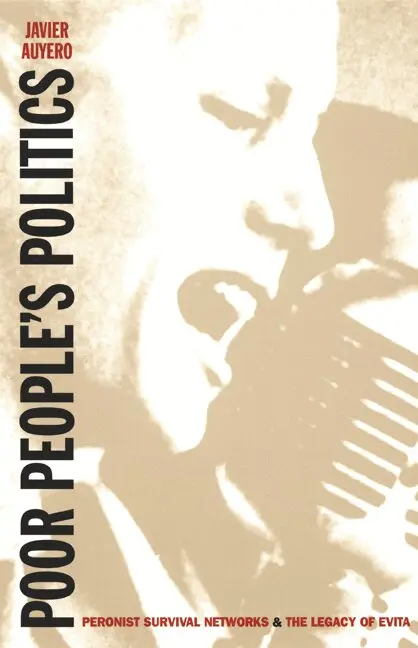
    Poor People's Politics

    Peronist Survival Networks and the Legacy of Evita

    AvJavier Auyero

    Häftad, Engelska, 2001

    375 kr

    Beställningsvara. Skickas inom 5-8 vardagar. Fri frakt över 249 kr.

    Fler format och utgåvor

    E-bok

    568 kr

    Beskrivning

    “Political clientelism” is a term used to characterize the contemporary relationships between political elites and the poor in Latin America in which goods and services are traded for political favors. Javier Auyero critically deploys the notion in Poor People’s Politics to analyze the political practices of the Peronist Party among shantytown dwellers in contemporary Argentina. Looking closely at the slum-dwellers’ informal problem-solving networks, which are necessary for material survival, and the different meanings of Peronism within these networks, Auyero presents the first ethnography of urban clientelism ever carried out in Argentina. Revealing a deep familiarity with the lives of the urban poor in Villa ParaÍso, a stigmatized and destitute shantytown of Buenos Aires, Auyero demonstrates the ways in which local politicians present their vital favors to the poor and how the poor perceive and evaluate these favors. Having penetrated the networks, he describes how they are structured, what is traded, and the particular way in which women facilitate these transactions. Moreover, Auyero proposes that the act of granting favors or giving food in return for votes gives the politicians’ acts a performative and symbolic meaning that flavors the relation between problem-solver and problem-holder, while also creating quite different versions of contemporary Peronism. Along the way, Auyero is careful to situate the emergence and consolidation of clientelism in historic, cultural, and economic contexts.Poor People’s Politics reexamines the relationship between politics and the destitute in Latin America, showing how deeply embedded politics are in the lives of those who do not mobilize in the usual sense of the word but who are far from passive. It will appeal to a wide range of students and scholars of Latin American studies, sociology, anthropology, political science, history, and cultural studies.

    Produktinformation

    • Utgivningsdatum:2001-01-01
    • Mått:152 x 229 x 21 mm
    • Vikt:449 g
    • Format:Häftad
    • Språk:Engelska
    • Antal sidor:272
    • Förlag:Duke University Press
    • ISBN:9780822326212

    Utforska kategorier

    • Antropologi inom Samhälle och politik
    • Sociala och etiska frågor inom Samhälle och politik
    • Politik och statsskick inom Samhälle och politik

    Mer om författaren

    Javier Auyero is Joe R. and Teresa Lozano Long Professor of Latin American Sociology at the University of Texas, Austin.

    Recensioner i media

    “At the level of most political science literature on urban poverty and clientelism, this work is genuinely pathbreaking. Combining the best of ‘thick description’ ethnography with a sense of more global processes at work in a society, Auyero uses the most up-to-date analytical frameworks to interrogate an object of study that has rarely-if ever-been so addressed. This is a book to be reckoned with over the next few years and beyond.”-Daniel James, author of DoÑa MarÍa’s Story: Life History, Memory, and Political Identity “Other people write about patronage politics as a form of organization, as a scourge to eradicate, or as a necessary evil on the way to full democracy. Javier Auyero writes about it as a raucous, improvised, crucial way of surviving poverty and inequality. Reporting perceptive first-hand observations in playful, energetic prose, Auyero illuminates poor people’s politics in Argentina and elsewhere.”-Charles Tilly, Columbia University

    Innehållsförteckning

    • Acknowledgments ixWho Is Who in the Peronist Network xiiiIntroduction: The Day of the Rally Complaining about T-shirts on Peron's Birthday 11. "They Were Mostly Poor People" Poverty and Inequality in Contemporary Buenos Aires 292. "Most of Them Were Coming from Villa Paraiso" History and Lived Experiences of Shantytown Dwellers 453. "They Knew Matilde" The Problem-Solving Network 804. "We Will Fight Forever, We Are Peronists" Eva Peron as a Public Performance 1195. The "Clientelist" Viewpoint How Shantytown Dwellers Perceive and Evaluate Political Clientelism 1526. "They Were All Peronists" The Remnants of the Populist Heresy 182Conclusions Problem Solving through Political Mediation as a Structure of Feeling 205Epilogue Last Rally 215Notes 219Bibliography 237Index 255