• Fri frakt över 249 kr
  • •
  • Snabba leveranser
  • •
  • Billiga böcker
Kundservice

Du är på sajten för privatpersoner.

Företag, bibliotek eller offentlig verksamhet?

Du handlar på classic.bokus.com, där alla dina funktioner finns intakta.
Till classic.bokus.com
Bokus logotyp. Gå till startsidan.
  • Erbjudanden
  • Nyheter
  • Student
  • Topplistor
  • Barn & ungdom
  • Bokus Play
  • E-böcker
  • Pocketböcker
  • Spel & pussel

Må bättre, för mindre! Upp till 50% rabatt på hälsoböcker

Sidfot

Mina sidor

    Hjälp

    • Kundservice
    • Vanliga frågor och svar
    • Frakt och leverans
    • Retur vid ångerrätt
    • Reklamera vara
    • Betalning
    • Köpvillkor
    • Allmänna villkor
    • Information om webbplatsens tillgänglighet

    Om Bokus

    • Om oss
    • Pressrum
    • För studenter
    • För företag
    • För bibliotek och offentlig verksamhet
    • För leverantörer
    • Hållbarhet

    Populärt

    • Aktuella erbjudanden
    • Presentkort
    • Studentlitteratur
    • Nya böcker
    • Topplistor
    • Signerade böcker
    • Engelska böcker

    Inspiration

    • Boktips
    • BookTok
    • Populära bokserier
    • Barnbokskaraktärer
    • Populära författare
    Logotyp för Bokus
    Följ oss på Facebook (extern länk)Följ oss på Instagram (extern länk)Följ oss på YouTube (extern länk)Följ oss på TikTok (extern länk)
    bokus @ CookiesAnpassa cookiesIntegritetspolicyKöpvillkor
    Till Citymail hemsida (extern länk)Till Budbee hemsida (extern länk)Till Postnord hemsida (extern länk)Till Schenker hemsida (extern länk)Till Early Bird hemsida (extern länk)Till Walleys hemsida (extern länk)
    1. Historia och arkeologi
    2. Historia
    3. Historia: särskilda händelser och ämnen
    4. Kolonialism och imperialism

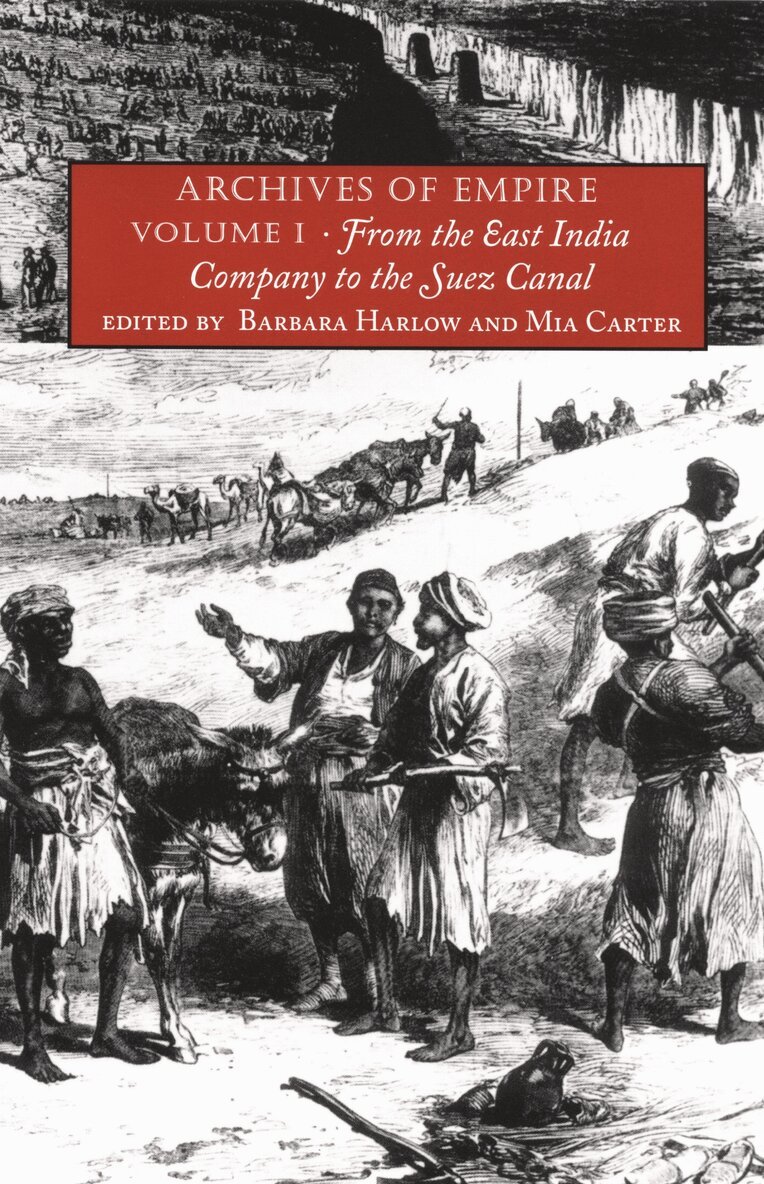
    Archives of Empire

    Volume I. from the East India Company to the Suez Canal

    AvBarbara Harlow,Mia Carter

    Häftad, Engelska, 2003

    514 kr

    Beställningsvara. Skickas inom 5-8 vardagar. Fri frakt över 249 kr.

    Beskrivning

    A rich collection of primary materials, the multivolume Archives of Empire provides a documentary history of nineteenth-century British imperialism from the Indian subcontinent to the Suez Canal to southernmost Africa. Barbara Harlow and Mia Carter have carefully selected a diverse range of texts that track the debates over imperialism in the ranks of the military, the corridors of political power, the lobbies of missionary organizations, the halls of royal geographic and ethnographic societies, the boardrooms of trading companies, the editorial offices of major newspapers, and far-flung parts of the empire itself. Focusing on a particular region and historical period, each volume in Archives of Empire is organized into sections preceded by brief introductions. Documents including mercantile company charters, parliamentary records, explorers’ accounts, and political cartoons are complemented by timelines, maps, and bibligraphies. Unique resources for teachers and students, these books reveal the complexities of nineteenth-century colonialism and emphasize its enduring relevance to the “global markets” of the twenty-first century. Tracing the beginnings of the British colonial enterprise in South Asia and the Middle East, From the Company to the Canal brings together key texts from the era of the privately owned British East India Company through the crises that led to the company’s takeover by the Crown in 1858. It ends with the momentous opening of the Suez Canal in 1869. Government proclamations, military reports, and newspaper articles are included here alongside pieces by Rudyard Kipling, Charles Dickens, John Stuart Mill, Karl Marx, Benjamin Disraeli, and many others. A number of documents chronicle arguments between mercantilists and free trade advocates over the competing interests of the nation and the East India Company. Others provide accounts of imperial crises-including the trial of Warren Hastings, the Indian Rebellion (Sepoy Mutiny), and the Arabi Uprising-that highlight the human, political, and economic costs of imperial domination and control.

    Produktinformation

    • Utgivningsdatum:2003-12-31
    • Mått:156 x 235 x 49 mm
    • Vikt:1 179 g
    • Format:Häftad
    • Språk:Engelska
    • Antal sidor:832
    • Förlag:Duke University Press
    • ISBN:9780822331643

    Utforska kategorier

    • Kolonialism och imperialism inom Historia och arkeologi
    • Allmän historia och världshistoria inom Historia och arkeologi

    Mer om författaren

    Barbara Harlow is Louann and Larry Temple Centennial Professor of English at the University of Texas, Austin.Mia Carter is Associate Professor of English at the University of Texas, Austin. They are coeditors of Imperialism and Orientalism: A Documentary Sourcebook.

    Recensioner i media

    “Archives of Empire offers a valuable and original intervention in contemporary studies of imperialism, providing a rich array of source material pertaining to the imperial project and the wide-ranging grounds for its critique.”-Anne McClintock, author of Imperial Leather: Race, Gender, and Sexuality in the Colonial Contest "Archives of Empire is a substantial and valuable project containing a generous sampling of key primary texts for understanding both the crucial events in and the debates around British imperialism in the nineteenth century.”-David Lloyd, coeditor of The Politics of Culture in the Shadow of Capital

    Innehållsförteckning

    • Acknowledgments xixGeneral Introduction: Readings in Imperialism and Orientalism xxiVolume Introduction: From the Company to the Canal 1I. COMPANY TO CANAL, 1757-1869 INTRODUCTION: Adventure Capitalism: Mercantilism, Militarism, and the British East India Company 13Chronology of Events 16List of the Governors and Governors-General of India 17List of the Newabs of Bengal 18India under Cornwallis (1792) [map] 19India under Wellesley (1799) [map] 19India under Hastings (1832) [map] 20India under Dalhousie (1856) [map] 20G.A. (George Alfred) Henty, Excerpt from With Clive in India (n.d.) 21“Agreement between the Nabob Nudjum-ul-Dowlah and the Company, 12 August 1765” 25Anonymous, An Inquiry into the Rights of the East India Company of Making War and Peace (1772) 27East India Company Act, 1773 31James Mill, “The Constitution of the East India Company” (1817) 39James Mill, Letter to Durmont (1819) 47John Stuart Mill. Excerpt from Autobiography (1873) 48Government of India Act, 1833 49Lord Thomas Babington Macaulay, “Lord Clive” (1840) 59Samuel Lucas, “The Spoliation of Oude” (1857) 72Sir Arthur Wellesley, “Memorandum on Marquess Wellesley’s Government of India” (1806) 81II. ORIENTAL DEPOTISM INTRODUCTON: Oriental Despotisms and Political Economies 89Baron de Montesquieu, “Distinctive Properties of a Despotic Government” (1746) 92Baron de Montesquieu, Excerpts from Persian Letters (1721) 92Adam Smith, “America and the East Indies” (1776) 95Robert Orme, “Of the Government and People of Indostan” (1782) 107John Stuart Mill, Excerpt from The Principles of Political Economy (1848) 111John Stuart Mill, Excerpt from “Considerations on Representative Government” (1861) 113Karl Marx, “On Imperialism in India” (1853) 117III. THE IMPEACHMENT OF WARREN HASTINGS INTRODUCTION: Warren Hastings: Naughty Nabob or National Hero? 131Warren Hastings, “Warren Hastings to the Court of General Directors, 11 November 1773” 135Warren Hastings, Excerpt from Memoirs Relative to the State of India (1786) 137Edmund Burke, “Edmund Burke on the Impeachment of Warren Hastings, 15-19 February 1788” 143Westminister Hall during the trial of Warren Hastings (1788) [illustration] 146Fanny Burney, Diary Selections (1788) 155Edmund Burke, “From the Third Day of Edmund Burke’s Speech Opening the Impeachment, 18 February 1788” 160Warren Hastings, “From the Address of Warren Hastings in His Defence, 2 June 1791” 163Lord Thomas Babington Macaulay, “Warren Hastings” (1841) 166IV. THE CASE OF TIPU SULTAN INTRODUCTION: Tipu Sultan: Oriental Despot or National Hero? 171G.A. Henty, Excerpts from The Tiger of Mysore (189?) 173“Tippoo Sahib at the Lines of Travancore” (1789) [illustration] 174Major Diram, “Treaties of Peace, and Review of the Consequences of War” (1793) 175Selected Letters between Tipu and Company Governors-General, 1798-1799 180Wilkie Collins, “Prologue: The Storming of Seringapatam, 1799” (1869) 195V. ORIENTALISM INTRODUCTION: Orientalism: The East as a Career 203Mary Shelley, Excerpts from Frankenstein (1813/1831) 206Benjamin Disraeli, Excerpt from Sibyl, or the Two Nations (1845) 208Definitions from the Hobson-Jobson Dictionary 209G.W.F. Hegel, “India” (1822) 219William Jones, “A Discourse on the Institution of a Society for Inquiring into the History, Civil and Natural, the Antiquities, Arts, Sciences, and Literatures of Asia” (1784) 223Lord Thomas Babington Macaulay, “Minute on Indian Education” (1835) 227Max Muller, “The Aryan Section” (1876) 239VI. LAWS AND ORDERS INTRODUCTION: Ordering “Chaos”: Administering the Law 249Robert Orme, “Of the Laws and Justice of Indostan” (1782) 251Sir William Jones, Preface to “Institutes of Hindu Law: Or, the Ordinances of Menu” (1794) 261Lord Thomas Babington Macaulay, “Introductory Report upon the Indian Penal Code” (1837) 268VII. THUGGEE/THAGI INTRODUCTION: Decriminalizing the Landscape: Thugs and Poisoners 285A thug “family tree” (1836) [illustration] 288Thug depredations (1836) [map] 288Thugs giving a demonstration of their method of strangulation (1855) [photo] 289Captain William H. Sleeman, Excerpts from The Thugs or Phansigars of India: History of the Rise and Progress (1839) 297Fanny Parks Parlby, “A Kutcherry or Kachahri” (1850) 307Philip Meadows Taylor, “Thugs” (1877) 314Philip Meadows Taylor, Excerpts from Confessions of a Thug (1837) 315Captain William H. Sleeman, “Thug Approvers” (1833-1835?) 322VIII. SUTTEE/SATI INTRODUCTION: Sati/Suttee: Observances, Abolition, Observations 337Colonel Henry Yule and A.C. Burnell, “Suttee” [definition] (1903) 340Lord William Bentinck, “Bentinck’s Minute on Sati, 8 November 1892” 350Sati Regulation XVII, A.D. 1829 of the Bengal Code, 4 December 1829 361“The Duties of a Faithful Widow,” from Digest of Hindi Law (n.d.) 364Raja Ram Mohan Roy, “Petitions and Addresses on the Practice of Suttee (1818-1831)” 369G.W.F. Hegel, On Sati (1822) 374Charles Dickens, Death by Fire of Miss Havisham (1861) 375Jules Verne, “Fogg Rescues a Sati” (1873) 377Maspero Jingle [advertisement for Maspero Egyptian cigarettes] 379Ernest Renan, On Suttee (1893) 380Flora Annie Steel, “The Reformer’s Wife” (1933) 381IX. THE INDIAN UPRISING/SEPOY MUTINY 1857-1858 INTRODUCTION: The “Asiatic Mystery”: The Sepoy Mutiny, Rebellion, or Revolt 391Chronology of Events 396Rulers and Rebels: Some Major Figures 397Excerpts from The Who’s Who of Indian Martyrs (1969-1973) 400“Portrait of Nana Sahib” [illustration] 402“Sepoys, 1757” (1890) [illustration] 406“Attack of the Mutineers on the Redan Battery at Lucknow, July 30, 1857” (n.d.) [illustration] 406“The Asiatic Mystery. As Prepared by Sepoy D’Israeli” (1857) [illustration] 407“Proclamation to the People of Oude on Its Annexati