• Fri frakt över 249 kr
  • •
  • Snabba leveranser
  • •
  • Billiga böcker
Kundservice

Du är på sajten för privatpersoner.

Företag, bibliotek eller offentlig verksamhet?

Du handlar på classic.bokus.com, där alla dina funktioner finns intakta.
Till classic.bokus.com
Bokus logotyp. Gå till startsidan.
  • Erbjudanden
  • Student
  • Topplistor
  • Barn & ungdom
  • Bokus Play
  • E-böcker
  • Ljudböcker
  • Pocketböcker
  • Spel och pussel

5% studentrabatt – använd koden KURSBOK27 →

Sidfot

Mina sidor

    Hjälp

    • Kundservice
    • Vanliga frågor och svar
    • Frakt och leverans
    • Retur vid ångerrätt
    • Reklamera vara
    • Betalning
    • Köpvillkor
    • Allmänna villkor
    • Information om webbplatsens tillgänglighet

    Om Bokus

    • Om oss
    • Pressrum
    • För studenter
    • För företag
    • För bibliotek och offentlig verksamhet
    • För leverantörer
    • Hållbarhet

    Populärt

    • Aktuella erbjudanden
    • Presentkort
    • Studentlitteratur
    • Nya böcker
    • Topplistor
    • Signerade böcker
    • Engelska böcker

    Inspiration

    • Boktips
    • BookTok
    • Barnbokskaraktärer
    • Populära författare
    Logotyp för Bokus
    Följ oss på Facebook (extern länk)Följ oss på Instagram (extern länk)Följ oss på YouTube (extern länk)Följ oss på TikTok (extern länk)
    bokus @ CookiesAnpassa cookiesIntegritetspolicyKöpvillkor
    Till Citymail hemsida (extern länk)Till Budbee hemsida (extern länk)Till Postnord hemsida (extern länk)Till Schenker hemsida (extern länk)Till Early Bird hemsida (extern länk)Till Walleys hemsida (extern länk)
    1. Naturvetenskap och teknik
    2. Teknik och industri
    3. Miljöteknik

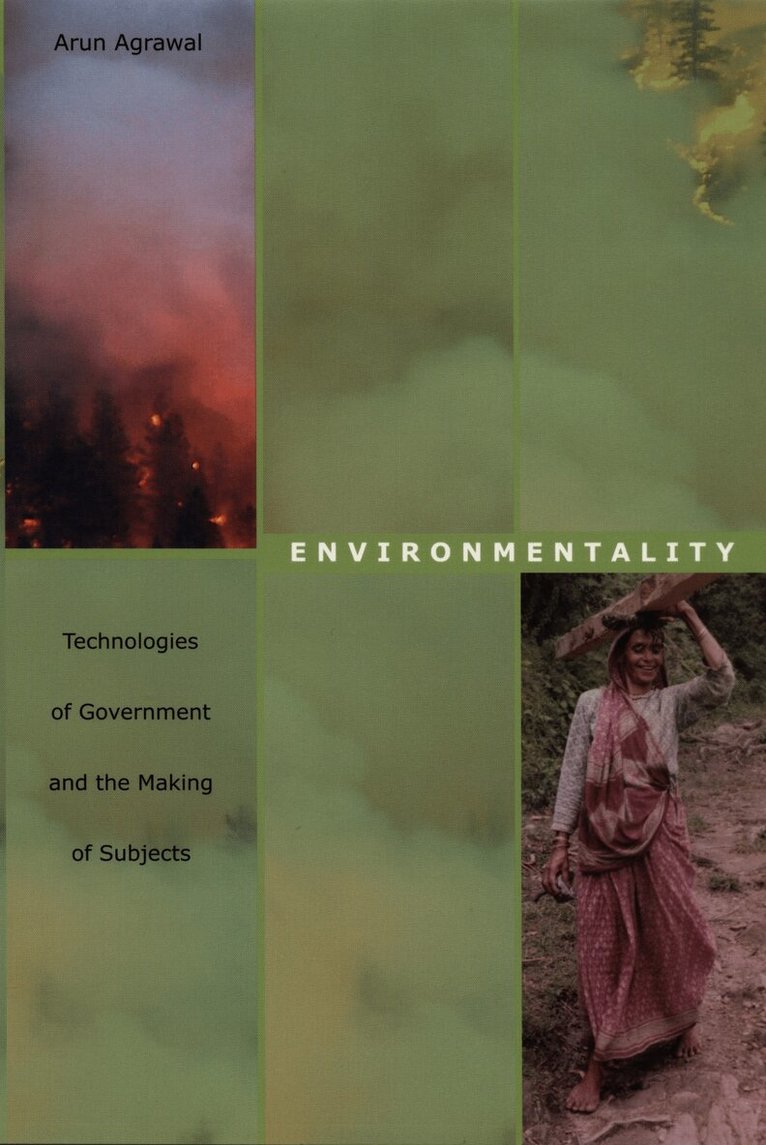
    Environmentality

    Technologies of Government and the Making of Subjects

    AvArun Agrawal

    Häftad, Engelska, 2005

    Del i serien New Ecologies for the Twenty-First Century

    543 kr

    Beställningsvara. Skickas inom 3-6 vardagar. Fri frakt över 249 kr.

    Fler format och utgåvor

    Inbunden

    1 535 kr

    E-bok

    552 kr

    Beskrivning

    In Kumaon in northern India, villagers set hundreds of forest fires in the early 1920s, protesting the colonial British state’s regulations to protect the environment. Yet by the 1990s, they had begun to conserve their forests carefully. In his innovative historical and political study, Arun Agrawal analyzes this striking transformation. He describes and explains the emergence of environmental identities and changes in state-locality relations and shows how the two are related. In so doing, he demonstrates that scholarship on common property, political ecology, and feminist environmentalism can be combined-in an approach he calls environmentality-to better understand changes in conservation efforts. Such an understanding is relevant far beyond Kumaon: local populations in more than fifty countries are engaged in similar efforts to protect their environmental resources.Agrawal brings environment and development studies, new institutional economics, and Foucauldian theories of power and subjectivity to bear on his ethnographical and historical research. He visited nearly forty villages in Kumaon, where he assessed the state of village forests, interviewed hundreds of Kumaonis, and examined local records. Drawing on his extensive fieldwork and archival research, he shows how decentralization strategies change relations between states and localities, community decision makers and common residents, and individuals and the environment. In exploring these changes and their significance, Agrawal establishes that theories of environmental politics are enriched by attention to the interconnections between power, knowledge, institutions, and subjectivities.

    Produktinformation

    • Utgivningsdatum:2005-04-06
    • Mått:152 x 230 x 20 mm
    • Vikt:420 g
    • Format:Häftad
    • Språk:Engelska
    • Serie:New Ecologies for the Twenty-First Century
    • Antal sidor:344
    • Förlag:Duke University Press
    • ISBN:9780822334927

    Utforska kategorier

    • Miljöteknik inom Naturvetenskap och teknik

    Mer om författaren

    Arun Agrawal is Associate Professor in the School of Natural Resources and Environment at the University of Michigan. He is the author of Greener Pastures: Politics, Markets, and Community among a Migrant Pastoral People and a coeditor of Agrarian Environments: Resources, Representations, and Rule in India, both also published by Duke University Press.

    Recensioner i media

    “Arun Agrawal achieves, in Environmentality, something of a breakthrough to new analytical territory where the binaries of state and society, structure and agency, public and private are transcended. He parlays the humble subject of community-based forestry and Foucault’s concept of ‘governmentality’ into the makings of an original and subtle analysis of modernity and nature.”-James C. Scott, Yale University “Arun Agrawal has written an amazing book that draws on a very-long-term case study to make general lessons. He analyzes the development of the mentality of citizens and officials related to the environment in a particular setting undergoing major shifts from centralization to a form of decentralization. All of us can take some important lessons from this book about how people’s mentalities change when they have power and knowledge to cope with a problem. That shift in knowledge and power took time and effort, but is one of the rare success stories of recent history.”-Elinor Ostrom, coeditor of Seeing the Forest and the Trees: Human-Environment Interactions in Forest Ecosystems “Environmentality offers readers in the fields of anthropology, environmental studies, and history a useful and interesting case study. . . . Environmentality is an excellent piece of scholarship, and a valuable addition to the fields of environmental anthropology and history, as well as to the general literature on colonial and postcolonial India.” - Sarah Strauss (American Anthropologist) "[A] particularly useful and timely piece of scholarship as it attempts to transgress what are often distant and diverse literatures. This book helps to shed light on the connections between environmental regulation, practice and subjectivity. And in that way, this book illustrates the complexity and connectivity of environmental conflicts and struggles that are often overlooked by more limited or constrained analytical approaches. The book is very clearly organized and well written. . . ." - Michael Mascarenhas (Rural Sociology) "Interesting. . . . The strength of the book lies in its exploration of agency among the local populations and the serious treatment of the culture that environmental regulation affects. . . . This book offers an insightful critique of the assumptions that both the state and peasant resistance are monolithic . . . and provides a useful starting point to understand the phenomena of community forestry that governments are implementing around the world." - Gregory Barton (American Historical Review)

    Innehållsförteckning

    • About the Series ixPreface and Acknowledgments xi1. Introduction: The Politics of Nature and the Making of Environmental Subjects 1Part I: Power/Knowledge and the Creation of Forests 252. Forests of Statistics: Colonial Environmental Knowledges 323. Struggles over Kumaon's Forests, 1815–1916 65Part II: A New Technology of Environmental Government: Politics, Institutions, and Subjectivities 874. Governmentalized Localities: The Dispersal of Regulation 1015. Inside the Regulatory Community 1276. Making Environmental Subjects: Intimate Government 1647. Conclusion: The Analytics of Environmentality 201Notes 231Bibliography 279Index 309