• Fri frakt över 249 kr
  • •
  • Snabba leveranser
  • •
  • Billiga böcker
Kundservice

Du är på sajten för privatpersoner.

Företag, bibliotek eller offentlig verksamhet?

Du handlar på classic.bokus.com, där alla dina funktioner finns intakta.
Till classic.bokus.com
Bokus logotyp. Gå till startsidan.
  • Erbjudanden
  • Nyheter
  • Student
  • Topplistor
  • Barn & ungdom
  • Bokus Play
  • E-böcker
  • Pocketböcker
  • Spel & pussel

10% rabatt på allt med kod: NYSTART10 →

Sidfot

Mina sidor

    Hjälp

    • Kundservice
    • Vanliga frågor och svar
    • Frakt och leverans
    • Retur vid ångerrätt
    • Reklamera vara
    • Betalning
    • Köpvillkor
    • Allmänna villkor
    • Information om webbplatsens tillgänglighet

    Om Bokus

    • Om oss
    • Pressrum
    • För studenter
    • För företag
    • För bibliotek och offentlig verksamhet
    • För leverantörer
    • Hållbarhet

    Populärt

    • Aktuella erbjudanden
    • Presentkort
    • Studentlitteratur
    • Nya böcker
    • Topplistor
    • Signerade böcker
    • Engelska böcker

    Inspiration

    • Boktips
    • BookTok
    • Populära bokserier
    • Barnbokskaraktärer
    • Populära författare
    Logotyp för Bokus
    Följ oss på Facebook (extern länk)Följ oss på Instagram (extern länk)Följ oss på YouTube (extern länk)Följ oss på TikTok (extern länk)
    bokus @ CookiesAnpassa cookiesIntegritetspolicyKöpvillkor
    Till Citymail hemsida (extern länk)Till Budbee hemsida (extern länk)Till Postnord hemsida (extern länk)Till Schenker hemsida (extern länk)Till Early Bird hemsida (extern länk)Till Walleys hemsida (extern länk)
    1. Samhälle och politik
    2. Samhälle och kultur
    3. Kultur och medier
    4. Referensverk och tvärvetenskap

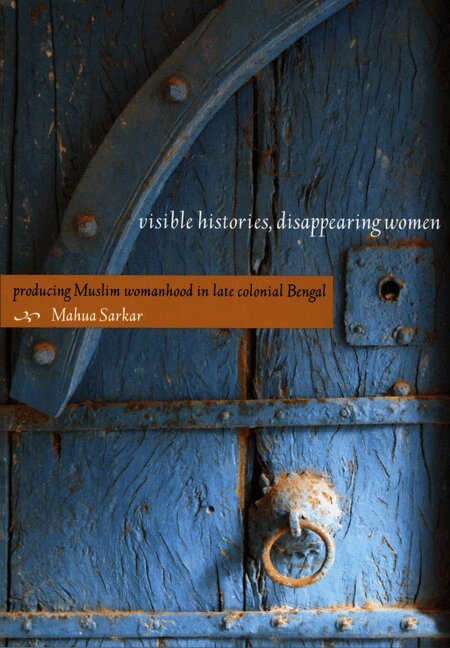
    Visible Histories, Disappearing Women

    Producing Muslim Womanhood in Late Colonial Bengal

    AvMahua Sarkar

    Häftad, Engelska, 2008

    431 kr

    Beställningsvara. Skickas inom 5-8 vardagar. Fri frakt över 249 kr.

    Fler format och utgåvor

    E-bok

    650 kr

    Beskrivning

    In Visible Histories, Disappearing Women, Mahua Sarkar examines how Muslim women in colonial Bengal came to be more marginalized than Hindu women in nationalist discourse and subsequent historical accounts. She also considers how their near-invisibility except as victims has underpinned the construction of the ideal citizen-subject in late colonial India. Through critical engagements with significant feminist and postcolonial scholarship, Sarkar maps out when and where Muslim women enter into the written history of colonial Bengal. She argues that the nation-centeredness of history as a discipline and the intellectual politics of liberal feminism have together contributed to the production of Muslim women as the oppressed, mute, and invisible “other” of the normative modern Indian subject.Drawing on extensive archival research and oral histories of Muslim women who lived in Calcutta and Dhaka in the first half of the twentieth century, Sarkar traces Muslim women as they surface and disappear in colonial, Hindu nationalist, and liberal Muslim writings, as well as in the memories of Muslim women themselves. The oral accounts provide both a rich source of information about the social fabric of urban Bengal during the final years of colonial rule and a glimpse of the kind of negotiations with stereotypes that even relatively privileged, middle-class Muslim women are still frequently obliged to make in India today. Sarkar concludes with some reflections on the complex links between past constructions of Muslim women, current representations, and the violence against them in contemporary India.

    Produktinformation

    • Utgivningsdatum:2008-04-25
    • Mått:156 x 229 x 21 mm
    • Vikt:481 g
    • Format:Häftad
    • Språk:Engelska
    • Antal sidor:352
    • Förlag:Duke University Press
    • ISBN:9780822342342

    Utforska kategorier

    • Referensverk och tvärvetenskap inom Samhälle och politik
    • Genusvetenskap inom Samhälle och politik

    Mer om författaren

    Mahua Sarkar is Associate Professor of Sociology and a faculty member of the Women’s Studies and Asian and Asian-American Studies programs at Binghamton University.

    Recensioner i media

    “Seeking to correct erstwhile celebratory representations of Muslim women, Visible Histories neither extols the virtues of Muslim womanhood in the late colonial period of Bengal, nor does it seek to redress for their untold stories. Visible Histories’ contribution to colonial historiography is more nuanced.” - Anita Anantharam, Journal of Colonialism and Colonial History “Mahua Sarkar’s . . . original and stimulating study. . . . Sarkar also seeks to enlarge notions of women’s ‘agency’ beyond those privileged by liberal feminists.” - Barbara D. Metcalf, Journal of Women’s History “By engaging with existing scholarship, Sarkar draws eclectically on a range of disciplines: sociology, anthropology, history, feminist and gender studies. The book represents historical sociology at its cutting edge by bringing intellectual history into the post-colonial present.” - Durba Ghosh, Social History “. . . Mahua Sarkar’s project . . . marks indeed a welcome and important intervention in postcolonial Indian historiography.” - Rochona Majumdar, Economic & Political Weekly “Visible Histories, Disappearing Women is an analytically insightful, genuinely original work that breaks new ground in South Asian history, gender and women’s studies, postcolonial theory, and historical sociology. One of its strengths is Mahua Sarkar’s insistence that history as a discipline and feminism as a politics have disappeared the Muslim woman as a subject.”-Antoinette Burton, editor of Archive Stories: Facts, Fictions, and the Writing of History “Mahua Sarkar’s insightful study of Bengali Muslim women’s writings and oral testimonies is not a simple project of reclaiming the history of marginalized subjects. The point of her thoughtful and penetrating analysis is to illuminate the structures of representation-in both official histories and popular memories-that produce the specific ways in which the figure of the Muslim woman becomes visible. Sarkar exposes the nation-centered focus and the liberal-feminist politics that have shaped the specific marginalization of Muslim women in accounts of late colonial Bengal. Hers is ultimately a passionate and nuanced call for a re-orientation of existing scholarship with far-reaching implications for the contours both of historiography and of contemporary politics.”-Mrinalini Sinha, author of Specters of Mother India: The Global Restructuring of an Empire “Mahua Sarkar’s project . . . marks indeed a welcome and important intervention in postcolonial Indian historiography.” - Rochona Majumdar (Economic and Political Weekly) “By engaging with existing scholarship, Sarkar draws eclectically on a range of disciplines: sociology, anthropology, history, feminist and gender studies. The book represents historical sociology at its cutting edge by bringing intellectual history into the post-colonial present.” - Durba Ghosh (Social History) “Mahua Sarkar’s . . . original and stimulating study. . . . Sarkar also seeks to enlarge notions of women’s ‘agency’ beyond those privileged by liberal feminists.” - Barbara D. Metcalf (Journal of Women's History) “Seeking to correct erstwhile celebratory representations of Muslim women, Visible Histories neither extols the virtues of Muslim womanhood in the late colonial period of Bengal, nor does it seek to redress for their untold stories. Visible Histories’ contribution to colonial historiography is more nuanced.” - Anita Anantharam (Journal of Colonialism & Colonial History)

    Innehållsförteckning

    • Acknowledgments ixIntroduction: Writing Difference 11. The Colonial Cast: The Merchant, the Soldier, the "Writer" (Clerk), Their Lovers, and the Trouble with "Native Women's" Histories 272. The Politics of (In)visibility: Muslim Women in (Hindu) Nationalist Discourse 483. Negotiating Modernity: The Social Production of Muslim-ness in Late Colonial Bengal 784. Difference in Memory 133Conclusion: Connections 196Notes 205Bibliography 287Index 331