• Fri frakt över 249 kr
  • •
  • Snabba leveranser
  • •
  • Billiga böcker
Kundservice

Du är på sajten för privatpersoner.

Företag, bibliotek eller offentlig verksamhet?

Du handlar på classic.bokus.com, där alla dina funktioner finns intakta.
Till classic.bokus.com
Bokus logotyp. Gå till startsidan.
  • Erbjudanden
  • Student
  • Topplistor
  • Barn & ungdom
  • Bokus Play
  • E-böcker
  • Ljudböcker
  • Pocketböcker
  • Spel och pussel

Pocketfynda! Hundratals böcker för 49 kr/st →

Sidfot

Mina sidor

    Hjälp

    • Kundservice
    • Vanliga frågor och svar
    • Frakt och leverans
    • Retur vid ångerrätt
    • Reklamera vara
    • Betalning
    • Köpvillkor
    • Allmänna villkor
    • Information om webbplatsens tillgänglighet

    Om Bokus

    • Om oss
    • Pressrum
    • För studenter
    • För företag
    • För bibliotek och offentlig verksamhet
    • För leverantörer
    • Hållbarhet

    Populärt

    • Aktuella erbjudanden
    • Presentkort
    • Studentlitteratur
    • Nya böcker
    • Topplistor
    • Signerade böcker
    • Engelska böcker

    Inspiration

    • Boktips
    • BookTok
    • Barnbokskaraktärer
    • Populära författare
    Logotyp för Bokus
    Följ oss på Facebook (extern länk)Följ oss på Instagram (extern länk)Följ oss på YouTube (extern länk)Följ oss på TikTok (extern länk)
    bokus @ CookiesAnpassa cookiesIntegritetspolicyKöpvillkor
    Till Citymail hemsida (extern länk)Till Budbee hemsida (extern länk)Till Postnord hemsida (extern länk)Till Schenker hemsida (extern länk)Till Early Bird hemsida (extern länk)Till Walleys hemsida (extern länk)
    1. Språk och ordböcker
    2. Språkvetenskap och lingvistik

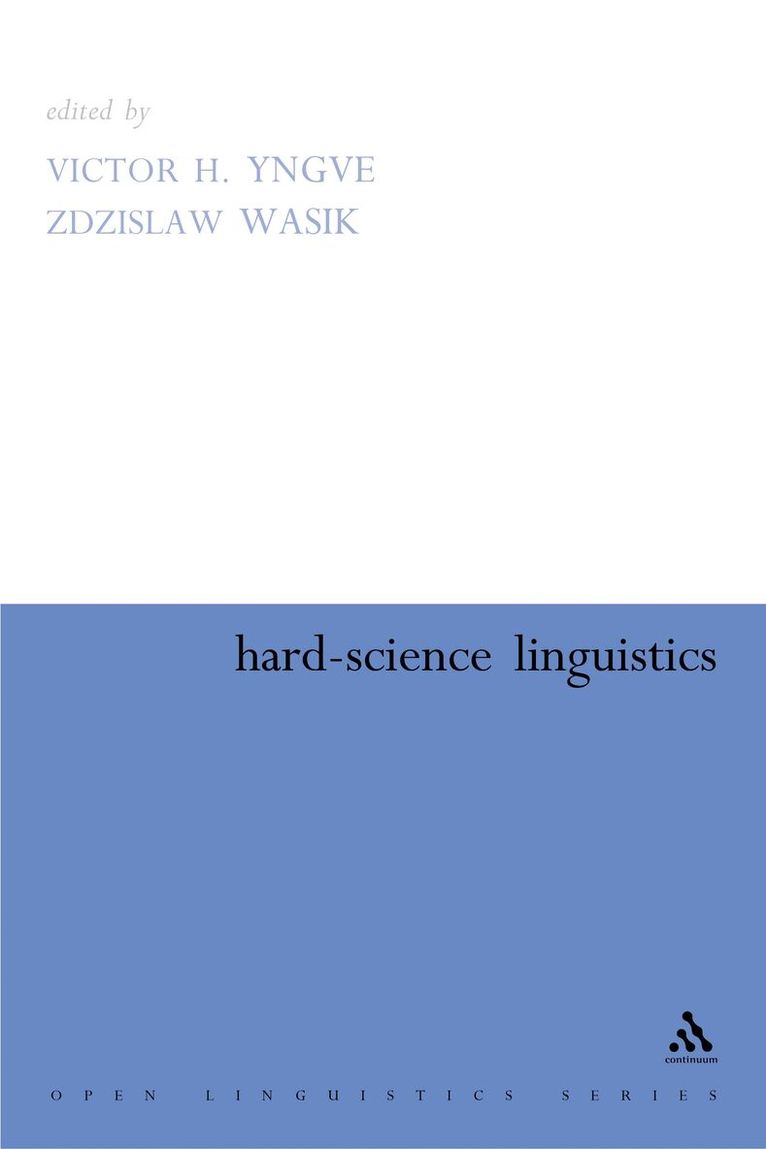
    Hard-Science Linguistics

    AvVictor Yngve,Zdzislaw Wasik

    Inbunden, Engelska, 2006

    2 782 kr

    Beställningsvara. Skickas inom 10-15 vardagar. Fri frakt över 249 kr.

    Beskrivning

    The impossibility of testing the depth hypothesis of 1960 of a connection between the complexities of grammar and a limited human temporary memory led to questioning the ancient grammatical foundations of linguistics and to developing standard hard-science foundations. This volume is the first detailed report on how to reconstitute linguistics on the new hard-science foundation laid by Victor H. Yngve in 1996. Hard-science (human) linguistics is the scientific study of how people communicate. It studies people and also communicative energy flow and other relevant parts of the physical environment. It studies the real world, not the world of language, and it develops theories testable against real-world evidence as is standard in the hard sciences. Hard-science linguistics takes its rightful place connecting the humanities and social sciences to biology, chemistry and physics. Thus linguistics becomes a natural science and contributes to the unity of science. This unity is clearly evident in the research reported here by these fifteen pioneering authors from diverse areas as they work to reconstitute linguistics as a true hard science.

    Produktinformation

    • Utgivningsdatum:2006-09-01
    • Mått:154 x 232 x 24 mm
    • Vikt:730 g
    • Format:Inbunden
    • Språk:Engelska
    • Antal sidor:416
    • Förlag:Bloomsbury Publishing PLC
    • ISBN:9780826461148

    Utforska kategorier

    • Språkvetenskap och lingvistik inom Språk och ordböcker

    Mer om författaren

    Victor H. Yngve is Professor Emeritus in Linguistics and Psychology at the University of Chicago. Zdzislaw Wasik is Professor in the School of English at Adam Mickiewicz University, Poland.

    Recensioner i media

    "...for an approach that touts the scientific, there is a disappointing lack of hard data and physically testable predictions." - Barbara Abbott, Studies in Second Language Acquisition, September 2008

    Innehållsförteckning

    • Introduction; Part I: Orientation to Hard-Science Linguistics; Part II: Reconstituting Phonetics-Phonology; Part III: In Search of Context; Part IV: Variational and Historical Linguistics; Part V: Social and Psychological Issues; Part VI: Practical Applications; Part VII: Index Introduction (Victor H. Yngve); Part I: Orientation to Hard-Science Linguistics; 1. The Depth Hypothesis and the New Hard-Science Linguistics (Victor H. Yngve); 2. Issues in Hard-Science Linguistics (Victor H. Yngve); 3. An Introduction to Hard-Science Linguistics (Victor H. Yngve); 4. Rules of Order (Victor H. Yngve); Part II: Reconstituting Phonetics-Phonology; 5. Towards a Physical Definition of the Vowel Systems of Languages (Laura L. Koenig, Long Island University and Haskins Laboratories) 6. Articulatory Events are Given in Advance (Douglas N. Honorof, Haskins Laboratories); 7. An Outline of Hard-Science Phonetics-Phonology (Victor H. Yngve); Part III: In Search of Context; 8. Reconstituting Notions of Reference (Lara Burazer, University of Ljubljana); 9. Reconstituting Austin's Verdictives (Bernard Paul Sypniewski, Rowan University, New Jersey); 10. Analysis of a Business Negotiation (Mojoa Schlamberger Brezar, University of Ljubljana); 11. Lottery Betting (Bernard Paul Sypniewski); Part IV: Variational and Historical Linguistics; 12. Moving a Classic Applied Linguistics Study into the Real World (Douglas W. Coleman, University of Toledo); 13. Describing Frisian Communities in Terms of Human Linguistics (Elzbieta Wasik, Adam Mickiewicz University, Poland); 14. Mayday or M'aider: A Call for Help in Understanding Linguistic Change (Janusz Malak, Opole University, Poland); 15. Linguistic Change as Changes in Linkages: Fifteenth-Century English (Carl Mills, University of Cincinnati); Part V: Social and Psychological Issues; 16. The Victorian Stereotype of an Irishman (Anna Cislo, University of Wroclaw, Poland); 17. Needs as Expressed in Educational Discourse on the Basis of Textbooks in Linguistics (Piotr Czajka, University of Wroclaw, Poland); Part VI: Practical Applications; 18. The Question of Translation (Martina Ozbot, University of Ljubljana); 19. Communicating Scientific Experiments in Journal Articles (W. John Hutchins, retired from University of East Anglia); Part VII: Disciplinary Considerations; 20. The Riches of the New World (Victor H. Yngve and Zdzislaw Wasik); 21. Coping with Cultural Differences (Victor H. Yngve and Zdzislaw Wasik); 22. The Conduct of Hard-Science Research (Victor H. Yngve); 23. To be a Scientist (Victor H. Yngve); Index