• Fri frakt över 249 kr
  • •
  • Snabba leveranser
  • •
  • Billiga böcker
Kundservice

Du är på sajten för privatpersoner.

Företag, bibliotek eller offentlig verksamhet?

Du handlar på classic.bokus.com, där alla dina funktioner finns intakta.
Till classic.bokus.com
Bokus logotyp. Gå till startsidan.
  • Erbjudanden
  • Nyheter
  • Student
  • Topplistor
  • Barn & ungdom
  • Bokus Play
  • E-böcker
  • Pocketböcker
  • Spel & pussel

10% rabatt på allt med kod: NYSTART10 →

Sidfot

Mina sidor

    Hjälp

    • Kundservice
    • Vanliga frågor och svar
    • Frakt och leverans
    • Retur vid ångerrätt
    • Reklamera vara
    • Betalning
    • Köpvillkor
    • Allmänna villkor
    • Information om webbplatsens tillgänglighet

    Om Bokus

    • Om oss
    • Pressrum
    • För studenter
    • För företag
    • För bibliotek och offentlig verksamhet
    • För leverantörer
    • Hållbarhet

    Populärt

    • Aktuella erbjudanden
    • Presentkort
    • Studentlitteratur
    • Nya böcker
    • Topplistor
    • Signerade böcker
    • Engelska böcker

    Inspiration

    • Boktips
    • BookTok
    • Populära bokserier
    • Barnbokskaraktärer
    • Populära författare
    Logotyp för Bokus
    Följ oss på Facebook (extern länk)Följ oss på Instagram (extern länk)Följ oss på YouTube (extern länk)Följ oss på TikTok (extern länk)
    bokus @ CookiesAnpassa cookiesIntegritetspolicyKöpvillkor
    Till Citymail hemsida (extern länk)Till Budbee hemsida (extern länk)Till Postnord hemsida (extern länk)Till Schenker hemsida (extern länk)Till Early Bird hemsida (extern länk)Till Walleys hemsida (extern länk)
    1. Medicin
    2. Medicin: icke kliniska discipliner
    3. Fysiologi

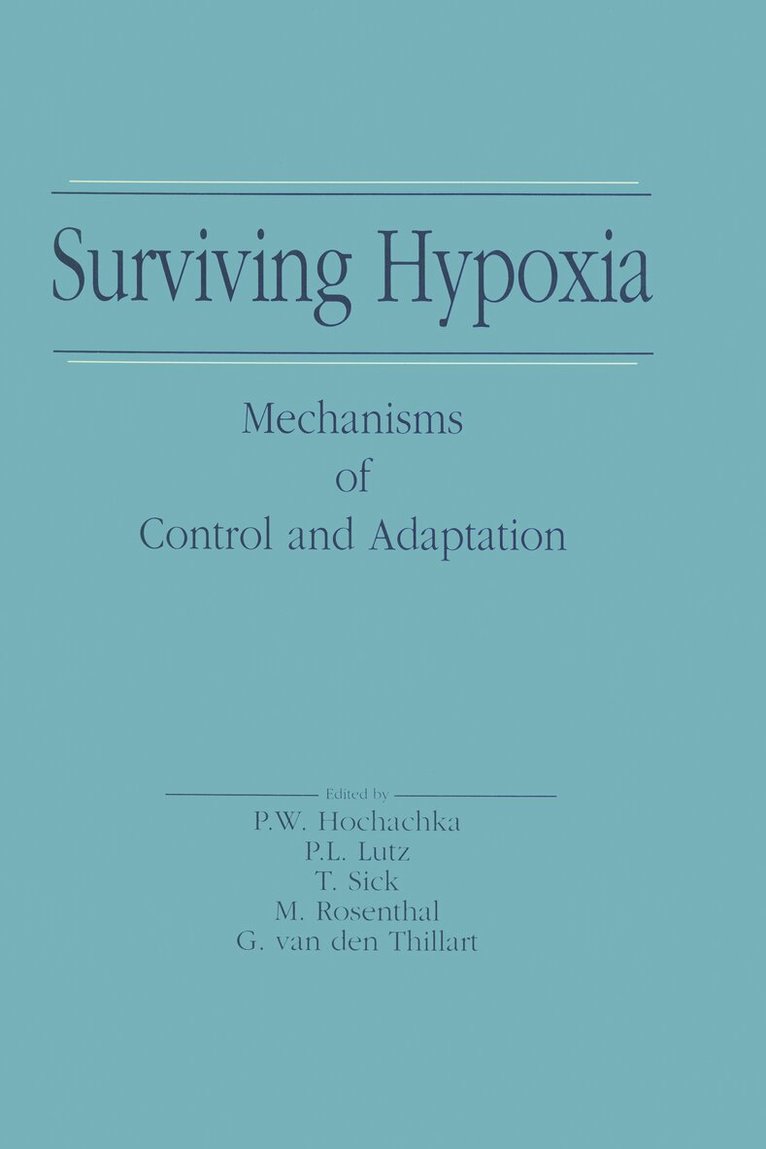
    Surviving Hypoxia

    Mechanisms of Control and Adaptation

    AvPeter W. Hochachka,Peter L. Lutz

    Inbunden, Engelska, 1993

    4 290 kr

    Tillfälligt slut

    Beskrivning

    Surviving Hypoxia: Mechanisms of Control and Adaptation is a synthesis of findings and thoughts concerning hypoxia. The thermodynamics of hypoxia are discussed in detail, including acid-base balance and self-pollution resulting from the accumulation of anaerobic end-products. The book focuses on descriptions and discussions of common facets, contrasting solutions in a variety of physiological hypoxia defense strategies, including those shown by plants, invertebrates, and vertebrates. Special treatment is given to the distinctive problems that hypoxia presents to vulnerable organs such as the kidney, liver, and brain. It also addresses pathological events in addition to protective mechanisms.Clinical implications of basic research are examined in the book, which provides new insights into underlying pathological processes occuring in hypoxic-induced organ failure and indicates new paths for successful clinical intervention. Surviving Hypoxia: Mechanisms of Control and Adaptation is an excellent reference for all researchers interested in the physiological effects of hypoxia, underlying pathological events, and protective mechanisms.

    Produktinformation

    • Utgivningsdatum:1993-03-24
    • Mått:178 x 254 x undefined mm
    • Vikt:1 247 g
    • Format:Inbunden
    • Språk:Engelska
    • Antal sidor:592
    • Förlag:Taylor & Francis Inc
    • ISBN:9780849342264

    Utforska kategorier

    • Fysiologi inom Medicin
    • Hjärt- och kärlsjukdomar inom Medicin

    Mer om författaren

    Hochachka\, Peter W.; Lutz\, Peter L.; Sick\, Thomas J.; Rosenthal\, Myron

    Innehållsförteckning

    • Volume Overview: Defense and Adaptational Strategies (P.W. Hochachka, P.L. Lutz, T. Sick, M. Rosenthal, and G. van den Thillart). ADVANTAGEOUS BIOCHEMICAL PATHWAYS. BIOENERGETIC ADVANTAGES. Intracellular Reactions Controlling Environmental Anaerobiosis in the Marine Annelid Arenicola marina, a Fresh Look at Old Pathways (G. Kamp). Aerobic and Anaerobic Energy Metabolism in the Life Cycle of Parasitic Helminths (A.G.M. Tielens and S.G. van den Bergh). Energy Metabolism of Invertebrate Erythrocytes: Anaerobic Metabolism of Blood Clams (A. de Zwaan and P. Cortesi). Rice and Wheat Seedlings as Plant Models of High and Low Tolerance to Anoxia (F. Menegus, L. Cattaruzza, H. Molinari, and E. Ragg). In Vivo Proton NMR of the Brain (W.M.M.J. Bovee, J. van Dijk, H. Slotboom, D. Bosman, and R.A.F.M. Chamuleau). EFFICIENCY ADVANTAGES. Efficiency and Power Strategies Under Hypoxia. Is Low Efficiency at High Glycolitic ATP Production a Paradox? (E. Gnaiger). Effects of Thyroid Hormone on the Energetic Efficiency of Muscle Contraction (C. van Hardeveld and W.S. Simonides). Adaptability of Metabolic Efficiencies Under Chronic Hypoxia in Man (P.W. Hochachka). pH ADVANTAGES. Multicompartmental Analyses of Acid-Base and Metabolic Homeostasis during Anaerobiosis: Invertebrate and Lower Vertebrate Examples (H-O Portner). Ethanol Formation and pH Regulation in Fish (A. van Waarde, G. van den Thillart, and M. Verhagen). pHi and Anabolic Arrest during Anoxia in Artemia franciscana Embryos (S.H. Hand). Interaction between Cytoplasmic Fermentation Reactions and Transport of Protons between Cytoplasm and Vacuoles (J.K.M. Roberts). pH and Metabolic Depression in Mammalian Hibernation. The Example of Brown Adipose Tissue (A. Malan). HYPOXIA DEFENSE AND CONTROL SYSTEMS. Environmental and Exercise Anaerobiosis in Frogs (G. Wegener and U. Krause). The Role of Metabolic Acidosis in the Buffering of ATP by Phosphagen Stores in Fish: An In Vivo NMR Study (G. van den Thillart and A. van Waarde). Molec