• Fri frakt över 249 kr
  • •
  • Snabba leveranser
  • •
  • Billiga böcker
Kundservice

Du är på sajten för privatpersoner.

Företag, bibliotek eller offentlig verksamhet?

Du handlar på classic.bokus.com, där alla dina funktioner finns intakta.
Till classic.bokus.com
Bokus logotyp. Gå till startsidan.
  • Erbjudanden
  • Nyheter
  • Student
  • Topplistor
  • Barn & ungdom
  • Bokus Play
  • E-böcker
  • Pocketböcker
  • Spel & pussel

10% rabatt på allt med kod: NYSTART10 →

Sidfot

Mina sidor

    Hjälp

    • Kundservice
    • Vanliga frågor och svar
    • Frakt och leverans
    • Retur vid ångerrätt
    • Reklamera vara
    • Betalning
    • Köpvillkor
    • Allmänna villkor
    • Information om webbplatsens tillgänglighet

    Om Bokus

    • Om oss
    • Pressrum
    • För studenter
    • För företag
    • För bibliotek och offentlig verksamhet
    • För leverantörer
    • Hållbarhet

    Populärt

    • Aktuella erbjudanden
    • Presentkort
    • Studentlitteratur
    • Nya böcker
    • Topplistor
    • Signerade böcker
    • Engelska böcker

    Inspiration

    • Boktips
    • BookTok
    • Populära bokserier
    • Barnbokskaraktärer
    • Populära författare
    Logotyp för Bokus
    Följ oss på Facebook (extern länk)Följ oss på Instagram (extern länk)Följ oss på YouTube (extern länk)Följ oss på TikTok (extern länk)
    bokus @ CookiesAnpassa cookiesIntegritetspolicyKöpvillkor
    Till Citymail hemsida (extern länk)Till Budbee hemsida (extern länk)Till Postnord hemsida (extern länk)Till Schenker hemsida (extern länk)Till Early Bird hemsida (extern länk)Till Walleys hemsida (extern länk)
    1. Juridik
    2. Rättsvetenskap
    3. Juristyrken

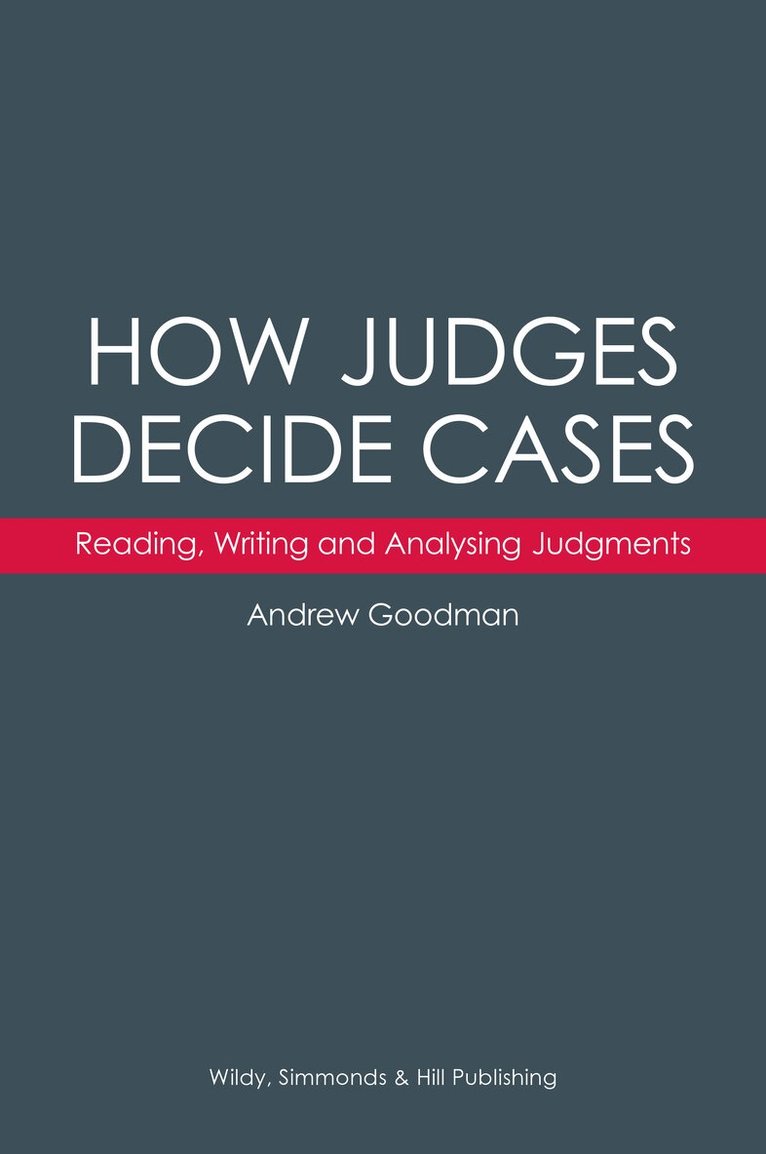
    How Judges Decide Cases: Reading, Writing and Analysing Judgments

    AvAndrew Goodman

    Häftad, Engelska, 2018

    762 kr

    Skickas . Fri frakt över 249 kr.

    Beskrivning

    How Judges Decide Cases is a unique and practical guide which looks at how cases are decided and judgments are written. It examines the style and language of judges expressing judicial opinion and considers the drive for rational justice. The book is founded upon independent research in the form of interviews conducted with judges at every level, from deputy district judges to justices of the Supreme Court, and the practical application of academic material more usually devoted to the structure and analysis of wider prose writing. This new edition has been revised to take into account modern scientific thinking on bias in decision-making and is generic to all areas of contentious law. Newly appointed recorders, deputy judges, tribunal chairman, lay magistrates and arbitrators as well as experienced practitioners will find it invaluable as a guide to the deconstruction of judgments for the purpose of appeal.

    Produktinformation

    • Utgivningsdatum:2018-06-15
    • Mått:152 x 229 x 17 mm
    • Vikt:448 g
    • Format:Häftad
    • Språk:Engelska
    • Antal sidor:268
    • Upplaga:2
    • Förlag:Wildy, Simmonds and Hill Publishing
    • ISBN:9780854902453

    Utforska kategorier

    • Juristyrken inom Juridik
    • Juridisk kompetens och praktik inom Juridik

    Mer om författaren

    Andrew Goodman is a barrister practising in professional indemnity, disciplinary and regulatory claims and in commercial, property and administrative law. He writes and lectures extensively on a range of subjects and is a Bar Council mediation advocacy trainer.

    Recensioner i media

    "A really useful resource...highly recommended” Law Gazette

    Innehållsförteckning

    • Introduction1HOW JUDGES DECIDE CASES1.1Judicial transparency1.2The mechanics of fact finding1.3Questions of weight in fact finding1.4Evidence on oath1.5The dilemma of impression1.6Menschkeit and judicial civility1.7Conscious and unconscious bias1.8Decision-making in interim applications1.9The exercise of judicial discretion1.10Decision-making by tribunals2THE APPELLATE JUDGMENT2.1Appellate courts and tribunals2.2Decision-making in the Court of Appeal2.3Dissent2.4The appeals and appellate committees of the Supreme Court2.5Delivery of Supreme Court judgments2.6Decision-making by the appellate committee2.7The appellate committee and judge-made law2.8Judicial Committee of the Privy Council3WRITING JUDGMENTS, DECISIONS AND AWARDS3.1Delivering and writing judgments3.2Preparation3.3Judgment in the lower courts3.4Judicial training3.5On finding facts3.6On addressing the loser3.7On the task in hand3.8On the issue of credibility3.9On the use of language3.10On using counsel’s written submissions3.11Personal views on framework3.12Civil fast track3.13Family cases3.14Master’s or district judge’s application3.15High Court trial3.16Arbitration3.17Writing tribunal decisions3.18A general approach3.18.1Identify the issues3.18.2Finding the facts3.18.3Telling the tale3.18.4Setting out the law3.18.5The parties’ submissions3.18.6Stating the conclusions3.19Majority decisions3.20Interlocutory rulings and orders3.21Model decision-writing for tribunals3.22Writing appellate judgments3.23Appellate tribunal awards3.24Court of Appeal judgments4READING JUDGMENTS4.1Basic principles: focus and time4.2Focus4.3Time4.4Inspectional reading4.5The mechanics of analytical reading4.6Form and structure4.7Preparing an analysis4.8Classification4.9Interpretation4.10Deconstruction4.11Syntopical reading5THE USE OF LANGUAGE IN JUDGMENTS5.1The choice of judicial language5.2Linguistic analysis5.3The use of words5.4The structure of sentences5.5The language of lawyers5.6Contemporary vocabulary and social change5.7Dealing with technical and specialist vocabulary5.8The residual use of legal Latin and French5.9Literary style in judgments5.10Judicial literary techniques5.11Imperative and declarative sentences5.12The compressive metaphor5.13The elegant variation5.14The factual allusion5.15The literary allusion5.16Simplification of ideas5.17Other techniques5.18The impact of distinctive judicial literary style6ANALYSING JUDGMENTS: REASONING, ARGUMENT AND LEGAL LOGIC6.1Reasoning, argument and legal logic6.2Locating the arguments6.3Units of reasoning6.4Finding the solution6.5The domestic approach6.6Judicial reasoning and the role of persuasion6.7Distinguishing grammatical and logical interpretation6.8Positive judicial argument6.9Aids to reasoning6.10The judge and the expert6.11The use of precedent6.12Precedent and reasoning6.13At the coal face: trial judges6.14Distinguishing your judgment6.15Ratio and obiter7ANALYSING JUDGMENTS: TECHNIQUES FOR CRITICISM7.1Criticising a judgment fairly7.2Analysing your disagreement objectively7.3Distinguishing between knowledge and opinion7.4The focus of your criticism7.5The mechanics of fair criticism7.6Uninformed7.7Misinformed7.8Illogical7.9Incompleteness7.10The structured critique8USING LAW REPORTS8.1Fundamentals and difficulties8.2The functionality of law reports8.3Accuracy in law reporting8.4Editorial anomaliesBibliography