• Fri frakt över 249 kr
  • •
  • Snabba leveranser
  • •
  • Billiga böcker
Kundservice

Du är på sajten för privatpersoner.

Företag, bibliotek eller offentlig verksamhet?

Du handlar på classic.bokus.com, där alla dina funktioner finns intakta.
Till classic.bokus.com
Bokus logotyp. Gå till startsidan.
  • Erbjudanden
  • Student
  • Topplistor
  • Barn & ungdom
  • Bokus Play
  • E-böcker
  • Ljudböcker
  • Pocketböcker
  • Spel & pussel

10% rabatt på allt med kod NYSTART10 →

Sidfot

Mina sidor

    Hjälp

    • Kundservice
    • Vanliga frågor och svar
    • Frakt och leverans
    • Retur vid ångerrätt
    • Reklamera vara
    • Betalning
    • Köpvillkor
    • Allmänna villkor
    • Information om webbplatsens tillgänglighet

    Om Bokus

    • Om oss
    • Pressrum
    • För studenter
    • För företag
    • För bibliotek och offentlig verksamhet
    • För leverantörer
    • Hållbarhet

    Populärt

    • Aktuella erbjudanden
    • Presentkort
    • Studentlitteratur
    • Nya böcker
    • Topplistor
    • Signerade böcker
    • Engelska böcker

    Inspiration

    • Boktips
    • BookTok
    • Populära bokserier
    • Barnbokskaraktärer
    • Populära författare
    Logotyp för Bokus
    Följ oss på Facebook (extern länk)Följ oss på Instagram (extern länk)Följ oss på YouTube (extern länk)Följ oss på TikTok (extern länk)
    bokus @ CookiesAnpassa cookiesIntegritetspolicyKöpvillkor
    Till Citymail hemsida (extern länk)Till Budbee hemsida (extern länk)Till Postnord hemsida (extern länk)Till Schenker hemsida (extern länk)Till Early Bird hemsida (extern länk)Till Walleys hemsida (extern länk)
    1. Skönlitteratur
    2. Essäer

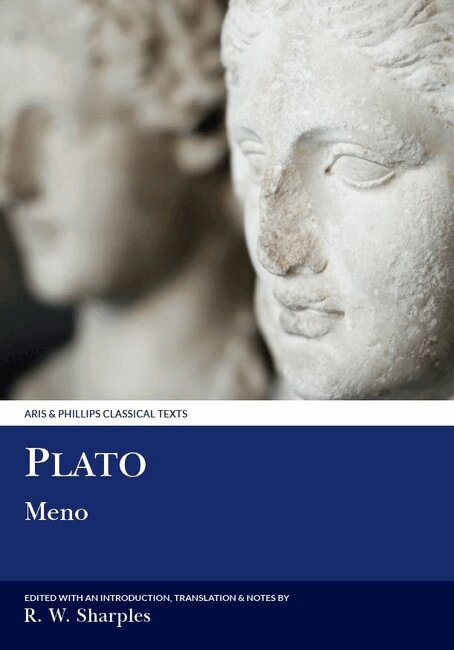
    Plato: Meno

    AvSharples,Robert W. Sharples

    Häftad, Engelska, 1985

    Del i serien Aris & Phillips Classical Texts

    571 kr

    Beställningsvara. Skickas inom 5-8 vardagar. Fri frakt över 249 kr.

    Beskrivning

    Plato’s Meno is the dialogue which more than any other occupies a transitional position between the early Socratic dialogues and the developed middle period theory of the Phaedo, Symposium and Republic. It is thus of particular interest for the insights that it gives us into the process by which Plato arrived at that theory. The issues which it raises are philosophically interesting in themselves: how can we know that we have the right answer to a question, unless we knew what the answer was before we asked the question in the first place? Is excellence (aretē) something that we can acquire by being taught, or is it something that we are born with? And the dialogue is of historical interest for the evidence it provides, both for ancient Greek notions of what constitutes excellence, and for contemporary attitudes to the Sophists, who claimed to teach excellence and took larger fees for doing so. First published in 1985, this edition was revised in 1991, and the preface and bibliography updated in 2004. Greek text with facing-page English translation, introduction, notes and commentary.

    Produktinformation

    • Utgivningsdatum:1985-01-01
    • Mått:147 x 210 x undefined mm
    • Format:Häftad
    • Språk:Engelska
    • Serie:Aris & Phillips Classical Texts
    • Antal sidor:206
    • Förlag:Liverpool University Press
    • ISBN:9780856682490
    • Översättare:Robert W. Sharples

    Utforska kategorier

    • Essäer inom Skönlitteratur
    • Litteraturvetenskap inom Skönlitteratur

    Mer om författaren

    †R.W. Sharples was Professor of Classics at University College London. He published widely on ancient philosophy, especially the Aristotelian tradition (Theophrastus, Alexander of Aphrodisias). His books include 'Stoics, Epicureans and Sceptics' (Routledge, 1996), 'Nemesius: On Fate' (Liverpool University Press, 2008), and 'Cicero: On Fate with Boethius: The Consolation of Philosophy IV.5–7 and V' and 'Plato: Meno' in the Aris & Phillips Classical Texts series.

    Innehållsförteckning

    • PrefaceAbbreviationsIntroductionI. GeneralII. Plato’s life and the date of the MenoIII. (a) Is excellence teachable? (I) (b) Developments in the Meno(c) The Meno and the middle period theory (d) Is excellence teachable? (II) IV. (a) The significance of the dialogue form(b) The dramatic date of the Meno(c) The characters in the dialogueV. Evidence for the textSelect BibliographySiglaText and TranslationCommentaryIndex