• Fri frakt över 249 kr
  • •
  • Snabba leveranser
  • •
  • Billiga böcker
Kundservice

Du är på sajten för privatpersoner.

Företag, bibliotek eller offentlig verksamhet?

Du handlar på classic.bokus.com, där alla dina funktioner finns intakta.
Till classic.bokus.com
Bokus logotyp. Gå till startsidan.
  • Erbjudanden
  • Nyheter
  • Student
  • Topplistor
  • Barn & ungdom
  • Bokus Play
  • E-böcker
  • Pocketböcker
  • Spel & pussel

10% studentrabatt med kod TERM26

Sidfot

Mina sidor

    Hjälp

    • Kundservice
    • Vanliga frågor och svar
    • Frakt och leverans
    • Retur vid ångerrätt
    • Reklamera vara
    • Betalning
    • Köpvillkor
    • Allmänna villkor
    • Information om webbplatsens tillgänglighet

    Om Bokus

    • Om oss
    • Pressrum
    • För studenter
    • För företag
    • För bibliotek och offentlig verksamhet
    • För leverantörer
    • Hållbarhet

    Populärt

    • Aktuella erbjudanden
    • Presentkort
    • Studentlitteratur
    • Nya böcker
    • Topplistor
    • Signerade böcker
    • Engelska böcker

    Inspiration

    • Boktips
    • BookTok
    • Populära bokserier
    • Barnbokskaraktärer
    • Populära författare
    Logotyp för Bokus
    Följ oss på Facebook (extern länk)Följ oss på Instagram (extern länk)Följ oss på YouTube (extern länk)Följ oss på TikTok (extern länk)
    bokus @ CookiesAnpassa cookiesIntegritetspolicyKöpvillkor
    Till Citymail hemsida (extern länk)Till Budbee hemsida (extern länk)Till Postnord hemsida (extern länk)Till Schenker hemsida (extern länk)Till Early Bird hemsida (extern länk)Till Walleys hemsida (extern länk)
    1. Skönlitteratur
    2. Poesi

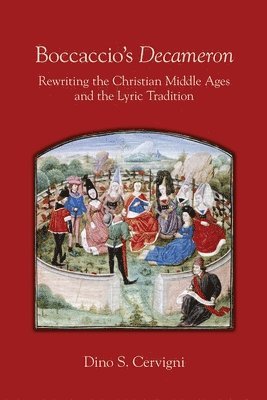
    Boccaccio`s "Decameron" – Rewriting the Christian Middle Ages and the Lyric Tradition

    AvDino S. Cervigni

    Häftad, Engelska, 2021

    1 041 kr

    Beställningsvara. Skickas inom 5-8 vardagar. Fri frakt över 249 kr.

    Beskrivning

    This study develops a new interpretation of The Decameron, Giovanni Boccaccio’s masterpiece, which has found new popularity in the wake of COVID. Dino S. Cervigni offers an inclusive and novel reading of the collection, theorizing that the first ninety tales offer a parodic rewriting of the Christian Middle Age, while the last ten tales craft a reconstruction of society based on human and liberal principles such as generosity and sacrifice. Still relevant to this day, The Decameron offers a notable description of the bubonic plague of 1348 which devastated Western Europe—drawing striking parallels with the current global pandemic. Furthermore, Boccaccio’s concluding message applies to all of us in the present moment, plunged as we are into a world of intellectual and ethical chaos, exhorting us to practice forgiveness, compassion, tolerance, mutual acceptance, and generous open-mindedness. No other book on The Decameron offers such a relevant, up-to-date reading of the classic work.

    Produktinformation

    • Utgivningsdatum:2021-01-08
    • Mått:153 x 229 x 30 mm
    • Vikt:770 g
    • Format:Häftad
    • Språk:Engelska
    • Antal sidor:554
    • Förlag:Arizona Center for Medieval & Renaissance Studies,US
    • ISBN:9780866986069

    Utforska kategorier

    • Poesi inom Skönlitteratur
    • Litteraturvetenskap inom Skönlitteratur

    Mer om författaren

    Dino S. Cervigni is professor emeritus of Romance languages and comparative literature at the University of North Carolina at Chapel Hill. He is the founder and editor-in-chief of Annali d’italianistica and is the author of numerous books, including Dante’s Poetry of Dreams.

    Innehållsförteckning

    • AcknowledgmentsNotes on Citations of the DecameronIntroduction1. The All-Encompassing Discourse: Topoi of the Poet, Women, and Critics2. The Brigata’s Overarching Tale: Rewriting the Christian Middle Ages3. The Decameron’s Ballads and Emilia’s Song: “I have such desire for my own beauty” (“Io son sì vaga della mia bellezza.” Dec. 1)4. Pampínea’s “What woman will sing if I myself do not?” (Qual donna canterà, s’i’non cant’io?” Dec. 2)5. Lauretta’s “No woman without consolation” (Niuna sconsolata.” Dec. 3)6. Filostrato’s Desperate Song: “Weeping, I show” (“Lagrimando dimostro.” Dec. 4)7. Dioneo in Love’s Chains: The Erotic Storyteller vs. the Pathetic Lover8. Love, War, and Servitude in Elissa’s (Dec. 6)9. Filomena’s Unhappy Love: “Ah, my wretched life!” (“Deh lassa la mia vita!” Dec. 7)10. Panfilo’s Erotic Song: “So great, O Love, is the good” (“Tanto è, Amore, il bene.” Dec. 8)11. Neifile’s Distant Beloved: “A young girl am I” (“Io mi son giovinetta.” Dec. 9)12. Making Amends and Behaving Magnificently: Dec. 10’s Secular Redemption13. Fiammetta’s Desperate Ballad (Dec. 10): Concluding All Lyric Singing14. The Decameron’s Precarious Centers, the Author’s Story, His Open-ended ConclusionAppendix: The Narrator as Moral Commentator: Humor, Humorous Tales, and Humorous StorytellersWorks Cited & BibliographyIndex of Important MattersIndex of Names