• Fri frakt över 249 kr
  • •
  • Snabba leveranser
  • •
  • Billiga böcker
Kundservice

Du är på sajten för privatpersoner.

Företag, bibliotek eller offentlig verksamhet?

Du handlar på classic.bokus.com, där alla dina funktioner finns intakta.
Till classic.bokus.com
Bokus logotyp. Gå till startsidan.
  • Erbjudanden
  • Student
  • Topplistor
  • Barn & ungdom
  • Bokus Play
  • E-böcker
  • Ljudböcker
  • Pocketböcker
  • Spel och pussel

Pocketfynda! Hundratals böcker för 49 kr/st →

Sidfot

Mina sidor

    Hjälp

    • Kundservice
    • Vanliga frågor och svar
    • Frakt och leverans
    • Retur vid ångerrätt
    • Reklamera vara
    • Betalning
    • Köpvillkor
    • Allmänna villkor
    • Information om webbplatsens tillgänglighet

    Om Bokus

    • Om oss
    • Pressrum
    • För studenter
    • För företag
    • För bibliotek och offentlig verksamhet
    • För leverantörer
    • Hållbarhet

    Populärt

    • Aktuella erbjudanden
    • Presentkort
    • Studentlitteratur
    • Nya böcker
    • Topplistor
    • Signerade böcker
    • Engelska böcker

    Inspiration

    • Boktips
    • BookTok
    • Barnbokskaraktärer
    • Populära författare
    Logotyp för Bokus
    Följ oss på Facebook (extern länk)Följ oss på Instagram (extern länk)Följ oss på YouTube (extern länk)Följ oss på TikTok (extern länk)
    bokus @ CookiesAnpassa cookiesIntegritetspolicyKöpvillkor
    Till Citymail hemsida (extern länk)Till Budbee hemsida (extern länk)Till Postnord hemsida (extern länk)Till Schenker hemsida (extern länk)Till Early Bird hemsida (extern länk)Till Walleys hemsida (extern länk)
    1. Samhälle och politik
    2. Sociologi och antropologi

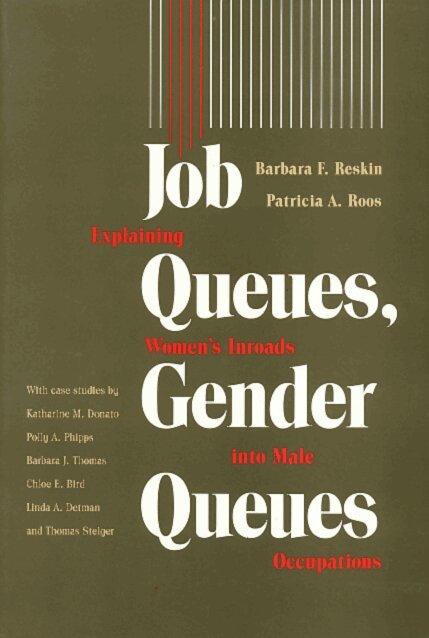
    Job Queues, Gender Queues

    Explaining Women's Inroads Into Male Occupations

    AvBarbara Reskin

    Häftad, Engelska, 1990

    Del i serien Women in the Political Economy

    388 kr

    Beställningsvara. Skickas inom 5-8 vardagar. Fri frakt över 249 kr.

    Beskrivning

    Since 1970, women have made widely publicized gains in several customarily male occupations. Many commentators have understood this apparent integration as an important step to sexual equality in the workplace. Barbara F. Reskin and Patricia A. Roos read a different lesson in the changing gender composition of occupations that were traditionally reserved for men. With persuasive evidence, Job Queues, Gender Queues offers a controversial interpretation of women's dramatic inroads into several male occupations based on case studies of "feminizing" male occupation.The authors propose and develop a queuing theory of occupations' sex composition. This theory contends that the labor market comprises a "gender queue" with employers preferring male to female workers for most jobs. Workers also rank jobs into a "job queue." As a result, the highest-ranked workers monopolize the most desirable jobs. Reskin and Roos use this queuing perspective to explain why several male occupations opened their doors to women after 1970. The second part of the book provides evidence for this queuing analysis by presenting case studies of the feminization of specific occupations. These include book editor, pharmacist, public relations specialist, bank manager, systems analyst, insurance adjuster, insurance salesperson, real estate salesperson, bartender, baker, and typesetter/compositor.In the series Women in the Political Economy, edited by Ronnie J. Steinberg.

    Produktinformation

    • Utgivningsdatum:1990-11-08
    • Mått:152 x 229 x 28 mm
    • Vikt:526 g
    • Format:Häftad
    • Språk:Engelska
    • Serie:Women in the Political Economy
    • Antal sidor:400
    • Förlag:Temple University Press,U.S.
    • ISBN:9780877227441

    Utforska kategorier

    • Sociologi och antropologi inom Samhälle och politik

    Mer om författaren

    Barbara Reskin is Professor of Sociology at the University of Illinois and Vice President of the American Sociological Association. She has published several books, including Women's Work, Men's Work: Sex Segregation on the Job (co-authored with Heidi Hartmann).Patricia A. Roos is Associate Professor of Sociology at Rutgers University and author of Gender and Work: A Comparative Analysis of Industrial Societies.Contributors: Case Studies by Katharine M. Donato, Polly A. Phipps, Barbara J. Thomas, Chloe E. Bird, Linda A. Detman, and Thomas Steiger.

    Recensioner i media

    "Even in the wake of feminism's ebullient 'second wave,' women routinely and almost universally get a raw deal in the labor market, with women of color getting the rawest deal of all. In Job Queues, Gender Queues, Barbara Reskin and Patricia Roos illustrate this with exemplary clarity."-Felicia Kombluh, Voice Literary Supplement

    Innehållsförteckning

    • PrefacePart I: Explaining the Changing Sex Composition of Occupations1. Occupational Sex Segregation: Persistence and Change2. Queuing and Changing Occupational Composition3. Consequences of Desegregation: Occupational Integration and Economic Equity?Part II: Case Studies of Occupation Change4. Culture, Commerce and Gender: The Feminization of Book Editing – Barbara F. Reskin5. Industrial and Occupational Change in Pharmacy: Prescription for Feminization – Polly A. Phipps6. Keepers of the Corporate Image: Women in Public Relations – Katharine M. Donato7. High Finance, Small Change: Women's Increased Representation in Bank Management – Chloe E. Bud8. Programming for Change? The Growing Demand for Women Systems Analysts – Katharine M. Donato9. Women's Gains in Insurance Sales: Increased Supply, Uncertain Demand – Barbara J. Thomas10. A Woman's Place is Selling Homes: Occupational Change and the Feminization of Real Estate Sales – Barbara J. Thomas and Barbara F. Reskin11. Occupational Resegregation among Insurance Adjusters and Examiners – Polly A. Phipps12. Women Behind Bars: The Feminization of Bartending – Linda A. Detman13. Baking and Baking Off: Deskilling and the Changing Sex Makeup of Bakers – Thomas Steiger and Barbara F. Reskin14. Hot-Metal to Electronic Composition: Gender, Technology, and Social Change – Patricia A. RoosPart III: ConclusionSummary, Implications, and ProspectsAppendix: Guidelines Used for Occupation Case StudiesReferencesName IndexSubject IndexAbout the Authors