• Fri frakt över 249 kr
  • •
  • Snabba leveranser
  • •
  • Billiga böcker
Kundservice

Du är på sajten för privatpersoner.

Företag, bibliotek eller offentlig verksamhet?

Du handlar på classic.bokus.com, där alla dina funktioner finns intakta.
Till classic.bokus.com
Bokus logotyp. Gå till startsidan.
  • Erbjudanden
  • Nyheter
  • Student
  • Topplistor
  • Barn & ungdom
  • Bokus Play
  • E-böcker
  • Pocketböcker
  • Spel & pussel

10% rabatt på allt med kod NYSTART10 →

Sidfot

Mina sidor

    Hjälp

    • Kundservice
    • Vanliga frågor och svar
    • Frakt och leverans
    • Retur vid ångerrätt
    • Reklamera vara
    • Betalning
    • Köpvillkor
    • Allmänna villkor
    • Information om webbplatsens tillgänglighet

    Om Bokus

    • Om oss
    • Pressrum
    • För studenter
    • För företag
    • För bibliotek och offentlig verksamhet
    • För leverantörer
    • Hållbarhet

    Populärt

    • Aktuella erbjudanden
    • Presentkort
    • Studentlitteratur
    • Nya böcker
    • Topplistor
    • Signerade böcker
    • Engelska böcker

    Inspiration

    • Boktips
    • BookTok
    • Populära bokserier
    • Barnbokskaraktärer
    • Populära författare
    Logotyp för Bokus
    Följ oss på Facebook (extern länk)Följ oss på Instagram (extern länk)Följ oss på YouTube (extern länk)Följ oss på TikTok (extern länk)
    bokus @ CookiesAnpassa cookiesIntegritetspolicyKöpvillkor
    Till Citymail hemsida (extern länk)Till Budbee hemsida (extern länk)Till Postnord hemsida (extern länk)Till Schenker hemsida (extern länk)Till Early Bird hemsida (extern länk)Till Walleys hemsida (extern länk)
    1. Samhälle och politik
    2. Politik och statsskick
    3. Centralt styre och förvaltning

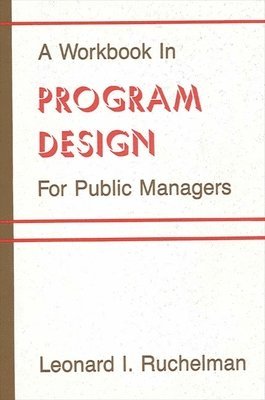
    Workbook in Program Design for Public Managers

    AvLeonard Ruchelman

    Häftad, Engelska, 1985

    Del i serien SUNY series in Public Administration

    362 kr

    Tillfälligt slut

    Beskrivning

    This is the first practical, step-by-step guide to a key management technique-the design of efficient, cost-effective programs. With social programs succumbing to the pressures of budgetary cutbacks and taxpayer opposition, it gives public administrators the skills to design programs that will endure even as resources decline.The author begins to bridge the gap between what is needed by society and what can be provided by government by assisting public managers in identifying and surmounting obstacles in the way of program change. He does so by synthesizing what is known about program planning as a body of knowledge with the application of programs under real life conditions. His how-to approach covers such tasks as selecting a problem for analysis, diagnosing the organizational setting, preparing a work plan, developing alternatives, collecting data, communicating results, and preparing for implementation. The exercises and exhibits included in this workbook are applicable to all areas of public service, including health and human services, social services, criminal justice, and education.

    Produktinformation

    • Utgivningsdatum:1985-06-30
    • Mått:152 x 229 x 8 mm
    • Vikt:336 g
    • Format:Häftad
    • Språk:Engelska
    • Serie:SUNY series in Public Administration
    • Antal sidor:136
    • Förlag:State University of New York Press
    • ISBN:9780887060250

    Utforska kategorier

    • Centralt styre och förvaltning inom Samhälle och politik

    Mer om författaren

    Leonard I. Ruchelman is Professor of Urban Studies and Public Administration at Old Dominion University.

    Innehållsförteckning

    • Preface 1. Introduction What is Program DesignProgram Design as Planned ChangeApproaches for Understanding the Process of ChangeThe Program Design Process 2. Getting Started Step 1—Selecting a Problem Area for AnalysisStep 2—Organizing for Program DesignSummary 3. Diagnosing the Organizational Setting Step 1—Describing the Performance GapStep 2—Rating Individual FactorsStep 3—Rating Organizational FactorsStep 4—Identifying Environmental FactorsStep 5— the Feasibility of a program Design ProjectSummary 4. Generating Public Support Step 1—Restating the Problem as an IssueStep 2—Identifying the Likely ActorsStep 3—Estimating the Issue Position, Power and Salience of Each ActorStep 4—Calculating Weights and ProbabilitiesStep 5—Identifying StrategiesSummary 5. Preparing a Workplan Step 1—Defining the ProblemStep 2—Describing the Current ProgramStep 3—Establishing the Project ScopeStep 4—Describing the Program Design MethodologyStep 5—Establishing and Assigning Work TasksStep 6—Approving the WorkplanSummary 6. Establishing Goals, Objectives and Performance Criteria Step 1—Reviewing Program MaterialStep 2—Defining Program GoalsStep 3—Defining Program ObjectivesStep 4—Establishing Performance CriteriaSummary 7. Developing Program Alternatives Step 1—Generating Program AlternativesStep 2—Screening Program AlternativesStep 3—ForecastingStep 4—Categorizing AlternativesSummary 8. Data Collection Step 1—Estimating Service DemandStep 2—Estimating CostsStep 3—Collecting Effectiveness DataStep 4—Collecting Feasibility informationSummary 9. Synthesizing the Data Step 1—Organizing the DataStep 2—Comparing the DataStep 3—Drawing ConclusionsSummary 10. Communicating the Results Step 1—Preparing the Draft ReportStep 2—Reviewing the Draft ReportStep 3— Transmitting the Final ReportSummary 11. Preparing for Implementation Step 1—Forming an Implementation TeamStep 2—Preparing an Implementation WorkplanStep 3—Methods for Monitoring Implementation ProgressStep 4—Follow-up StrategiesSummary and Conclusions Appendix A. Guide to Information Sources in Public Services Appendix B. Guide to Information Sources in Human Services Appendix C. Search Services Appendix D. Sample Program Design Report Glossary Annotated Bibliography