• Fri frakt över 249 kr
  • •
  • Snabba leveranser
  • •
  • Billiga böcker
Kundservice

Du är på sajten för privatpersoner.

Företag, bibliotek eller offentlig verksamhet?

Du handlar på classic.bokus.com, där alla dina funktioner finns intakta.
Till classic.bokus.com
Bokus logotyp. Gå till startsidan.
  • Erbjudanden
  • Nyheter
  • Student
  • Topplistor
  • Barn & ungdom
  • Bokus Play
  • E-böcker
  • Pocketböcker
  • Spel & pussel

10% rabatt på allt med kod: NYSTART10 →

Sidfot

Mina sidor

    Hjälp

    • Kundservice
    • Vanliga frågor och svar
    • Frakt och leverans
    • Retur vid ångerrätt
    • Reklamera vara
    • Betalning
    • Köpvillkor
    • Allmänna villkor
    • Information om webbplatsens tillgänglighet

    Om Bokus

    • Om oss
    • Pressrum
    • För studenter
    • För företag
    • För bibliotek och offentlig verksamhet
    • För leverantörer
    • Hållbarhet

    Populärt

    • Aktuella erbjudanden
    • Presentkort
    • Studentlitteratur
    • Nya böcker
    • Topplistor
    • Signerade böcker
    • Engelska böcker

    Inspiration

    • Boktips
    • BookTok
    • Populära bokserier
    • Barnbokskaraktärer
    • Populära författare
    Logotyp för Bokus
    Följ oss på Facebook (extern länk)Följ oss på Instagram (extern länk)Följ oss på YouTube (extern länk)Följ oss på TikTok (extern länk)
    bokus @ CookiesAnpassa cookiesIntegritetspolicyKöpvillkor
    Till Citymail hemsida (extern länk)Till Budbee hemsida (extern länk)Till Postnord hemsida (extern länk)Till Schenker hemsida (extern länk)Till Early Bird hemsida (extern länk)Till Walleys hemsida (extern länk)
    1. Samhälle och politik
    2. Politik och statsskick

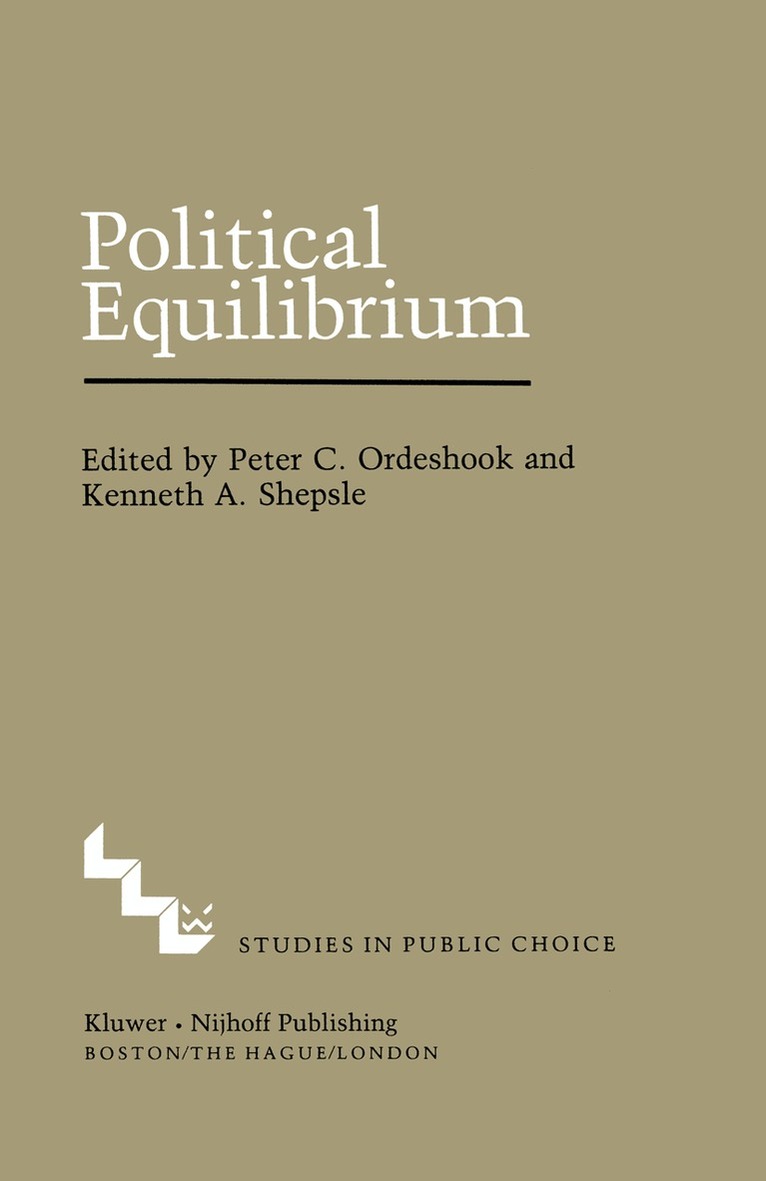
    Political Equilibrium: A Delicate Balance

    AvPeter C. Ordeshook,K.A. Shepsle

    Inbunden, Engelska, 1982

    Del i serien Studies in Public Choice

    1 086 kr

    Beställningsvara. Skickas inom 10-15 vardagar. Fri frakt över 249 kr.

    Fler format och utgåvor

    Häftad

    1 086 kr

    Beskrivning

    Peter C. Ordeshook and Kenneth A. Shepsle If the inaugural date of modern economics is set at 1776 with the publication of Adam Smith's The Wealth of Nations, then the analytical tradition in the study of politics is not even a decade younger, commencing nine years later with the publication of the Marquis de Condorcet's Essai sur l'application de l'analyse iz la probabilite des decisions rendues iz la pluralite des voix. The parallel, however, stops there for, unlike Smith and other classical economists who laid an intel- lectual foundation upon which a century of cumulative scientific research pro- ceeded, analytical political science suffered fits and starts. Condorcet, himself, acknowledges the earlier work (predating the Essai by some fourteen years) of Borda and, from time to time during the nineteenth century, their contributions were rediscovered by Dodgson, Nanson, and other political philosophers and arithmeticians. But, by century's end, there was nothing in political science to compare to the grand edifice of general equilibrium theory in neoclassical eco- nomics.Despite roots traversing two centuries, then, the analytical study of poli- tics is a twentieth-century affair. The initial inspiration and insight of Condorcet was seized upon just after World War II by Duncan Black, who wrote several papers on the equilibrium properties of majority rule in specific contexts (Black, 1948a,b). He expanded upon these themes in his now deservedly famous monograph, The Theory of xi PREFACE xii Committees and Elections, and the lesser-known essay with R. A.

    Produktinformation

    • Utgivningsdatum:1982-05-31
    • Mått:152 x 229 x 17 mm
    • Vikt:512 g
    • Format:Inbunden
    • Språk:Engelska
    • Serie:Studies in Public Choice
    • Antal sidor:210
    • Upplaga:1982
    • Förlag:Kluwer Academic Publishers
    • ISBN:9780898380736

    Utforska kategorier

    • Politik och statsskick inom Samhälle och politik

    Innehållsförteckning

    • I Equilibrium and Disequilibrium: The Conceptual Controversy Framed.- 1 Implications from the Disequilibrium of Majority Rule for the Study of Institutions.- 2 Political Disequilibrium and Scientific Inquiry: A Comment on William H. Riker’s “Implications from the Disequilibrium of Majority Rule for the Study of Institutions”.- 3 An Altimeter for Mr. Escher’s Stairway: A Comment on William H. Riker’s “Implications from the Disequilibrium of Majority Rule for the Study of Institutions”.- 4 A Reply to Ordeshook and Rae.- II Alternative Views of Political Equilibrium.- 5 Equilibrium, Disequilibrium, and the General Possibility of a Science of Politics.- 6 The Limitations of Equilibrium Analysis in Political Science.- 7 Instability and Development in the Political Economy.- 8 On the Properties of Stable Decision Procedures.- 9 An Experimental Test of Solution Theories for Cooperative Games in Normal Form.- III Equilibrium Analysis in Practice.- 10 Political Inequality: An Economic Approach.- 11 Sophisticated Voting under the Plurality Procedure.- 12 The Role of Imperfections of Health Insurance in Voter Support for Safety Regulation.- 13 The Entry Problem in a Political Race.- References.- List of Contributors.