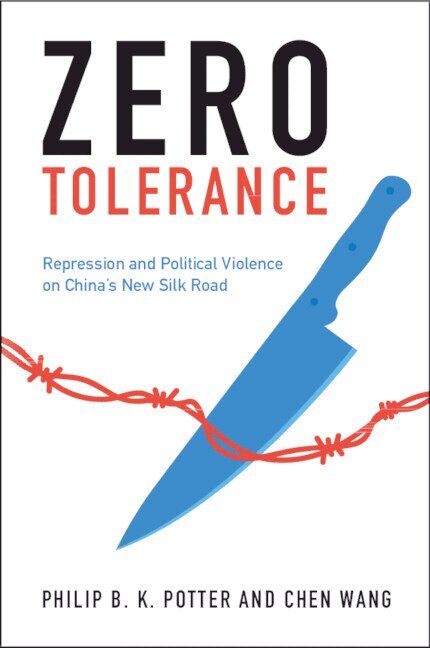
China's mistreatment of its Uyghur minority has drawn international condemnation and sanctions. The repression gripping Xinjiang is also hugely costly to China in Renminbi, personnel, and stifled economic productivity. Despite this, the Chinese Communist Party persists in its policies. Why? Drawing on extensive original data, Potter and Wang demonstrate insecurities about the stability of the regime and its claim to legitimacy motivate Chinese policies. These perceived threats to core interests drive the ferocity of the official response to Uyghur nationalism. The result is harsh repression, sophisticated media control, and selective international military cooperation. China's growing economic and military power means that the country's policies in Xinjiang and Central Asia have global implications. Zero Tolerance sheds light on this problem, informing policymakers, scholars, and students about an emerging global hotspot destined to play a central role in international politics in years to come.
Philip B. K. Potter is an Associate Professor of Politics and Founding Director of the National Security Policy Center in the Frank Batten School of Leadership and Public Policy at the University of Virginia. Chen Wang is an Assistant Professor in the Department of Politics and Philosophy at the University of Idaho. Prior to UoI, he was an America in the World Consortium (AWC) Postdoctoral Fellow at Duke University, a visiting scholar in the Institute for Security and Conflict Studies at George Washington University, and a research fellow affiliated with the National Security Policy Center in the Frank Batten School of Leadership and Public Policy at the University of Virginia. He studies international security and foreign policy.
Recensioner i media
'Potter and Wang's important new book taps a broader literature about domestic political violence and authoritarianism to enrich our understanding of China's policies for dealing with resentment and unrest among the Uyghur Muslims in Xinjiang. Although they detail and explain variation in Beijing's policies since 1949, ultimately they emphasize the clear trend in recent years toward ever harsher repression and tighter social controls. Their book also highlights new international dangers that China faces as its vast array of Belt and Road projects in Central Asia and beyond creates opportunities for political violence against Chinese targets motivated by anger about Beijing's policies towards Xinjiang's Muslims.' Avery Goldstein, David M. Knott Professor of Global Politics and International Relations, University of Pennsylvania
Innehållsförteckning
1. Introduction; 2. Political Violence in Xinjiang; 3. Political Sensitivities; 4. Securitization and Repression in Xinjiang; 5. Foreign Policy; 6. Conclusion; 7. Technical Appendix; 8. Technical Appendix; 9. Technical Appendix; 10. Technical Appendix; References.
Lennart Blomqvist, Sophia Zackrisson, Kasim Abul-Kasim, Ingvar Adnerhill, Nils Albiin, Peter Aspelin, Ylva Aurell, Mats O. Beckman, Ola Björgell, Torkel Brismar, Marika Cronhjort, Martin Delle, Olov Duvernoy, Olle Ekberg, Mårten Falkenberg, Thröstur Finnbogason, Olof Flodmark, Mats Geijer, Pär Gerwins, Marika Gullberg Lidegran, Mikael Gunnarsson, Mikael Hellström, Nils-Gunnar Holmer, Staffan Holmin, Kerstin Johansson, Åse Johnsson, Fredrik Jäderling, Nikolaos Kartalis, Elna-Marie Larsson, Peter Leander, Sigrid Leide Svegborn, Bertil Leidner, Henrik Leonhardt, Anders Levinsson, Lars Lönn, Anders Magnusson, Evangelos Mourtos, Anders Nilsson, Margareta Nilsson, Mats Nilsson, Ulf Nyman, Marcus Ohlsson, Per Åke Olofsson, Anders Persson, Inga Redlund Johnell, Katrine Riklund, Hans Ringertz, Michael Sandborg, Anna Karin Siösteen Tofte, Mikael Skorpil, Freddy Ståhlberg, Michael Söderman, Anne Thilander Klang, Ulf Tylen, Ulla Ullberg, Jonas Wallström, Chen Wang, Håkan Weiber, Johan Wikström, Maria Vinell, Ronnie Wirestam