• Fri frakt över 249 kr
  • •
  • Snabba leveranser
  • •
  • Billiga böcker
Kundservice

Du är på sajten för privatpersoner.

Företag, bibliotek eller offentlig verksamhet?

Du handlar på classic.bokus.com, där alla dina funktioner finns intakta.
Till classic.bokus.com
Bokus logotyp. Gå till startsidan.
  • Erbjudanden
  • Nyheter
  • Student
  • Topplistor
  • Barn & ungdom
  • Bokus Play
  • E-böcker
  • Pocketböcker
  • Spel & pussel

10% rabatt på allt med kod: NYSTART10 →

Sidfot

Mina sidor

    Hjälp

    • Kundservice
    • Vanliga frågor och svar
    • Frakt och leverans
    • Retur vid ångerrätt
    • Reklamera vara
    • Betalning
    • Köpvillkor
    • Allmänna villkor
    • Information om webbplatsens tillgänglighet

    Om Bokus

    • Om oss
    • Pressrum
    • För studenter
    • För företag
    • För bibliotek och offentlig verksamhet
    • För leverantörer
    • Hållbarhet

    Populärt

    • Aktuella erbjudanden
    • Presentkort
    • Studentlitteratur
    • Nya böcker
    • Topplistor
    • Signerade böcker
    • Engelska böcker

    Inspiration

    • Boktips
    • BookTok
    • Populära bokserier
    • Barnbokskaraktärer
    • Populära författare
    Logotyp för Bokus
    Följ oss på Facebook (extern länk)Följ oss på Instagram (extern länk)Följ oss på YouTube (extern länk)Följ oss på TikTok (extern länk)
    bokus @ CookiesAnpassa cookiesIntegritetspolicyKöpvillkor
    Till Citymail hemsida (extern länk)Till Budbee hemsida (extern länk)Till Postnord hemsida (extern länk)Till Schenker hemsida (extern länk)Till Early Bird hemsida (extern länk)Till Walleys hemsida (extern länk)
    1. Skönlitteratur
    2. Litteraturvetenskap

    Nineteenth-Century Literature in Transition: The 1830s

    AvJohn Gardner,David Stewart

    Inbunden, Engelska, 2024

    Del i serien Nineteenth-Century Literature in Transition

    1 437 kr

    Beställningsvara. Skickas inom 10-15 vardagar. Fri frakt över 249 kr.

    Beskrivning

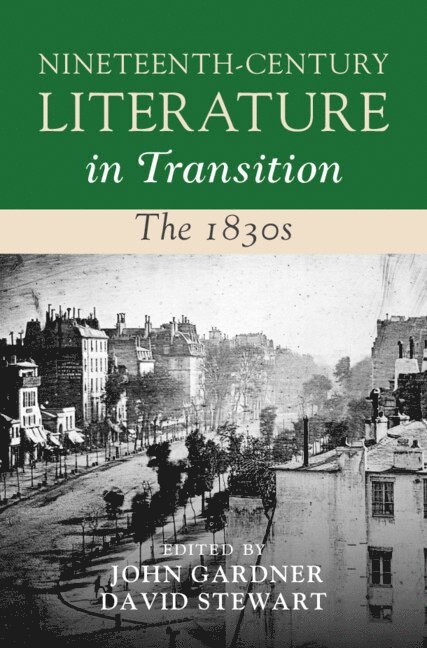
    This instalment in the Nineteenth-Century Literature in Transition series concerns a decade that was as technologically transitional as it was eventful on a global scale. It collects work from a group of internationally renowned scholars across disciplinary boundaries in order to engage with the wide array of cultural developments that defined the 1830s. Often overlooked as a boundary between the Romantic and Victorian periods, this decade was, the book proposes, the central pivot of the nineteenth century. Far from a time of peaceful reform, it was marked by violent colonial expansion, political resistance, and revolutionary technologies such as the photograph, the expansion of steam power, and the railway that changed the world irreversibly. Contributors explore a flurry of cultural forms to take the pulse of the decade, from Silver Fork fiction to lithography, from working-class periodicals to photographs, and from urban sketches to magazine fiction.

    Produktinformation

    • Utgivningsdatum:2024-06-06
    • Mått:159 x 235 x 26 mm
    • Vikt:680 g
    • Format:Inbunden
    • Språk:Engelska
    • Serie:Nineteenth-Century Literature in Transition
    • Antal sidor:370
    • Förlag:Cambridge University Press
    • ISBN:9781009268516

    Utforska kategorier

    • Litteraturvetenskap inom Skönlitteratur
    • Litteraturvetenskap inom Skönlitteratur

    Mer om författaren

    John Gardner is Dean of the Doctoral School and Professor of English Literature at Anglia Ruskin University. Gardner is also the Leverhulme Trust Research Fellow on 'Turning the Screw: Engineering Romanticism', a project which examines convergences between literary and engineering cultures. David Stewart is Associate Professor of English Literature at Northumbria University. He is the author of Romantic Magazines and Metropolitan Literary Culture (2011) and The Form of Poetry in the 1820s and 1830s: A Period of Doubt (2018).

    Innehållsförteckning

    • Introduction John Gardner and David Stewart; 1. On the eve: William Benbow, Francis Macerone and the transmission of revolution John Gardner; 2. 'An infectious madness': disability and the epidemiology of social unrest in Dickens's Barnaby Rudge Essaka Joshua; 3. Augustus Hardin Beaumont, slavery apologias, and popular radical literature in the 1830s Tom Scriven; 4. Patterns of industry: Harriet Martineau's illustrated masculinities Valerie Sanders; 5. Mother Earth: gender and geology in the 1830s Adelene Buckland; 6. The polite fictions of slavery: British antislavery in the 1830s Juliet Shields; 7. Suffering, sentiment, and the rise of humanitarian literature in the 1830s Porscha Fermanis; 8. Steam and iron in the 1830s: liberal imperialism, Thomas Love Peacock, and the Nemesi Peter J. Kitson; 9. Lithography and the comic image 1825–1840 Brian Maidment; 10. Jorrocks's canon: Dickens, Surtees and 1830s print culture John Strachan; 11. Tennyson, Dickens, Poe, Browning, and the Brontës: Blackwood's Magazine and 'The foreheads of a new generation' Robert Morrison; 12. Boz in London: The 1830s and the urban turn in the English novel Sambudha Sen; 13. Letitia Elizabeth Landon, chronicler of the 1830s David Stewart; 14. Railway imaginary in the 1830s Nicola Kirkby: finding form; 15. The emerging language of photography Jennifer Green-Lewis; Afterword Richard Cronin.