• Fri frakt över 249 kr
  • •
  • Snabba leveranser
  • •
  • Billiga böcker
Kundservice

Du är på sajten för privatpersoner.

Företag, bibliotek eller offentlig verksamhet?

Du handlar på classic.bokus.com, där alla dina funktioner finns intakta.
Till classic.bokus.com
Bokus logotyp. Gå till startsidan.
  • Erbjudanden
  • Nyheter
  • Student
  • Topplistor
  • Barn & ungdom
  • Bokus Play
  • E-böcker
  • Pocketböcker
  • Spel & pussel

10% rabatt på allt med kod: NYSTART10 →

Sidfot

Mina sidor

    Hjälp

    • Kundservice
    • Vanliga frågor och svar
    • Frakt och leverans
    • Retur vid ångerrätt
    • Reklamera vara
    • Betalning
    • Köpvillkor
    • Allmänna villkor
    • Information om webbplatsens tillgänglighet

    Om Bokus

    • Om oss
    • Pressrum
    • För studenter
    • För företag
    • För bibliotek och offentlig verksamhet
    • För leverantörer
    • Hållbarhet

    Populärt

    • Aktuella erbjudanden
    • Presentkort
    • Studentlitteratur
    • Nya böcker
    • Topplistor
    • Signerade böcker
    • Engelska böcker

    Inspiration

    • Boktips
    • BookTok
    • Populära bokserier
    • Barnbokskaraktärer
    • Populära författare
    Logotyp för Bokus
    Följ oss på Facebook (extern länk)Följ oss på Instagram (extern länk)Följ oss på YouTube (extern länk)Följ oss på TikTok (extern länk)
    bokus @ CookiesAnpassa cookiesIntegritetspolicyKöpvillkor
    Till Citymail hemsida (extern länk)Till Budbee hemsida (extern länk)Till Postnord hemsida (extern länk)Till Schenker hemsida (extern länk)Till Early Bird hemsida (extern länk)Till Walleys hemsida (extern länk)
    1. Ekonomi och Ledarskap
    2. Nationalekonomi
    3. Makroekonomi

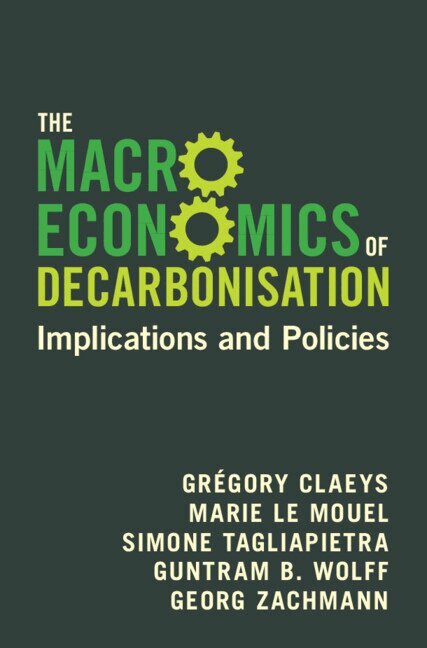
    The Macroeconomics of Decarbonisation

    Implications and Policies

    AvGrégory Claeys,Marie Le Mouel

    Inbunden, Engelska, 2024

    1 168 kr

    Beställningsvara. Skickas inom 10-15 vardagar. Fri frakt över 249 kr.

    Fler format och utgåvor

    Häftad

    364 kr

    Beskrivning

    Decarbonisation is the reduction of carbon dioxide emissions using low carbon power sources, lowering output of greenhouse gasses into the atmosphere. This is essential to meet global temperature standards set by international climate agreements. To limit global warming to 1.5°C, hence avoiding the worst-case scenarios predicted by climate science, the world economy must rapidly reduce its emissions and reach climate neutrality within the next three decades. This will not be an easy journey. Shifting away from carbon-intensive production will require a historic transformation of the structure of our economies. Written by a team of academics linked to the European think tank Bruegel, The Macroeconomics of Decarbonisation provides a guide to the macroeconomic fundamentals of decarbonisation. It identifies the major economic transformations, both over the long- and short-run, and the roadblocks requiring policy intervention. It proposes a macroeconomic policy agenda for decarbonisation to achieve the climate goals of the international community.

    Produktinformation

    • Utgivningsdatum:2024-02-08
    • Mått:160 x 235 x 25 mm
    • Vikt:640 g
    • Format:Inbunden
    • Språk:Engelska
    • Antal sidor:346
    • Förlag:Cambridge University Press
    • ISBN:9781009438360

    Utforska kategorier

    • Makroekonomi inom Ekonomi och Ledarskap
    • Miljöekonomi inom Ekonomi och Ledarskap

    Mer om författaren

    Grégory Claeys is a Senior Fellow at the Brussels-based economic think tank Bruegel, where he has been working since 2014, and an Associate Professor at the Conservatoire National des Arts et Métiers in Paris where he has been teaching macroeconomics since 2015. His research interests include international macroeconomics and finance, central banking and European economic governance. Marie Le Mouel is an Affiliate Fellow at Bruegel and a Lecturer at Tilburg University, where she has been teaching economic growth since 2018. Her research interests include the macroeconomics of decarbonisation, green industrial policy, drivers of productivity growth and dispersion, and intangible assets. Simone Tagliapietra is a Senior fellow at Bruegel. He is also a Professor of Energy and Climate Policy at The Johns Hopkins University – School of Advanced International Studies (SAIS) Europe. With a record of numerous policy and scientific publications, also in leading journals such as Nature and Science, he is the author of Global Energy Fundamentals (Cambridge University Press, 2020). Guntram B. Wolff is the CEO of the German Council on Foreign Relations (DGAP) since 2022. He is a widely cited academic working on European political economy, climate, macroeconomic policy and geopolitics. From 2013-2022, he developed Bruegel into a globally leading institute and regularly testified to EU finance ministers' ECOFIN meeting. Georg Zachmann is a Senior Fellow at Bruegel. Over the past decade, he conducted extensive empirical works on identifying regional economic potentials. In the energy crisis Georg's work gained prominence in the media, providing clear assessments of Europe's supply situation. He previously worked at the German Ministry of Finance.

    Recensioner i media

    'The authors provide a unique insight into the short and long-term economic implications of decarbonisation, applying a rigorous and thorough approach to assessing the multidimensional facets of the transition. A 'must-read' for policymakers and the private sector whose combined mobilisation will be essential to achieve climate neutrality by 2050.' Alexandra Dimitrijevic, Managing Director, Global Head of Research, S&P Global Ratings

    Innehållsförteckning

    • Introduction; 1. Understanding deep decarbonisation over the long run; 2. Understanding decarbonisation's short-term disruptions to economic activity; 3. The distributional effects of climate policy; 4. Public finances and decarbonisation; 5. Greening innovation, industrial and competition policies; 6. Mobilising the financial system for decarbonisation; 7. Decarbonisation and labour markets; 8. Greening central banks; Conclusions: the macroeconomics of decarbonisation: between degrowth and green growth.