• Fri frakt över 249 kr
  • •
  • Snabba leveranser
  • •
  • Billiga böcker
Kundservice

Du är på sajten för privatpersoner.

Företag, bibliotek eller offentlig verksamhet?

Du handlar på classic.bokus.com, där alla dina funktioner finns intakta.
Till classic.bokus.com
Bokus logotyp. Gå till startsidan.
  • Erbjudanden
  • Nyheter
  • Student
  • Topplistor
  • Barn & ungdom
  • Bokus Play
  • E-böcker
  • Pocketböcker
  • Spel & pussel

10% studentrabatt med kod TERM26

Sidfot

Mina sidor

    Hjälp

    • Kundservice
    • Vanliga frågor och svar
    • Frakt och leverans
    • Retur vid ångerrätt
    • Reklamera vara
    • Betalning
    • Köpvillkor
    • Allmänna villkor
    • Information om webbplatsens tillgänglighet

    Om Bokus

    • Om oss
    • Pressrum
    • För studenter
    • För företag
    • För bibliotek och offentlig verksamhet
    • För leverantörer
    • Hållbarhet

    Populärt

    • Aktuella erbjudanden
    • Presentkort
    • Studentlitteratur
    • Nya böcker
    • Topplistor
    • Signerade böcker
    • Engelska böcker

    Inspiration

    • Boktips
    • BookTok
    • Populära bokserier
    • Barnbokskaraktärer
    • Populära författare
    Logotyp för Bokus
    Följ oss på Facebook (extern länk)Följ oss på Instagram (extern länk)Följ oss på YouTube (extern länk)Följ oss på TikTok (extern länk)
    bokus @ CookiesAnpassa cookiesIntegritetspolicyKöpvillkor
    Till Citymail hemsida (extern länk)Till Budbee hemsida (extern länk)Till Postnord hemsida (extern länk)Till Schenker hemsida (extern länk)Till Early Bird hemsida (extern länk)Till Walleys hemsida (extern länk)
    1. Samhälle och politik
    2. Politik och statsskick

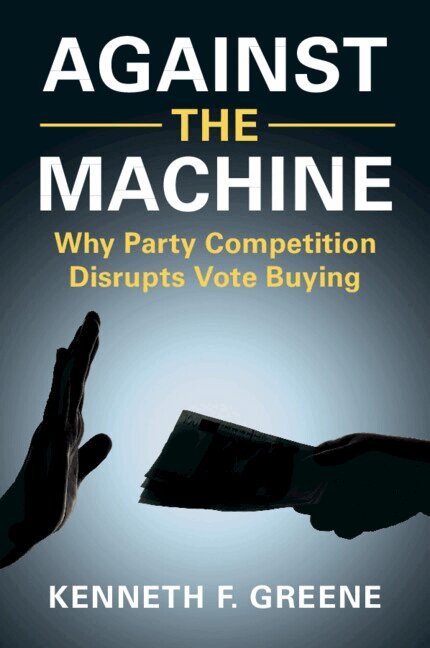
    Against the Machine

    Why Party Competition Disrupts Vote Buying

    AvKenneth F. Greene

    Häftad, Engelska, 2026

    366 kr

    Kommande

    Fler format och utgåvor

    Inbunden

    Kommande

    Beskrivning

    This book explains variations in the effectiveness of vote buying. Current theory assumes that vote buying is effective, rotting democracy's foundations. Yet evidence shows that it rarely succeeds. Against the Machine presents a partisan competition theory to explain why buying vote choices is typically ineffective, the conditions under which it occasionally succeeds, and why it persists despite meager electoral returns. Competitive elections arm voters with the psychological wherewithal to resist the influence of electoral gifts, deprive political machines of the information they need to target compliant clients, and reinforce belief in ballot secrecy. The success or failure of vote buying thus relies more on the capacity of parties that challenge machines rather than the prowess of political machines themselves. Against the Machine provides a new account of vote buying that paints a more optimistic portrait of elections, voter behavior, and the chances for political accountability in new democracies.

    Produktinformation

    • Utgivningsdatum:2026-09-10
    • Mått:152 x 229 x 17 mm
    • Vikt:421 g
    • Format:Häftad
    • Språk:Engelska
    • Antal sidor:328
    • Förlag:Cambridge University Press
    • ISBN:9781009776752

    Utforska kategorier

    • Politik och statsskick inom Samhälle och politik

    Mer om författaren

    Kenneth F. Greene is Professor of Government at the University of Texas at Austin. He is the author of the award-winning book, Why Dominant Parties Lose (2007). His research on political regimes, voting behavior, and political parties has also received several awards from the American Political Science Association.

    Recensioner i media

    'Why does vote buying so often fail? Greene shows that the forces of democratic competition erode the effectiveness of vote buying, empowering voters to choose freely. Theoretically original, empirically rigorous, and refreshingly optimistic, this book will reshape how we think about clientelism and the promises of democracy.' Alisha C. Holland, Gates Professor of Developing Societies, Department of Government, Harvard University

    Innehållsförteckning

    • Acknowledgments; Part I. Introduction: 1. The Challenge of Vote Buying in Competitive Democracies; Part II. The Macro Perspective: Variation in the Effectiveness of Vote Buying: 2. The Vulnerability of Contemporary Electoral Clientelism; 3. Local Electoral Competitiveness and the Efficacy of Vote Buying in Mexico; Part III. The Micro Perspective: How Electoral Gifts Influence Voter Behavior: 4. Love Isn't for Sale: Partisan Responses to Vote-Buying Offers; 5. Moving Targets: Selecting Clients in the Shadow of Partisan Campaigns; 6. Catch Me if You Can: Why Voters Comply or Defect under the Secret Ballot; Part IV. Comparative Perspectives and Implications: 7. Why Major Machines Fail: Vote Buying in Argentina, Colombia, and Turkey; 8. Conclusion: Elections and Accountability in New Democracies; References; Appendix; Index.