• Fri frakt över 249 kr
  • •
  • Snabba leveranser
  • •
  • Billiga böcker
Kundservice

Du är på sajten för privatpersoner.

Företag, bibliotek eller offentlig verksamhet?

Du handlar på classic.bokus.com, där alla dina funktioner finns intakta.
Till classic.bokus.com
Bokus logotyp. Gå till startsidan.
  • Erbjudanden
  • Nyheter
  • Student
  • Topplistor
  • Barn & ungdom
  • Bokus Play
  • E-böcker
  • Pocketböcker
  • Spel & pussel

10% rabatt på allt med kod: NYSTART10 →

Sidfot

Mina sidor

    Hjälp

    • Kundservice
    • Vanliga frågor och svar
    • Frakt och leverans
    • Retur vid ångerrätt
    • Reklamera vara
    • Betalning
    • Köpvillkor
    • Allmänna villkor
    • Information om webbplatsens tillgänglighet

    Om Bokus

    • Om oss
    • Pressrum
    • För studenter
    • För företag
    • För bibliotek och offentlig verksamhet
    • För leverantörer
    • Hållbarhet

    Populärt

    • Aktuella erbjudanden
    • Presentkort
    • Studentlitteratur
    • Nya böcker
    • Topplistor
    • Signerade böcker
    • Engelska böcker

    Inspiration

    • Boktips
    • BookTok
    • Populära bokserier
    • Barnbokskaraktärer
    • Populära författare
    Logotyp för Bokus
    Följ oss på Facebook (extern länk)Följ oss på Instagram (extern länk)Följ oss på YouTube (extern länk)Följ oss på TikTok (extern länk)
    bokus @ CookiesAnpassa cookiesIntegritetspolicyKöpvillkor
    Till Citymail hemsida (extern länk)Till Budbee hemsida (extern länk)Till Postnord hemsida (extern länk)Till Schenker hemsida (extern länk)Till Early Bird hemsida (extern länk)Till Walleys hemsida (extern länk)
    1. Språk och ordböcker
    2. Språkvetenskap och lingvistik

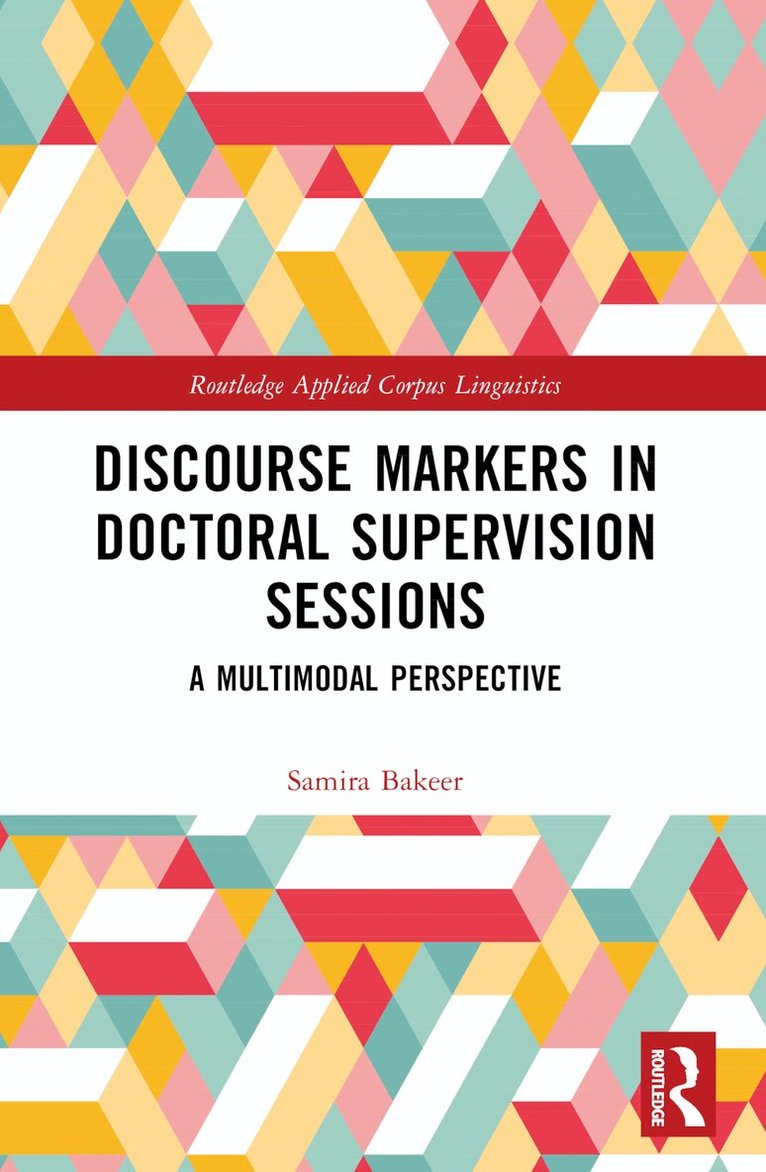
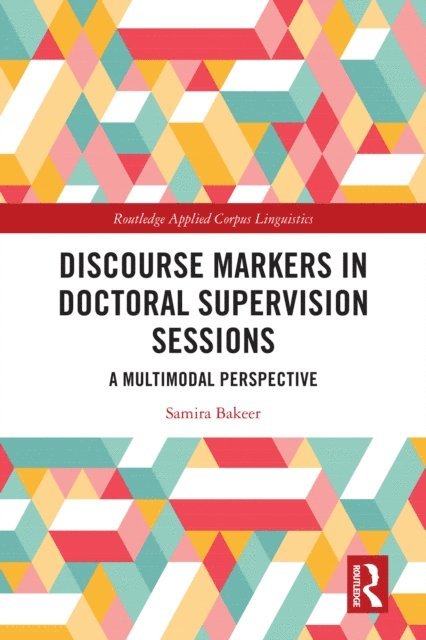
    Discourse Markers in Doctoral Supervision Sessions

    A Multimodal Perspective

    AvSamira Bakeer

    Inbunden, Engelska, 2023

    Del i serien Routledge Applied Corpus Linguistics

    2 493 kr

    Beställningsvara. Skickas inom 10-15 vardagar. Fri frakt över 249 kr.

    Fler format och utgåvor

    E-bok

    760 kr

    E-bok

    760 kr

    Häftad

    643 kr

    Beskrivning

    Language is a complex system that transfers ideas, feelings, experiences, beliefs, and cultures to others. One of the interactional resources that are utilised to make this transmission more coherent and effective is Discourse Markers (DMs). This monograph analyses these markers in doctoral supervisions but uses a multimodal approach to provide a deeper understanding of these DMs and uncovers potential hidden meanings that would escape a purely verbal analysis. Using a dataset consisting of a corpus of video-recorded doctoral supervision meetings, this book provides an innovative and cutting-edge approach to the analysis of DMs and sheds new light on the complexity and dynamicity of naturally occurring discourse where meaning-making rests on a close coordination of both verbal and embodied conducts.The book makes very useful reading for scholars in the fields of discourse markers, conversation analysis, corpus linguistics and multimodality. It could collaterally be appealing to anyone simply interested in the study of human communication.

    Produktinformation

    • Utgivningsdatum:2023-09-29
    • Mått:156 x 234 x 20 mm
    • Vikt:680 g
    • Format:Inbunden
    • Språk:Engelska
    • Serie:Routledge Applied Corpus Linguistics
    • Antal sidor:268
    • Förlag:Taylor & Francis Ltd
    • ISBN:9781032025957

    Utforska kategorier

    • Språkvetenskap och lingvistik inom Språk och ordböcker

    Mer om författaren

    Samira Bakeer is a Senior Lecturer at the school of English at Misurata University, Libya.

    Innehållsförteckning

    • List of FiguresList of TablesAcknowledgementsChapter 1: Introduction1.1 Preliminary remarks1.2 Why the context of doctoral supervision?1.3 Extending the boundaries1.4 Overview of the bookReferencesChapter 2: Discourse marker as a field of inquiry: Connecting meaning, context, and multimodality2.1 Terminology and definition2.2 Commonly defined features2.3 Major frameworks for analysing DMs2.3.1 Coherence-based approach2.3.2 Relevance-based perspective2.3.3 Grammatical-Pragmatic Perspective2.3.4 Corpus-based Approach 2.4 The functions of DMs adopted in the study2.5 The influence of context2.5.1 Supervisory sessions as an instance of academic discourse 2.5.2 Previous studies on DMs in supervision contexts 2.6 DMs from a multimodal perspective: Identifying the research gap2.6.1 Multimodality: Definition and classifications2.6.2 Gesture types2.6.3 Speech-gesture interface 2.6.4 Speech-gesture synchrony 2.6.5 DMs from a multimodal perspective: Relevant Studies2.6.6 Challenges in multimodal DMs research 2.7 Summary References Chapter 3: Methodological considerations3.1 Corpus linguistics 3.2 Conversation Analysis 3.2.1 Knowledge and Epistemicity3.2.2 The interactional practices of Affiliation and alignment3.3 Case study3.4 The data 3.4.1 Context and research participants 3.4.2 Data collection3.4.3 Data processing Selection of DMsIdentifying functions of DMsEthical considerationsReferences Chapter 4: Towards a multimodal analytical framework4.1 Transcriptions and annotation 4.2 The multimodal coding scheme4.2.1 Hand gesture4.2.2 Head gesture 4.2.3 Body Posture 4.2.4 Prosodic features4.3 Reliability and validity 4.4 SummaryReferences Chapter 5: Insights from corpus analysis5.1 DMs at the textual level5.1.1 Overall frequency and distribution5.1.2 Functional profile 5.1.3 The positioning in turns5.1.4 Combinations of DMs5.2 DMs at the Prosodic level5.2.1 Distribution of tone patterns 5.2.2 Position of DMs and tone choice 5.2.3 Prosodic properties of DMs and their pragmatic functions1. The falling tone2. The rising tone3. The level tone 4. The fall-rise tone 5. The rise-fall Tone 5.3 DMs and the co-occurrences of embodied resources 5.3.1 Frequency analysis 5.3.2 Identifying gestures patterns and functions5.3.2.1 Hand movements 1. The throwing-away gesture2. The palm-side epistemic gesture3. The ring gesture4. Palm-up open hand gesture5.3.2.2 Gaze and facial movements5.4 Concluding remarksReferences Chapter 6: 6. Case study 1: Supervisory discourse in an English studies domain6.1 DMs in Student 1’s speech 6.1.1 You know 6.1.2 I don’t know and gaze orientations6.1.3 Or something like that: The brushing aside gesture6.2 DMs in Supervisor 1’s speech 6.2.1 So 6.2.2 Well6.3 Concluding remarksReferences Chapter 7: Case study 2: Supervisory discourse in an engineering studies domain7.1 DMs in Student 2’s speech7.1.1 I mean: Enhancing the clarity of the communicative act7.1.2 I think: Assertiveness vs tentativeness1. The role of chopping gestures in highlighting strong opinions2. Expressing a negotiated opinion 7.1.3 The palm-up open hand gesture with so and honestly1. The case of the PUOH gesture with so2. The case of the PUOH gesture with honestly 7.2 DMs in Supervisor 2’s speech7.2.1 But 1. Signalling mitigated disagreement 2. Marking a direct contrast3. Indexing speaker’s return to main topic4. The meaning of Open Hand Prone gesture with but7.2.2 The role of duration in disambiguating the functions of well 7.3 Concluding remarksReferences Chapter 8: The interactional architecture: DMs in different types of speech-exchange systems8.1 Organisational talk: Manifestations of persuasion vs. power8.2 Instructional talk and advice-giving 8.2.1 Advice and the embodied display of precision 8.3 Argumentative talk and the management of (dis)alignment 8.4 Discursive talk and the negotiation of epistemic displays 8.4.1 Creating a sense of CollectivityReferences Chapter 9: Concluding remarks9.1 Overarching conclusions9.2 The influence of context9.2.1 DMs and Rapport management 9.2.2 The negotiation of identity 9.3 What understandings can a multimodal perspective on DMs offer?9.3.1 The body as a resource for the negotiation of epistemicity 9.3.2 Gesture as assistance of Self-disclosure 9.3.3 The embodiment of precision 9.3.4 DMs and the Interface of prosodic prominence and hand gesture 9.3.5 Revisiting the characteristics of DMs9.4 DMs and the dynamics of doctoral supervision: Two possible factors 9.5 Implications and further perspectivesReferences Index