• Fri frakt över 249 kr
  • •
  • Snabba leveranser
  • •
  • Billiga böcker
Kundservice

Du är på sajten för privatpersoner.

Företag, bibliotek eller offentlig verksamhet?

Du handlar på classic.bokus.com, där alla dina funktioner finns intakta.
Till classic.bokus.com
Bokus logotyp. Gå till startsidan.
  • Erbjudanden
  • Nyheter
  • Student
  • Topplistor
  • Barn & ungdom
  • Bokus Play
  • E-böcker
  • Pocketböcker
  • Spel & pussel

10% rabatt på allt med kod NYSTART10 →

Sidfot

Mina sidor

    Hjälp

    • Kundservice
    • Vanliga frågor och svar
    • Frakt och leverans
    • Retur vid ångerrätt
    • Reklamera vara
    • Betalning
    • Köpvillkor
    • Allmänna villkor
    • Information om webbplatsens tillgänglighet

    Om Bokus

    • Om oss
    • Pressrum
    • För studenter
    • För företag
    • För bibliotek och offentlig verksamhet
    • För leverantörer
    • Hållbarhet

    Populärt

    • Aktuella erbjudanden
    • Presentkort
    • Studentlitteratur
    • Nya böcker
    • Topplistor
    • Signerade böcker
    • Engelska böcker

    Inspiration

    • Boktips
    • BookTok
    • Populära bokserier
    • Barnbokskaraktärer
    • Populära författare
    Logotyp för Bokus
    Följ oss på Facebook (extern länk)Följ oss på Instagram (extern länk)Följ oss på YouTube (extern länk)Följ oss på TikTok (extern länk)
    bokus @ CookiesAnpassa cookiesIntegritetspolicyKöpvillkor
    Till Citymail hemsida (extern länk)Till Budbee hemsida (extern länk)Till Postnord hemsida (extern länk)Till Schenker hemsida (extern länk)Till Early Bird hemsida (extern länk)Till Walleys hemsida (extern länk)
    1. Naturvetenskap och teknik
    2. Teknik och industri
    3. Elektronik och kommunikationer

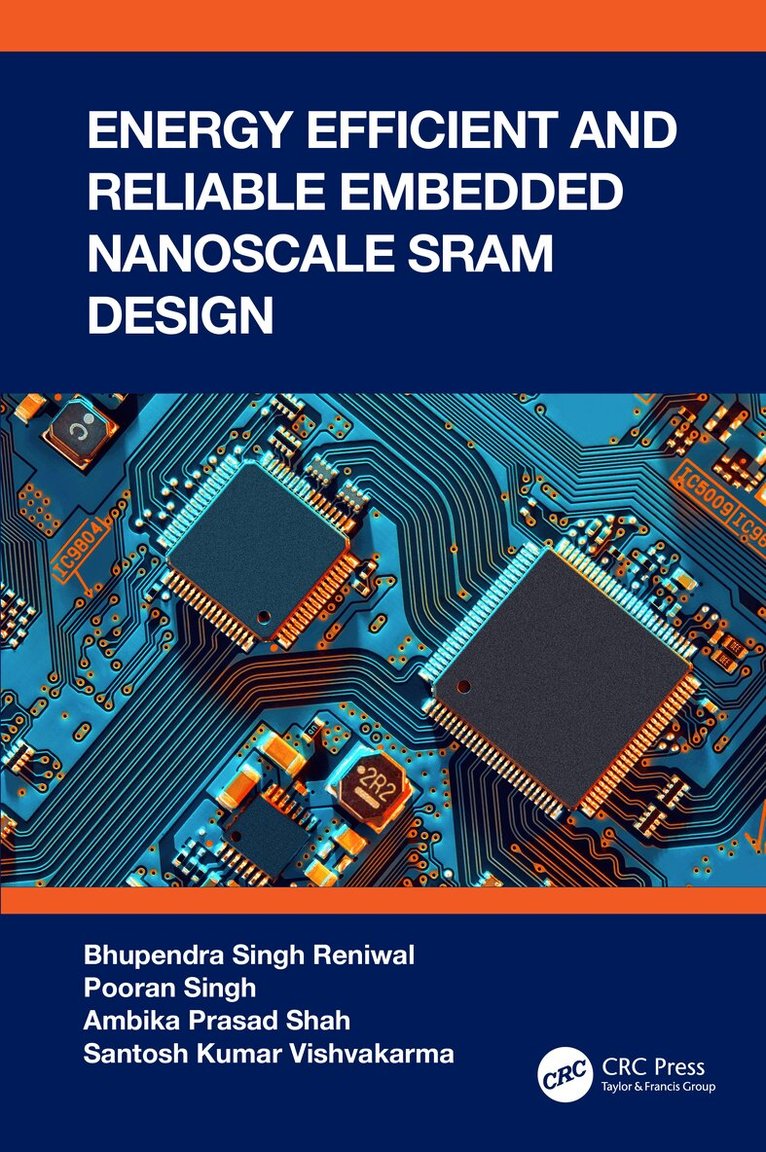
    Energy Efficient and Reliable Embedded Nanoscale SRAM Design

    AvBhupendra Singh Reniwal,Pooran Singh

    Häftad, Engelska, 2025

    794 kr

    Beställningsvara. Skickas inom 10-15 vardagar. Fri frakt över 249 kr.

    Fler format och utgåvor

    Inbunden

    2 058 kr

    Beskrivning

    This reference text covers a wide spectrum for designing robust embedded memory and peripheral circuitry. It will serve as a useful text for senior undergraduate and graduate students and professionals in areas including electronics and communications engineering, electrical engineering, mechanical engineering, and aerospace engineering. Discusses low-power design methodologies for static random-access memory (SRAM) Covers radiation-hardened SRAM design for aerospace applications Focuses on various reliability issues that are faced by submicron technologies Exhibits more stable memory topologiesNanoscale technologies unveiled significant challenges to the design of energy- efficient and reliable SRAMs. This reference text investigates the impact of process variation, leakage, aging, soft errors and related reliability issues in embedded memory and periphery circuitry.The text adopts a unique way to explain the SRAM bitcell, array design, and analysis of its design parameters to meet the sub-nano-regime challenges for complementary metal-oxide semiconductor devices. It comprehensively covers low- power-design methodologies for SRAM, exhibits more stable memory topologies, and radiation-hardened SRAM design for aerospace applications. Every chapter includes a glossary, highlights, a question bank, and problems. The text will serve as a useful text for senior undergraduate students, graduate students, and professionals in areas including electronics and communications engineering, electrical engineering, mechanical engineering, and aerospace engineering. Discussing comprehensive studies of variability-induced failure mechanism in sense amplifiers and power, delay, and read yield trade-offs, this reference text will serve as a useful text for senior undergraduate, graduate students, and professionals in areas including electronics and communications engineering, electrical engineering, mechanical engineering, and aerospace engineering. It covers the development of robust SRAMs, well suited for low-power multi-core processors for wireless sensors node, battery-operated portable devices, personal health care assistants, and smart Internet of Things applications.

    Produktinformation

    • Utgivningsdatum:2025-05-26
    • Mått:156 x 234 x 12 mm
    • Vikt:410 g
    • Format:Häftad
    • Språk:Engelska
    • Antal sidor:206
    • Förlag:Taylor & Francis Ltd
    • ISBN:9781032100593

    Utforska kategorier

    • Elektronik och kommunikationer inom Naturvetenskap och teknik
    • Energiteknik inom Naturvetenskap och teknik
    • Miljöteknik inom Naturvetenskap och teknik

    Mer om författaren

    Bhupendra Singh Reniwal received B. Tech & M. Tech from SGSITS-Indore and Ph.D. from IIT, Indore, India in 2006, 2011 and 2016 respectively. He is currently working as Assistant Professor in the Department of Electrical Engineering, Indian Institute of Technology Jodhpur, India. Post Ph.D. he has worked as a Senior Product Development Engineer, Semiconductor Vertical in UST Global Bangalore, India Mixed-Signal IP Solution Group (MIG) at Intel Corporation Penang, Malaysia, and Systems & Technology Group, ASIC Foundry, IBM Bangalore where he was involved on developing Energy Efficient Memory Architecture, I/O Circuit Design, and its pre-silicon validation, for Internet of Things (IoT), applications in subnanometric trigate FinFET processes. In IBM he was involved in R&D on low power methodology definition at Schematic2GDS level for sub-nanometric nodes, especially for FinFET memory design. He has served the Department of Electronics & Communication Engineering IIITDM Kancheepuram and BITS Pilani, as an Assistant Professor from Nov-2019 to Oct-2022 and May-Dec 2017, respectively. He is a recipient of the prestigious SIRE-2022 Faculty Fellowship from the Department of Science & Technology (DST) GOI and joined University of Virginia, USA as a Visiting Faculty. He received the User Design Best Research Paper Award in IEEE 29th International Conference on VLSI Design and Best Poster Presentation Award for Ultra Low Power SRAM Design in Ramanujan Conclave 2016. He is a recipient of the International Travel Award as early recognition in Solid State Circuit Design from the Association of Computing Machinery (ACM), NY, USA, and DST.Dr. Pooran Singh is an Assistant Professor in the Department of Electrical and Computer Engineering at Mahindra University École Centrale School of Engineering. Dr. Pooran graduated with a Ph.D. from the Department of Electrical Engineering, IIT Indore. He is a Fulbright-Nehru Doctoral Fellow (2014-15). Under Fulbright Fellowship he was associated with the Department Electrical and Computer Engineering, Georgia Institute of Technology, Atlanta USA for a period of one year. Prior to joining MU, he was an Analog Design Engineer (SRAM Design) at Intel Microelectronics, Penang, Malaysia. Over there his his primary work included designing SRAM circuits, Pre-layout SRAM design and analysis of its various design parameters i.e. read margin/write margin, critical path, read/write performance, dynamic and leakage power at different PVT values for Intel’s 7nm and 10nm FPGAs. His primary research work includes designing low power and robust SRAM for space applications, In-Memory compute and for IoT devices.Dr. Ambika Prasad Shah is currently working as an Assistant Professor, Electrical Engineering Department, and Associate Dean Corporate Relations at Indian Institute of Technology Jammu, India. He received Ph.D. degree from the Electrical Engineering Department, Indian Institute of Technology Indore, India. Before joining IIT Jammu, Dr. Shah worked as a Postdoctoral Fellow at the Institute for Microelectronics, TU Vienna, Austria. He is the recipient of the Young Scientist Award from the M.P. Council of Science and Technology Bhopal, M.P. India. He has authored/co-authored more than 70 research papers in peer-reviewed international journals and conferences. He was the Conference Organizing Chair for VDAT-2022 and Fellowship Chair for VLSID-2022. He is a fellow of IETE, senior member of IEEE, and member of ACM, ISTE, ISCA, IEI, and IAENG.His current research interest includes reliability analysis of digital circuits, Design for reliability, fault-tolerant circuits, reliability modeling, low power high-performance circuit designs, and Hardware Security circuits.Prof. Santosh Kumar Vishvakarma is with the Department of Electrical Engineering, Indian Institute of Technology Indore, MP, India as Professor. He is engaged with teaching and research in the area of Energy-Efficient and Reliable SRAM Memory Design, Enhancing Performance and Configurable Architecture for DNN Accelerators, SRAM based In-Memory Computing Architecture for Edge AI, Reliable, Secure Design for IoT Application, Design for Reliability. Prof. Vishvakarma is the reviewer of various Journals like IEEE Transaction on Electron Devices, IEEE Transaction on Nanotechnology, IEEE Transaction on VLSI Integration System, Elsevier Microelectronics Journal, Elsevier Integration the VLSI Journal, IEEE Transaction on VLSI Integration System, Analog Integrated Circuits and Signal Processing Springer, Circuits, Systems & Signal Processing (CSSP), Solid State Electronics etc. He is a Member of IEEE, Professional Member of VLSI Society of India, Associate Member of Institute of Nanotechnology, Life member of Indian Microelectronics Society (IMS), India.He is the General Chair of 23rd International Symposium on VLSI Design and Test (VDAT-2019) On July 4-6, 2019, IIT Indore, India.Prof. Vishvakarma did schooling from Gorakhpur itself and then Bachelor of Science (B.Sc.) in Electronics, Master of Science (M.Sc.) in Electronics and Master of Technology (M.Tech.) in Microelectronics from University of Gorakhpur, Devi Ahilya Vishvidayalaya Indore and Panjab University Chandigarh in 1999, 2001 and 2003 respectively. Dr. Vishvakarma obtained Ph.D. degree on the topic "Analytical Modeling of Low Leakage MGDG MOSFET and its Application to SRAM" from Microelectronics and VLSI Group, Department of Electronics and Computer Engineering, Indian Institute of Technology, Roorkee (IITR) in 2010 and worked under the supervision of Prof. S. Dasgupta, & Prof. A. K. Saxena in the area of MOS device modeling and SRAM circuit design.

    Innehållsförteckning

    • Chapter 1IntroductionChapter 2Design Metrics for Embedded SRAM Chapter 3SRAM Bitcells Over Conventional Memories Chapter 4Offset correction in Sense AmplifierChapter 5Data Sensing in SRAM a Hybrid Approach with FinFET Chapter 6Bias Temperature Instability Aware and Soft Error Tolerant SRAM Cell