• Fri frakt över 249 kr
  • •
  • Snabba leveranser
  • •
  • Billiga böcker
Kundservice

Du är på sajten för privatpersoner.

Företag, bibliotek eller offentlig verksamhet?

Du handlar på classic.bokus.com, där alla dina funktioner finns intakta.
Till classic.bokus.com
Bokus logotyp. Gå till startsidan.
  • Erbjudanden
  • Nyheter
  • Student
  • Topplistor
  • Barn & ungdom
  • Bokus Play
  • E-böcker
  • Pocketböcker
  • Spel & pussel

10% rabatt på allt med kod: NYSTART10 →

Sidfot

Mina sidor

    Hjälp

    • Kundservice
    • Vanliga frågor och svar
    • Frakt och leverans
    • Retur vid ångerrätt
    • Reklamera vara
    • Betalning
    • Köpvillkor
    • Allmänna villkor
    • Information om webbplatsens tillgänglighet

    Om Bokus

    • Om oss
    • Pressrum
    • För studenter
    • För företag
    • För bibliotek och offentlig verksamhet
    • För leverantörer
    • Hållbarhet

    Populärt

    • Aktuella erbjudanden
    • Presentkort
    • Studentlitteratur
    • Nya böcker
    • Topplistor
    • Signerade böcker
    • Engelska böcker

    Inspiration

    • Boktips
    • BookTok
    • Populära bokserier
    • Barnbokskaraktärer
    • Populära författare
    Logotyp för Bokus
    Följ oss på Facebook (extern länk)Följ oss på Instagram (extern länk)Följ oss på YouTube (extern länk)Följ oss på TikTok (extern länk)
    bokus @ CookiesAnpassa cookiesIntegritetspolicyKöpvillkor
    Till Citymail hemsida (extern länk)Till Budbee hemsida (extern länk)Till Postnord hemsida (extern länk)Till Schenker hemsida (extern länk)Till Early Bird hemsida (extern länk)Till Walleys hemsida (extern länk)
    1. Naturvetenskap och teknik
    2. Teknik och industri
    3. Elektronik och kommunikationer

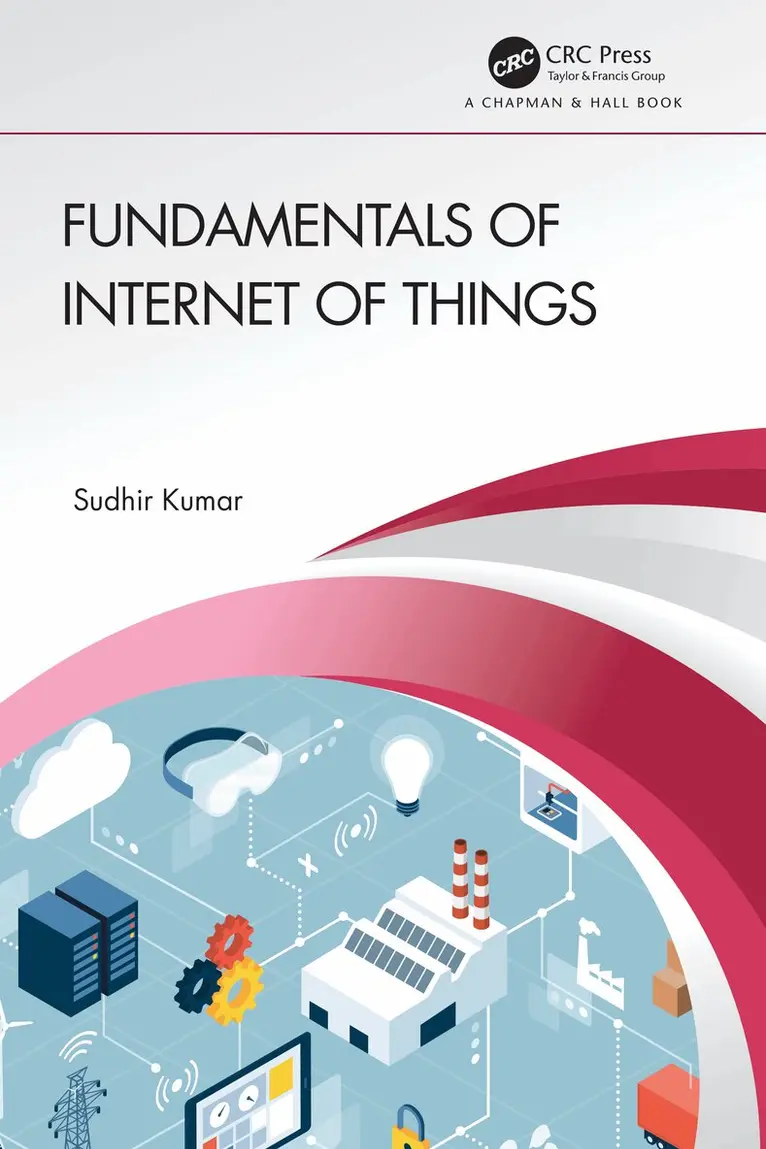
    Fundamentals of Internet of Things

    AvSudhir Kumar

    Häftad, Engelska, 2024

    821 kr

    Beställningsvara. Skickas inom 10-15 vardagar. Fri frakt över 249 kr.

    Fler format och utgåvor

    E-bok

    1 002 kr

    E-bok

    1 004 kr

    Inbunden

    2 421 kr

    Beskrivning

    The Internet of Things (IoT) networks have revolutionized the world and have innumerable real-time applications on automation. A few examples include driverless cars, remote monitoring of the elderly, remote order of tea or coffee of your choice from a vending machine, and home/industrial automation amongst others.Fundamentals of Internet of Things build the foundations of IoT networks by leveraging the relevant concepts from signal processing, communications, net-works, and machine learning. The book covers two fundamental components of IoT networks, namely, the Internet and Things. In particular, the book focuses on networking concepts, protocols, clustering, data fusion, localization, energy harvesting, control optimization, data analytics, fog computing, privacy, and security including elliptic curve cryptography and blockchain technology. Most of the existing books are theoretical and without many mathematical details and examples. In addition, some essential topics of the IoT networks are also missing in the existing books.Features:• The book covers cutting-edge research topics• Provides mathematical understanding of the topics in addition to relevant theory and insights• Includes illustrations with hand-solved numerical examples for visualization of the theory and testing of understanding• Lucid and crisp explanation to lessen the study time of the readerThe book is a complete package of the fundamentals of IoT networks and is suitable for graduate-level students and researchers who want to dive into the world of IoT networks.

    Produktinformation

    • Utgivningsdatum:2024-10-04
    • Mått:156 x 234 x 16 mm
    • Vikt:440 g
    • Format:Häftad
    • Språk:Engelska
    • Antal sidor:264
    • Förlag:Taylor & Francis Ltd
    • ISBN:9781032126500

    Utforska kategorier

    • Elektronik och kommunikationer inom Naturvetenskap och teknik
    • Systemvetenskap och AI inom Data och IT
    • Databaser inom Data och IT

    Mer om författaren

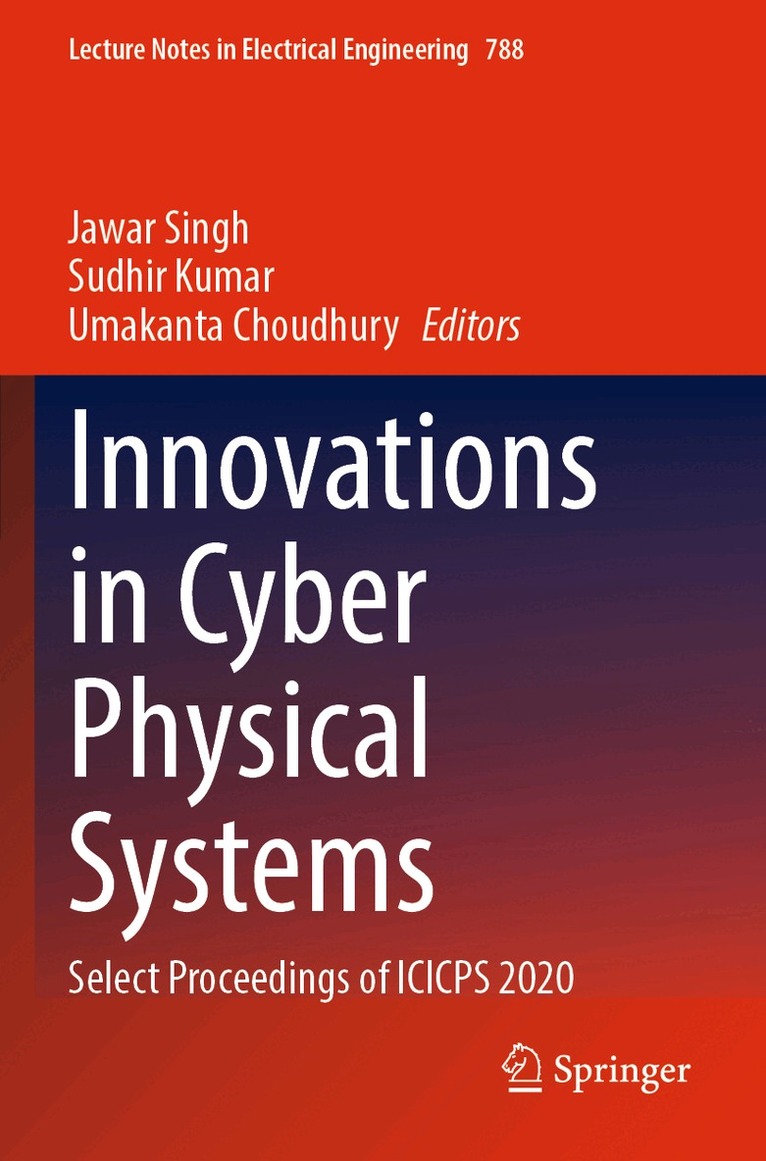
    Sudhir Kumar is currently an Assistant Professor with the Electrical Engineering (EE) department, Indian Institute of Technology Patna, Patna, India since May 2017. He received his B.Tech. degree in Electronics and Communication Engineering (ECE) from West Bengal University of Technology, Kolkata, India, in 2010 and a Ph.D. degree from the Electrical Engineering Department, Indian Institute of Technology Kanpur, India, in 2015. He has worked as an Erasmus Mundus Fellow with the Department of Computer Science, the University of Oxford, U.K from October 2014 to July 2015 and a Scientist with TCS Research, Kolkata, India from February 2016 to July 2016. Subsequently, he joined as an Assistant Professor at Visvesvaraya National Institute of Technology (VNIT), Nagpur, India from July 2016 to May 2017. He published more than 50 research articles in prestigious journals, conference proceedings and book chapters. He has also edited a book titled "Innovations in Cyber Physical Systems", led two patents, and undertaken four sponsored projects. His broad research interests include Wireless Sensor Networks, Internet of Things (IoT), Molecular Communications, 6G Wireless Communications Systems, Signal Processing, Machine Learning, and Deep Learning. Dr. Kumar is a recipient of several awards and fellowships, such as the Best Teacher Award in UG Teaching from the EE Department; the best poster paper award at COMSNETS 2021; the CSIR, and SERB International Travel Grants; the National Award from L&T-ISTE for having guided the Best M.Tech. Thesis (Second Prize); the SERB Indo-U.S. Postdoctoral Fellowship, the India-EU Namaste Fellowship; the TCS Research Scholarship; the MHRD Scholarship; the IEEE ICC Student Travel Grant Award; and the COMSNETS Travel Grant. He has guided several B.Tech. and M.Tech. projects which won national awards. He is a member of ACM, a senior member of IEEE, and a life member of ISTE.

    Innehållsförteckning

    • 1. Things and Internet. 1.1 Introduction. 1.2 Things. 1.3 Internet. 1.4 Summary. 1.5 Exercises. 2. Standards and Protocols. 2.1 Introduction. 2.2 IEEE 802.11 Protocol. 2.3 IEEE 802.15.4 Protocol. 2.4 LoRaWAN Protocol. 2.5 6LowPAN Protocol. 2.6 Application Protocols. 2.7 Summary. 2.8 Exercises. 3. Clustering and Data Fusion. 3.1 Introduction. 3.2 Clustering Technique. 3.3 Energy Efficient Clustering. 3.4 Sensor Data Fusion. 3.5 Dempster-Shafer Theory for Data Fusion. 3.6 Decision Fusion. 3.7 Summary. 3.8 Exercises. 4. Smart Device Localization. 4.1 Introduction. 4.2 Taxonomy of Localization Algorithms. 4.3 Distance-based Localization Methods. 4.4 Distance-free Localization Methods. 4.5 Performance Metrics. 4.6 Summary. 4.7 Exercises. 5. Energy Harvesting and Control Optimization. 5.1 Introduction. 5.2 Energy Harvesting. 5.3 Model Predictive Control. 5.4 Summary. 5.5 Exercises. 6. Things Data Analytics. 6.1 Introduction. 6.2 Understanding the Buzz Words. 6.3 Supervised Learning. 6.4 Unsupervised Learning. 6.5 Bias and Variance Tradeoff. 6.6 Artificial Neural Networks. 6.7 Evaluation Method. 6.8 Summary. 6.9 Exercises. 7. Fog Computing. 7.1 Introduction. 7.2 Technologies for Fog Computing. 7.3 Mobility in Fog Framework. 7.4 Fog Orchestration. 7.5 Localization in Fog Computing Framework. 7.6 Task Offloading. 7.7 Summary. 7.8 Exercises. 8. Privacy and Security of Things Data. 8.1 Introduction. 8.2 Data Privacy. 8.3 Elliptic Curve Cryptography. 8.4 Blockchain. 8.5 Summary. 8.6 Exercises. 9. Applications of IoT. 9.1 Introduction. 9.2 Smart Healthcare. 9.3 Smart City. 9.4 Summary. 9.5 Exercises